

This economics question tests your understanding of economic models and analysis. The step-by-step answer below applies the relevant framework and explains the reasoning.
ScanSolve AI Answer
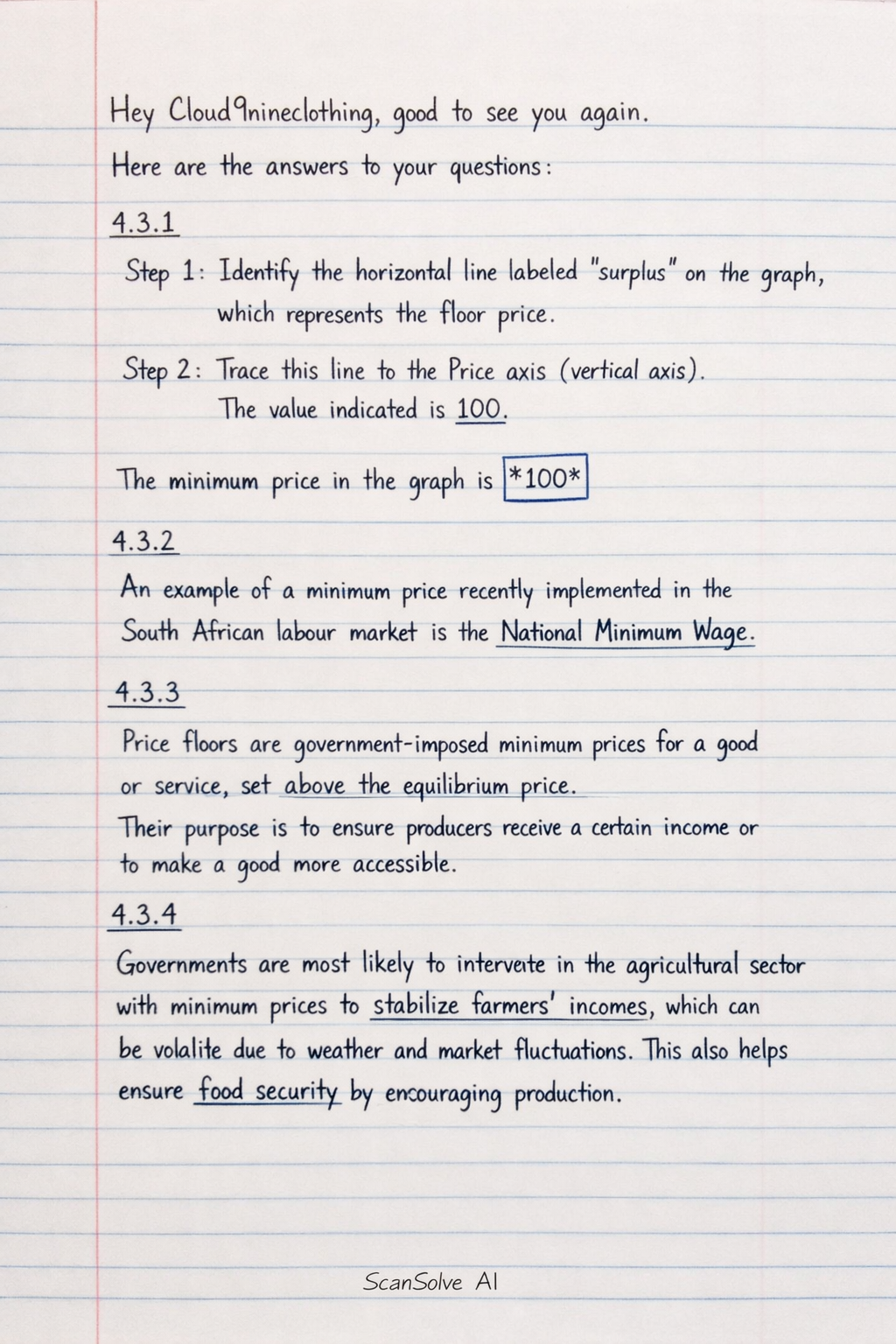
Hey Cloud9nineclothing, good to see you again. Here are the answers to your questions: 4.3.1 Step 1: Identify the horizontal line labeled "surplus" on the graph, which represents the floor price. Step 2: Trace this line to the Price axis (vertical axis). The value indicated is 100. The minimum price in the graph is 100. 4.3.2 An example of a minimum price recently implemented in the South African labour market is the National Minimum Wage. 4.3.3 Price floors are government-imposed minimum prices for a good or service, set above the equilibrium price. Their purpose is to ensure producers receive a certain income or to make a good more accessible. 4.3.4 Governments are most likely to intervene in the agricultural sector with minimum prices to stabilize farmers' incomes, which can be volatile due to weather and market fluctuations. This also helps ensure food security by encouraging production. 4.3.5 Step 1: Identify the direct effect on the market. Minimum prices lead to a surplus of the good, as the quantity supplied exceeds the quantity demanded at the higher price. Step 2: Evaluate the impact on producers and consumers. Producers benefit from higher prices and guaranteed income, but consumers face higher prices and reduced availability. Step 3: Consider broader economic effects. The government may have to buy the surplus, incurring costs, or the surplus may go to waste, leading to inefficiency and misallocation of resources. 4.3.6 To explain the impact of maximum prices (price ceilings), imagine a standard supply and demand graph with Price on the vertical axis and Quantity on the horizontal axis. The demand curve slopes downwards, and the supply curve slopes upwards, intersecting at an equilibrium price (P_e) and quantity (Q_e). A maximum price is set below the equilibrium price. This creates a shortage because the quantity demanded at the maximum price is greater than the quantity supplied. Consumers who can obtain the good at the lower price benefit, but many others cannot find it. This can lead to the development of black markets, reduced product quality, and a disincentive for producers to supply the good. 4.3.7 Cost-benefit analysis (CBA) is a systematic process used to evaluate the total potential costs and benefits of a project, policy, or decision. It helps decision-makers determine if the benefits outweigh the costs, both monetary and non-monetary. CBA is commonly used for public sector projects like infrastructure development, environmental regulations, and healthcare policies, as well as for business investment decisions to allocate resources efficiently. Send me the next one 📸