
Explain the concepts of Gross Domestic Product (GDP) Gross National Product, Gross Domestic Expenditure, Gross Domestic Income, the Balance of Payments and Exchange Rates.
ScanSolve AI Answer
Answer
Gross Domestic Product (GDP) measures the total monetary value of all finished goods and services produced within a country's borders in a specific time period. It is a key indicator of the economic health and size of a nation's economy.
Gross National Product (GNP) measures the total monetary value of all finished goods and services produced by a country's residents, regardless of their location. It includes income earned by domestic residents from overseas investments and excludes income earned by foreign residents within the country.
Gross Domestic Expenditure (GDE) represents the total spending on all final goods and services within a country's borders during a specific period. It is calculated as the sum of consumption, investment, government spending, and net exports (exports minus imports).
Gross Domestic Income (GDI) measures the total income earned by all factors of production (wages, profits, rent, interest) within a country's borders in a specific time period. In theory, GDI should equal GDP, as one person's spending is another person's income.
The Balance of Payments (BoP) is a statement that summarizes all economic transactions between residents of a country and the rest of the world over a specific period. It consists of the current account (trade in goods and services, income, transfers) and the capital and financial accounts (investments).
Exchange Rates represent the value of one country's currency in relation to another country's currency. They determine how much one currency is worth when exchanged for another, influencing international trade and investment.
Still stuck on this one?
Ask a follow-up, and the answer starts from this question.
More Economics Questions
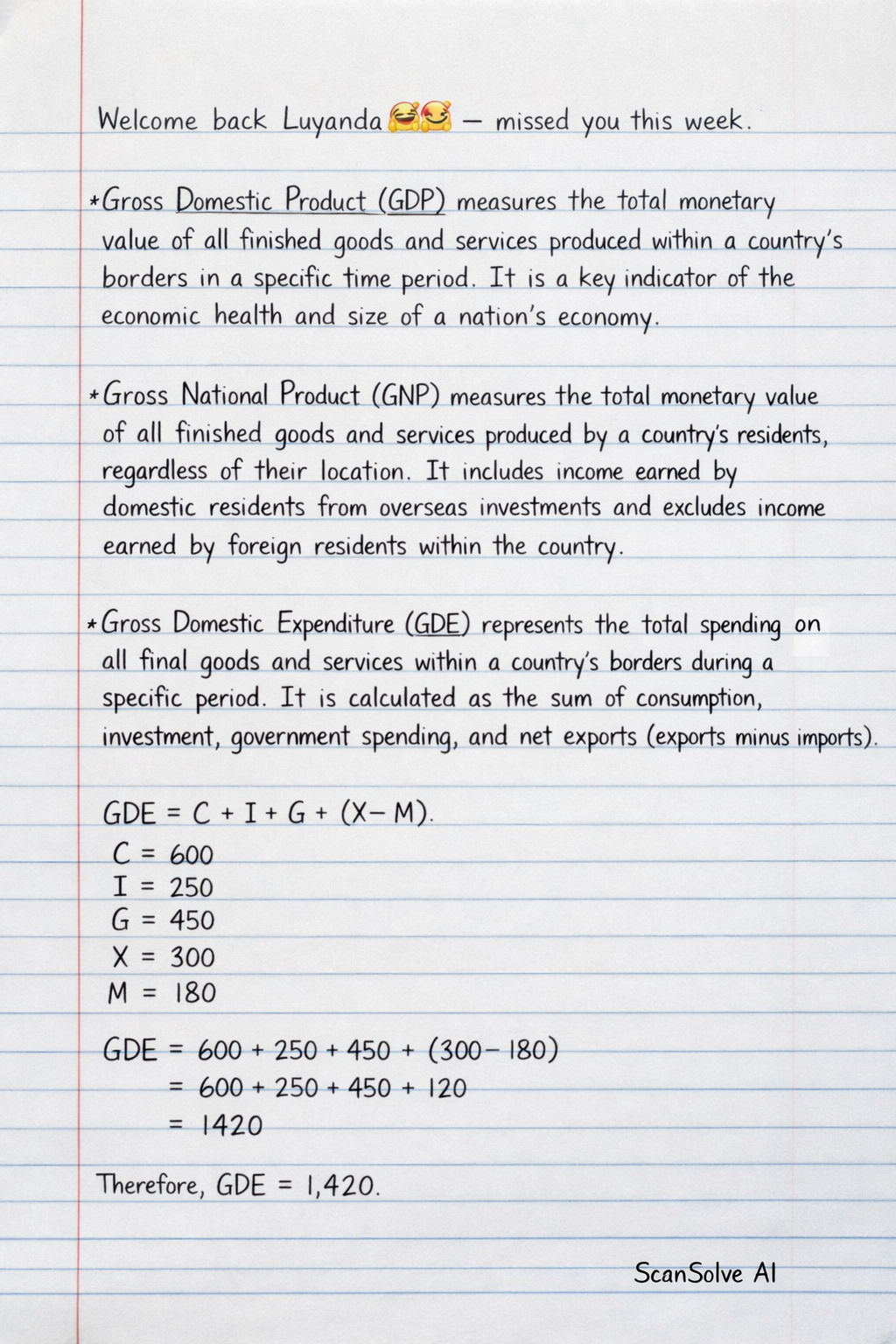
Handwritten Step-by-Step Solution
Get this as a handwritten image on WhatsApp — like a tutor wrote it for you.
Try on WhatsApp