
There are calculations inside the question paper
Economics
ScanSolve AI Answer
Step-by-step solution
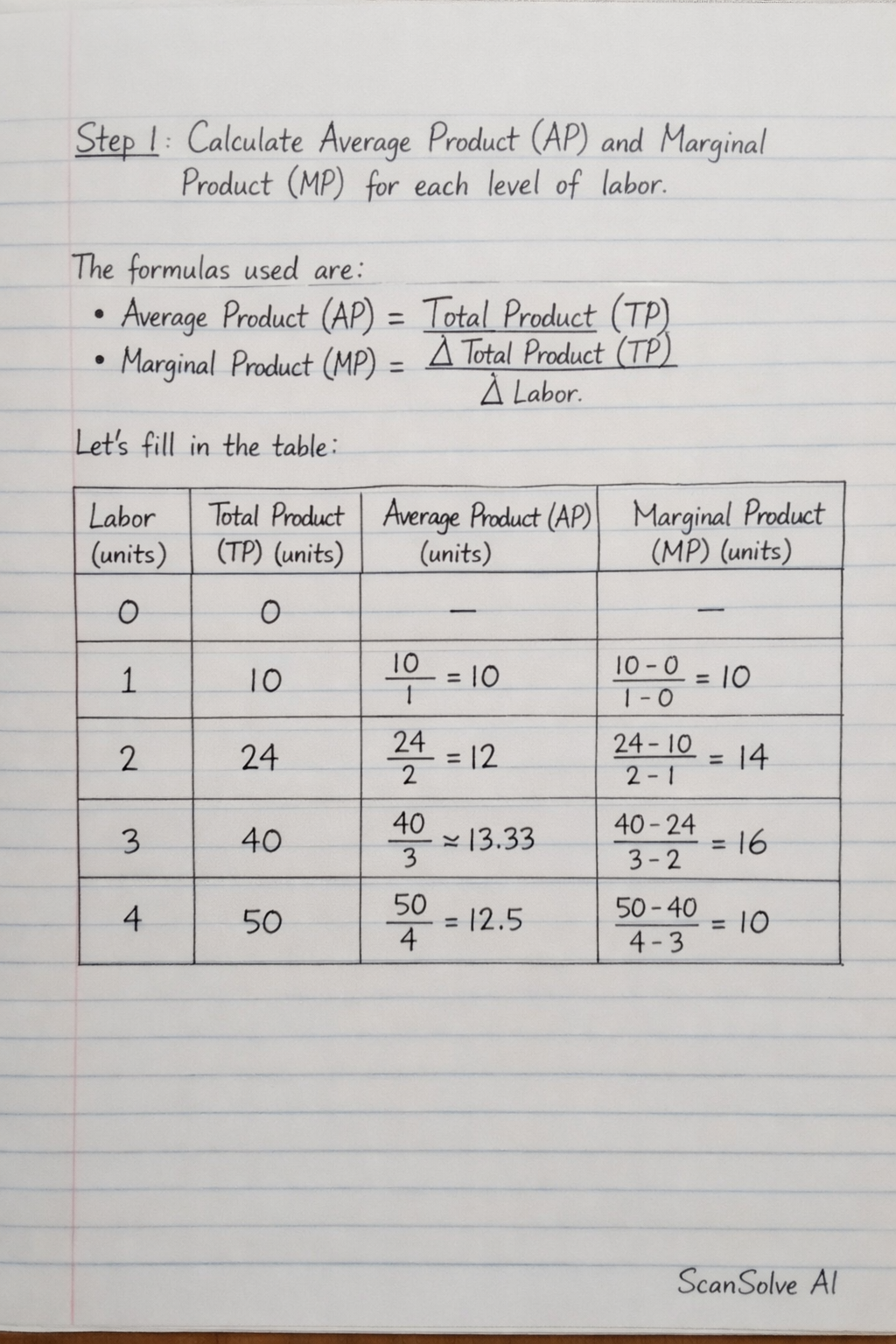
3 stepsCalculate Average Product (AP) and Marginal Product (MP) for each level of labor.
The formulas used are:
- Average Product (AP) =
- Marginal Product (MP) =
Let's fill in the table:
Labor (units) Total Product (TP) (units) Average Product (AP) (units) Marginal Product (MP) (units) 0 0 - - 1 10 2 24 3 40 4 50 5 56 6 57 7 56 8 52 State the completed table.
The completed table is:
Explain the relationship between AP and MP based on the table.
- When Marginal Product (MP) is greater than Average Product (AP) (e.g., at Labor = 2, MP = 14 and AP = 12; at Labor = 3, MP = 16 and AP = 13.33), the Average Product (AP) is increasing.
- The Average Product (AP) reaches its maximum value of approximately 13.33 at Labor = 3. At this point, the MP (16) is still greater than AP (13.33). The exact intersection where MP = AP would occur between Labor = 3 and Labor = 4, where AP starts to fall.
- When Marginal Product (MP) is less than Average Product (AP) (e.g., at Labor = 4, MP = 10 and AP = 12.5; at Labor = 5, MP = 6 and AP = 11.2), the Average Product (AP) is decreasing.
- The Marginal Product (MP) starts to decline earlier than AP, reaching its maximum at Labor = 3 (MP = 16) and then falling, eventually becoming negative (at Labor = 7 and 8).
Was this helpful?
Still stuck on this one?
Ask a follow-up, and the answer starts from this question.
Got a different question?Ask your own question
More Economics Questions
Handwritten Step-by-Step Solution
Get this as a handwritten image on WhatsApp — like a tutor wrote it for you.
Try on WhatsApp