
We read your photo as:
Explain the concepts of price elasticity of demand and supply. What are the implications of inelastic demand for tax burden, and how does an increase in income tax affect consumer spending?
ScanSolve AI Answer
Answers
3 partsStep-by-step solution
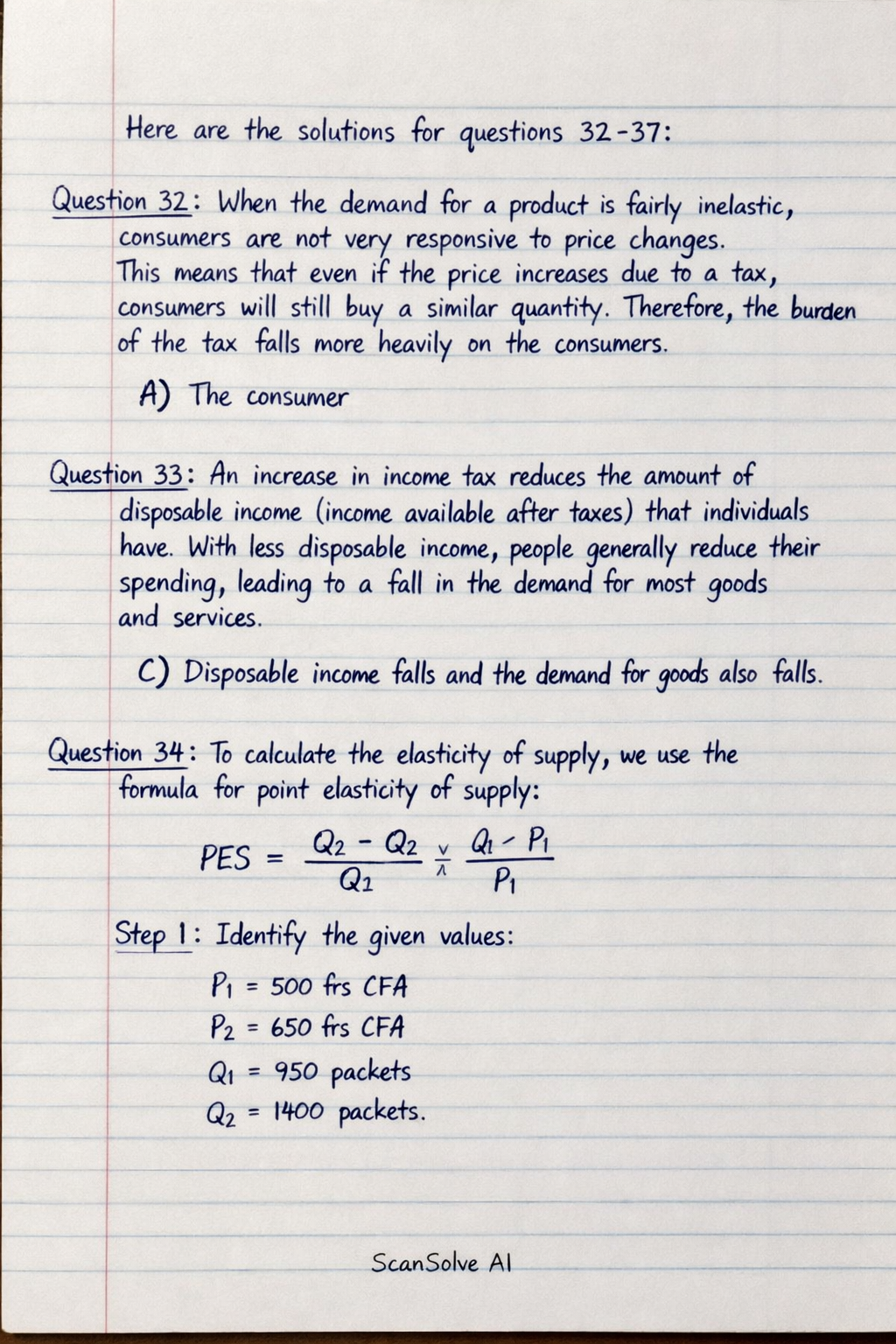
12 stepsHere are the solutions for questions 32-37:
Question 32: When the demand for a product is fairly inelastic, consumers are not very responsive to price changes. This means that even if the price increases due to a tax, consumers will still buy a similar quantity. Therefore, the burden of the tax falls more heavily on the consumers.
- A) The consumer
Question 33: An increase in income tax reduces the amount of disposable income (income available after taxes) that individuals have. With less disposable income, people generally reduce their spending, leading to a fall in the demand for most goods and services.
- C) Disposable income falls and the demand for goods also falls.
Part 34· 4 steps
To calculate the elasticity of supply, we use the formula for point elasticity of supply
Identify the given values.
Calculate the percentage change in quantity supplied.
Calculate the percentage change in price.
Calculate the Price Elasticity of Supply (PES).
Rounding to two decimal places, the elasticity of supply is approximately 1.58.
- C)
Part 35
To calculate the cross elasticity of demand for petrol, we use the formula
Identify the given values.
(initial price of cars)
(new price of cars)
(initial quantity of petrol demanded)
(new quantity of petrol demanded)Calculate the percentage change in quantity demanded of petrol.
Calculate the percentage change in the price of cars.
Calculate the Cross Elasticity of Demand (XED).
Rounding to one decimal place, the cross elasticity of demand for petrol is approximately -1.9. The negative sign indicates that cars and petrol are complementary goods.
- D)
Part 36
To calculate the Price Elasticity of Demand (PED) for bread, we use the formula
Identify the given values.
Calculate the percentage change in quantity demanded.
Calculate the percentage change in price.
Calculate the Price Elasticity of Demand (PED).
Rounding to two decimal places, the PED is approximately 1.36.
- C)
Question 37: When businessmen intentionally hold back goods from the market in anticipation of higher future prices, they are creating a situation where the supply is artificially restricted. This is known as artificial scarcity.
- D) Artificial scarcity
Try one yourself
A new problem that tests the same skill.
Still stuck on this one?
Ask a follow-up, and the answer starts from this question.
More Economics Questions
Handwritten Step-by-Step Solution
Get this as a handwritten image on WhatsApp — like a tutor wrote it for you.
Try on WhatsApp