
We read your photo as:
Explain the difference between absolute advantage and comparative advantage. Calculate the opportunity cost of producing each product in each country.
ScanSolve AI Answer
Step-by-step solution
5 stepsPart 1
Explain the difference between absolute advantage and comparative advantage.
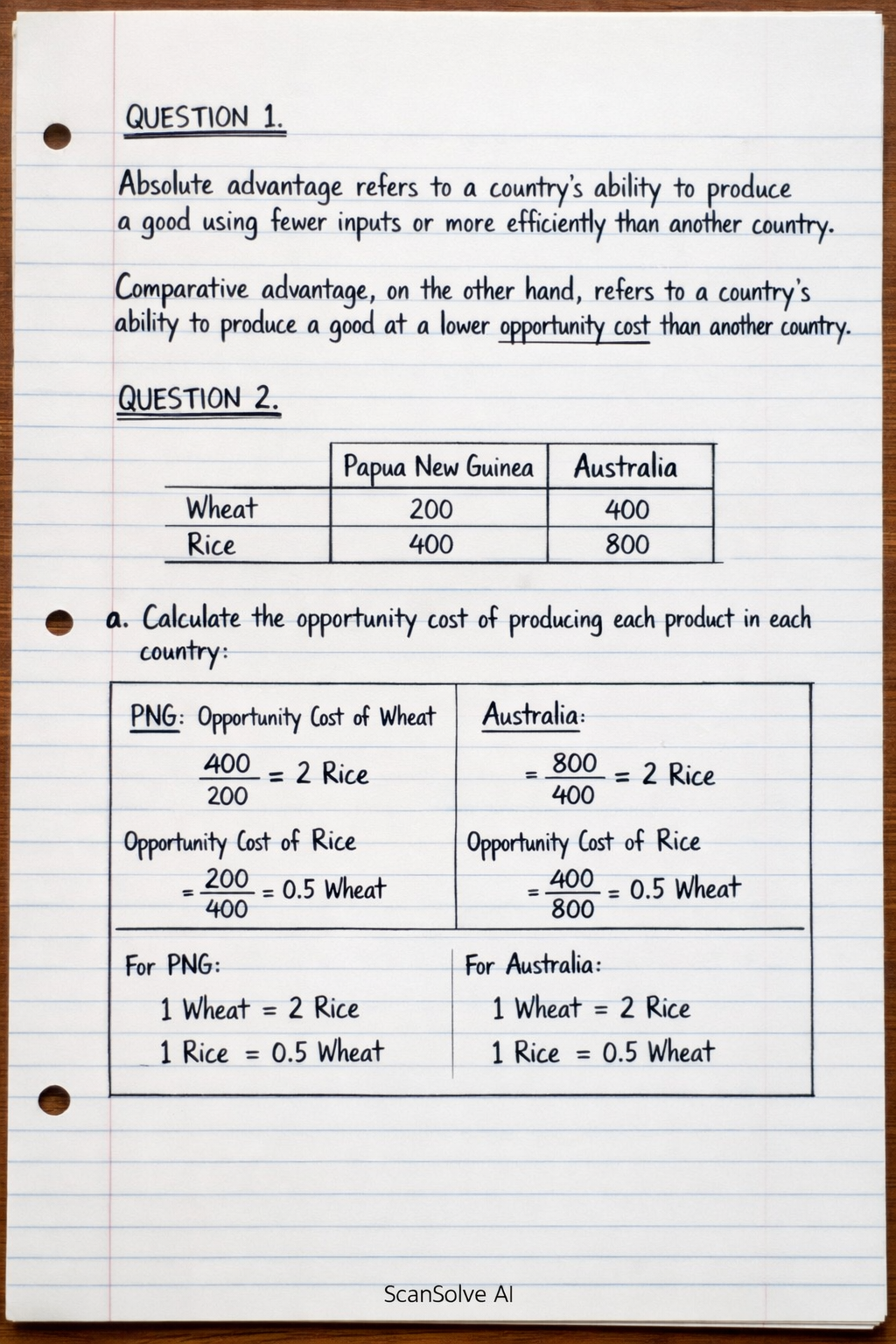
Absolute advantage refers to a country's ability to produce a good using fewer inputs or more efficiently than another country. Comparative advantage, on the other hand, refers to a country's ability to produce a good at a lower opportunity cost than another country.
Part 2
The table below shows two countries producing both goods with the given resources.
| Papua New Guinea | Australia | |
|---|---|---|
| Wheat | 200 | 400 |
| Rice | 400 | 800 |
Part a· 3 steps
Calculate the opportunity cost of producing each product in each country.
(Show your working out in the box)
Calculate the opportunity cost for Papua New Guinea.
The opportunity cost of producing 1 unit of Wheat is the amount of Rice sacrificed.
The opportunity cost of producing 1 unit of Rice is the amount of Wheat sacrificed.
Calculate the opportunity cost for Australia.
The opportunity cost of producing 1 unit of Wheat is the amount of Rice sacrificed.
The opportunity cost of producing 1 unit of Rice is the amount of Wheat sacrificed.
Fill in the table with the calculated opportunity costs.
Papua New Guinea Australia Opportunity cost of wheat 2 Rice 2 Rice Opportunity cost of rice 0.5 Wheat 0.5 Wheat
Part b· 2 steps
If the two countries above decide to specialize in the production of a good they have comparative advantage in, which product would each of them produce?
Compare the opportunity costs for each good between the two countries.
- For Wheat: Papua New Guinea's opportunity cost is 2 Rice. Australia's opportunity cost is 2 Rice.
- For Rice: Papua New Guinea's opportunity cost is 0.5 Wheat. Australia's opportunity cost is 0.5 Wheat.
Determine specialization based on comparative advantage.
Since the opportunity costs for producing both Wheat and Rice are identical for both Papua New Guinea and Australia, neither country has a comparative advantage over the other in either good. Therefore, based on these figures, there is no basis for specialization according to comparative advantage.
Australia: No comparative advantage
Papua New Guinea: No comparative advantage
Part 3
Explain the effect of tariff on prices and quantity of goods and services demanded and supplied.
(Use the appropriate graph to help you explain and label the graph correctly)
A tariff is a tax imposed on imported goods. When a tariff is imposed, it increases the cost of bringing foreign goods into the domestic market.
- Effect on Price: The price of imported goods in the domestic market will increase by the amount of the tariff, or close to it. This also tends to raise the price of domestically produced goods that compete with the imports, as domestic producers can now charge more without being undercut by cheaper imports.
- Effect on Quantity Demanded: As the price of goods and services increases due to the tariff, the quantity demanded by consumers in the domestic market will decrease, following the law of demand.
- Effect on Quantity Supplied: The higher domestic price incentivizes domestic producers to increase their production, leading to an increase in the quantity supplied by local firms. Conversely, the higher cost for importers leads to a decrease in the quantity of imported goods supplied to the domestic market.
Graphical Representation:
Imagine a standard supply and demand graph with Price on the y-axis and Quantity on the x-axis.
- Draw a downward-sloping Domestic Demand curve () and an upward-sloping Domestic Supply curve ().
- Initially, assume a World Price () that is below the domestic equilibrium price. This line is horizontal, representing perfectly elastic supply from the world market.
- At , domestic consumers demand units, and domestic producers supply units. The difference, , represents the quantity of goods imported.
- When a tariff () is imposed, the effective price for imports rises to . Draw a new horizontal line at above .
- At the new higher price , domestic consumers demand a lower quantity, .
- At , domestic producers are incentivized to supply a higher quantity, .
- The new quantity of imports will be , which is less than the original imports. In summary, the graph would show the price level rising from to , the total quantity consumed falling from to , domestic production increasing from to , and imports decreasing.
Still stuck on this one?
Ask a follow-up, and the answer starts from this question.
More Economics Questions
Handwritten Step-by-Step Solution
Get this as a handwritten image on WhatsApp — like a tutor wrote it for you.
Try on WhatsApp