
We read your photo as:
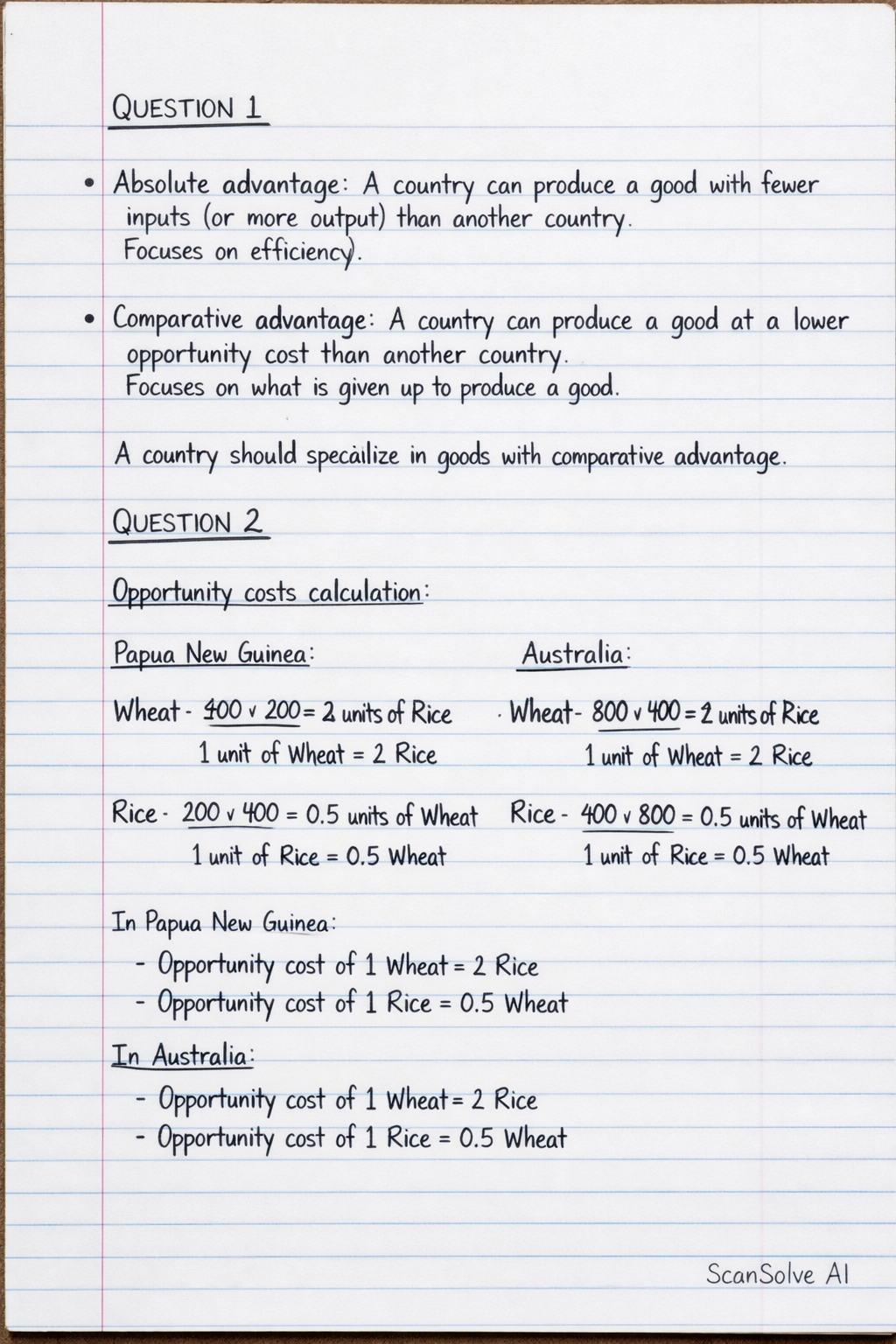
Explain the difference between absolute advantage and comparative advantage, and calculate opportunity costs using a given table.
ScanSolve AI Answer
Answers
2 partsQUESTION 1
Explain the difference between absolute advantage and comparative advantage.
- Absolute advantage refers to a country's ability to produce a good using fewer inputs (or more output from the same inputs) than another country. It focuses on efficiency in production.
- Comparative advantage refers to a country's ability to produce a good at a lower opportunity cost than another country. It focuses on what a country gives up to produce a good, rather than how much it can produce in absolute terms. A country should specialize in producing goods for which it has a comparative advantage.
QUESTION 2
The table below shows two countries producing both goods with the given resources.
| Papua New Guinea | Australia | |
|---|---|---|
| Wheat | 200 | 400 |
| Rice | 400 | 800 |
a. Calculate the opportunity cost of producing each product in each country.
Papua New Guinea:
- Opportunity cost of wheat: To produce 200 units of wheat, PNG gives up 400 units of rice.
- Opportunity cost of rice: To produce 400 units of rice, PNG gives up 200 units of wheat.
Australia:
- Opportunity cost of wheat: To produce 400 units of wheat, Australia gives up 800 units of rice.
- Opportunity cost of rice: To produce 800 units of rice, Australia gives up 400 units of wheat.
Here is the completed table:
b. If the two countries above decide to specialize in the production of a good they have comparative advantage in, which product would each of them produce?
- Comparing the opportunity costs:
- For Wheat: PNG's OC (2 Rice) = Australia's OC (2 Rice)
- For Rice: PNG's OC (0.5 Wheat) = Australia's OC (0.5 Wheat)
- Since the opportunity costs for producing both wheat and rice are identical for both Papua New Guinea and Australia, neither country has a comparative advantage over the other in producing either good. Therefore, there is no basis for specialization based on comparative advantage in this scenario.
Australia:
Papua New Guinea:
QUESTION 3
Explain the effect of tariff on prices and quantity of goods and services demanded and supplied. (Use the appropriate graph to help you explain and label the graph correctly)
A tariff is a tax imposed by a government on imported goods or services. Its effects on prices and quantities are as follows:
- Price: A tariff increases the cost of importing goods, which leads to an increase in the domestic market price of the imported good. Consumers will pay a higher price for the good.
- Quantity Demanded: Due to the higher domestic price, the quantity of the good demanded by domestic consumers will decrease, as consumers respond to the increased cost.
- Quantity Supplied (Domestic): The higher domestic price makes it more profitable for domestic producers to supply the good. Consequently, the quantity supplied by domestic producers will increase.
- Quantity of Imports: The combination of decreased domestic demand and increased domestic supply results in a reduction in the quantity of goods imported into the country.
Graphical Representation (cannot be drawn here):
An appropriate graph would show the domestic supply and demand curves for a good. Initially, the world price () would be below the domestic equilibrium, leading to imports. When a tariff is imposed, the effective price for imports rises to . This new higher price would be shown on the graph, illustrating the decrease in quantity demanded, increase in domestic quantity supplied, and the resulting reduction in the volume of imports. The graph would also typically show areas representing consumer surplus, producer surplus, government revenue from the tariff, and deadweight loss.
Try one yourself
A new problem that tests the same skill.
Still stuck on this one?
Ask a follow-up, and the answer starts from this question.
More Economics Questions
Handwritten Step-by-Step Solution
Get this as a handwritten image on WhatsApp — like a tutor wrote it for you.
Try on WhatsApp