
We read your photo as:
Draw the demand and supply curves, determine the equilibrium price and quantity.
ScanSolve AI Answer
Answers
2 partsStep-by-step solution
3 stepsPart 14.1
To draw the demand and supply curve:
- Draw a graph with the Price (R) on the vertical (y) axis and Quantity on the horizontal (x) axis.
- Demand Curve: Plot the following points (Quantity Demanded, Price) and connect them with a smooth curve:
- (22, R600)
- (34, R500)
- (55, R400)
- (62, R300)
- (79, R200)
- (94, R100) This curve should slope downwards from left to right.
- Supply Curve: Plot the following points (Quantity Supplied, Price) and connect them with a smooth curve:
- (105, R600)
- (86, R500)
- (75, R400)
- (54, R300)
- (31, R200)
- (20, R100) This curve should slope upwards from left to right. The point where these two curves intersect represents the equilibrium.
Part 14.2
Identify the prices where quantity demanded and quantity supplied are closest.
At R400, Quantity Demanded = 55 and Quantity Supplied = 75.
At R300, Quantity Demanded = 62 and Quantity Supplied = 54.The equilibrium price is where quantity demanded equals quantity supplied.
Since it's not exactly in the table, we interpolate between R300 and R400.
Using linear interpolation, the equilibrium price is approximately R328.57.
The equilibrium price is .
Part 14.3
The equilibrium quantity corresponds to the equilibrium price where quantity demanded equals quantity supplied.
Using linear interpolation, the equilibrium quantity is approximately 60 units.
The equilibrium quantity is .
Part 15.1
Demand is the quantity of a good or service that consumers are willing and able to purchase at various prices during a specific period.
Part 15.2
The demand curve slopes downward from left to right due to the Law of Demand, which states that as the price of a good increases, the quantity demanded decreases, assuming all other factors remain constant. Consumers buy less at higher prices because their purchasing power decreases (income effect) and they may switch to cheaper alternatives (substitution effect).
Part 15.3
The Law of Supply states that, ceteris paribus (all else being equal), as the price of a good or service increases, the quantity supplied by producers also increases. Conversely, as the price decreases, the quantity supplied decreases. This is because higher prices generally lead to higher profit opportunities for producers, incentivizing them to produce and sell more.
Part 15.4
Supply is the quantity of a good or service that producers are willing and able to offer for sale at various prices during a specific period.
Try one yourself
A new problem that tests the same skill.
Still stuck on this one?
Ask a follow-up, and the answer starts from this question.
More Economics Questions
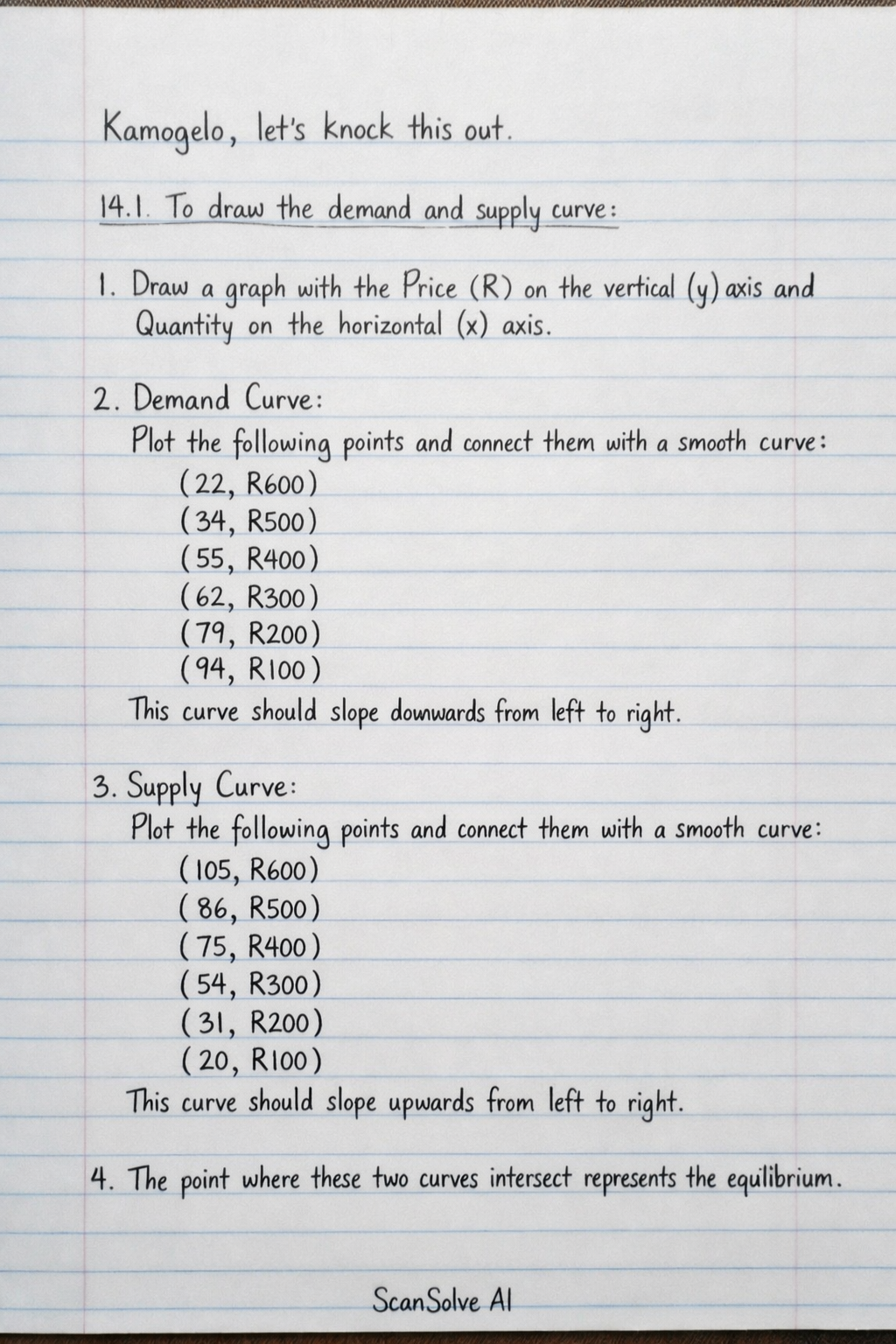
Handwritten Step-by-Step Solution
Get this as a handwritten image on WhatsApp — like a tutor wrote it for you.
Try on WhatsApp