
We read your photo as:
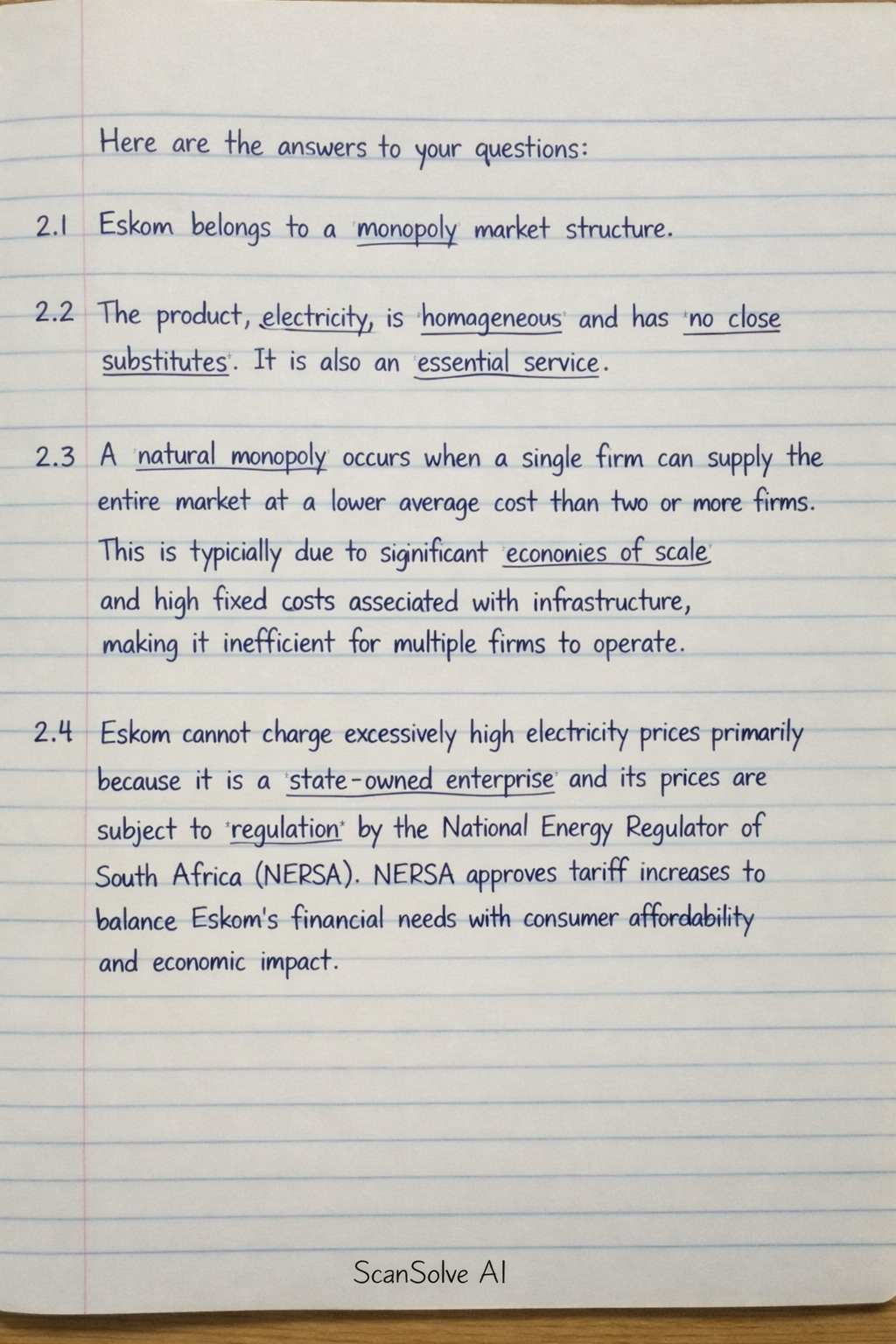
Eskom belongs to a monopoly market structure.
ScanSolve AI Answer
Here are the answers to your questions:
2.1
Eskom belongs to a monopoly market structure.
2.2
The product, electricity, is homogeneous and has no close substitutes. It is also an essential service.
2.3
A natural monopoly occurs when a single firm can supply the entire market at a lower average cost than two or more firms. This is typically due to significant economies of scale and high fixed costs associated with infrastructure, making it inefficient for multiple firms to operate.
2.4
Eskom cannot charge excessively high electricity prices primarily because it is a state-owned enterprise and its prices are subject to regulation by the National Energy Regulator of South Africa (NERSA). NERSA approves tariff increases to balance Eskom's financial needs with consumer affordability and economic impact.
2.5
Reasons for the failure of Eskom include:
- Aging infrastructure and insufficient maintenance, leading to frequent breakdowns and load shedding.
- Corruption and mismanagement that diverted funds and hindered operational efficiency.
- Insufficient investment in new generation capacity over many years to meet growing demand.
- High debt levels making it difficult to fund necessary upgrades and expansions.
- Skills shortages in critical technical and managerial areas.
2.6
As characteristics of a monopoly:
- Entrance: Monopolies are characterized by high barriers to entry, which prevent new firms from entering the market. These barriers can be legal (patents, licenses), natural (control of essential resources), or economic (high start-up costs, economies of scale).
- Control over price: A monopolist has significant control over the price of its product because it is the sole supplier. It is a price maker, meaning it can set prices without direct competition, though this power can be limited by government regulation or the elasticity of demand.
2.7
An increase in electricity prices will affect the economy in several ways:
- Increased production costs: Businesses, especially energy-intensive industries, will face higher operating costs, which can lead to reduced profitability or passed-on costs to consumers.
- Inflation: Higher production costs often result in businesses increasing the prices of their goods and services, contributing to general inflation.
- Reduced consumer spending: Households will have less disposable income due to higher electricity bills, potentially leading to a decrease in overall consumer spending.
- Reduced competitiveness: Industries may become less competitive internationally if their production costs rise significantly compared to rivals in other countries.
- Impact on economic growth: The combined effect of higher costs, reduced spending, and lower competitiveness can slow down economic growth and potentially lead to job losses.
Still stuck on this one?
Ask a follow-up, and the answer starts from this question.
More Economics Questions
Handwritten Step-by-Step Solution
Get this as a handwritten image on WhatsApp — like a tutor wrote it for you.
Try on WhatsApp