

This economics question tests your understanding of economic models and analysis. The step-by-step answer below applies the relevant framework and explains the reasoning.
ScanSolve AI Answer
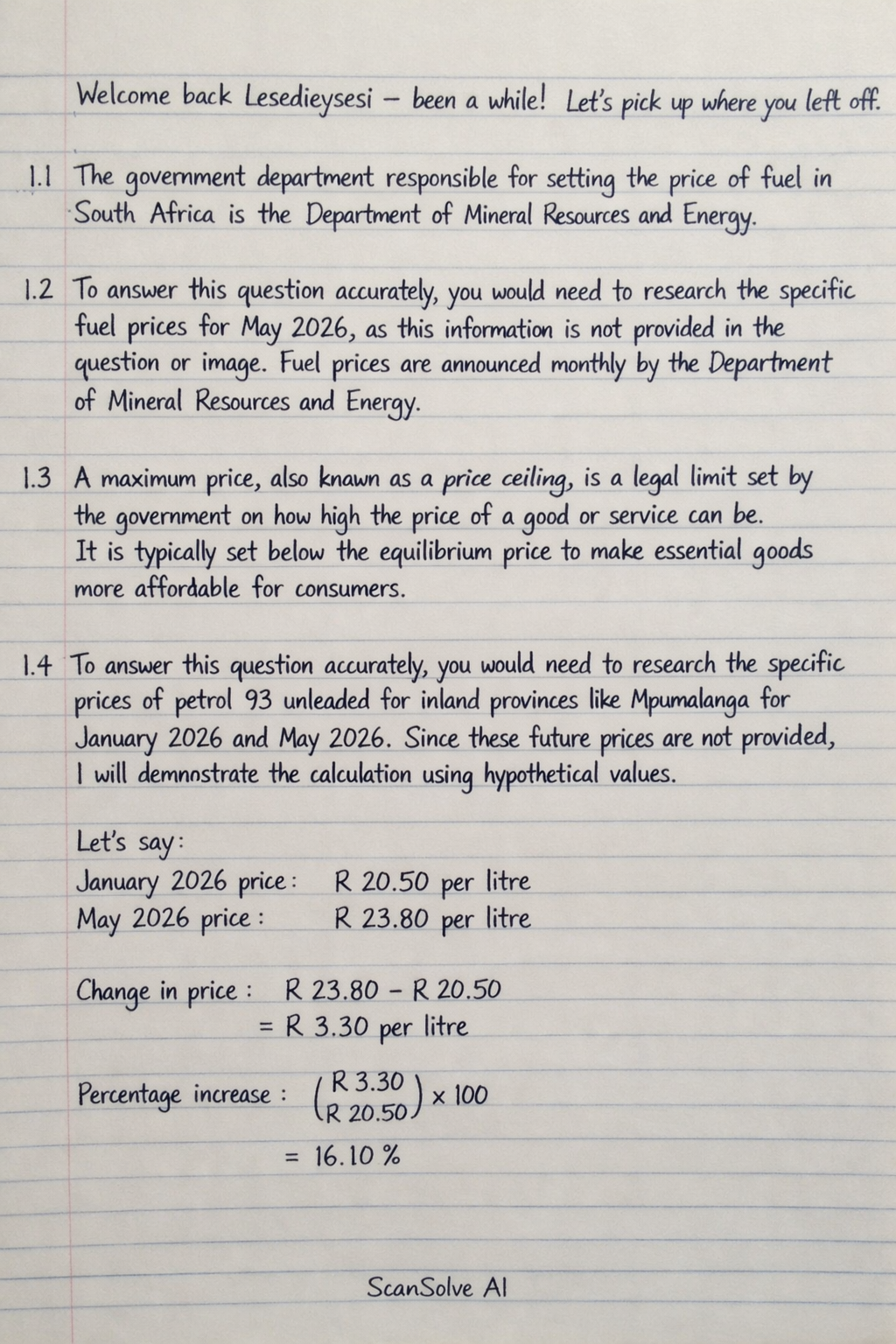
Welcome back Lesedieysesi — been a while! Let's pick up where you left off. 1.1 The government department responsible for setting the price of fuel in South Africa is the Department of Mineral Resources and Energy. 1.2 To answer this question accurately, you would need to research the specific fuel prices for May 2026, as this information is not provided in the question or image. Fuel prices are announced monthly by the Department of Mineral Resources and Energy. 1.3 A maximum price, also known as a price ceiling, is a legal limit set by the government on how high the price of a good or service can be. It is typically set below the equilibrium price to make essential goods more affordable for consumers. 1.4 To answer this question accurately, you would need to research the specific prices of petrol 93 unleaded for inland provinces like Mpumalanga for January 2026 and May 2026. Since these future prices are not provided, I will demonstrate the calculation using hypothetical values. Step 1: Assume hypothetical prices. Let the price in January 2026 be R22.00 per liter. Let the price in May 2026 be R25.30 per liter. Step 2: Calculate the absolute increase in price. Absolute Increase = Price in May 2026 - Price in January 2026 Absolute Increase = R25.30 - R22.00 = R3.30 Step 3: Calculate the percentage increase. Percentage Increase = ( Absolute IncreasePrice in January 2026 ) × 100\% Percentage Increase = ( R3.30R22.00 ) × 100\% Percentage Increase = 0.15 × 100\% = 15\% The percentage increase in price would be 15%. 1.5 A well-labelled maximum price graph (price ceiling) would include: • A horizontal axis labelled "Quantity" and a vertical axis labelled "Price". • An upward-sloping supply curve (S) and a downward-sloping demand curve (D). • The intersection of the supply and demand curves, indicating the equilibrium price (P_e) and equilibrium quantity (Q_e). • A horizontal line drawn below the equilibrium price, labelled "Maximum Price" or "Price Ceiling" (P_max). • At the maximum price, the quantity demanded (Q_d) would be greater than the quantity supplied (Q_s), creating a shortage in the market. This shortage would be indicated by the horizontal distance between the supply and demand curves at P_max. 1.6 The government sets a maximum price on fuel primarily to protect consumers from excessively high prices, especially for an essential commodity like fuel. This helps to control inflation, maintain affordability for households and businesses, and ensure economic stability by preventing fuel costs from becoming a barrier to economic activity. 1.7 When a maximum price (price ceiling) is set below the equilibrium price: • Demand: The lower price increases the quantity demanded by consumers, as fuel becomes more affordable. • Supply: The lower price discourages producers, leading to a decrease in the quantity supplied, as it becomes less profitable to produce and sell fuel. • The result is a shortage in the market, where the quantity demanded exceeds the quantity supplied. This can lead to queues, black markets, or rationing of fuel. Send me the next one 📸