
We read your photo as:
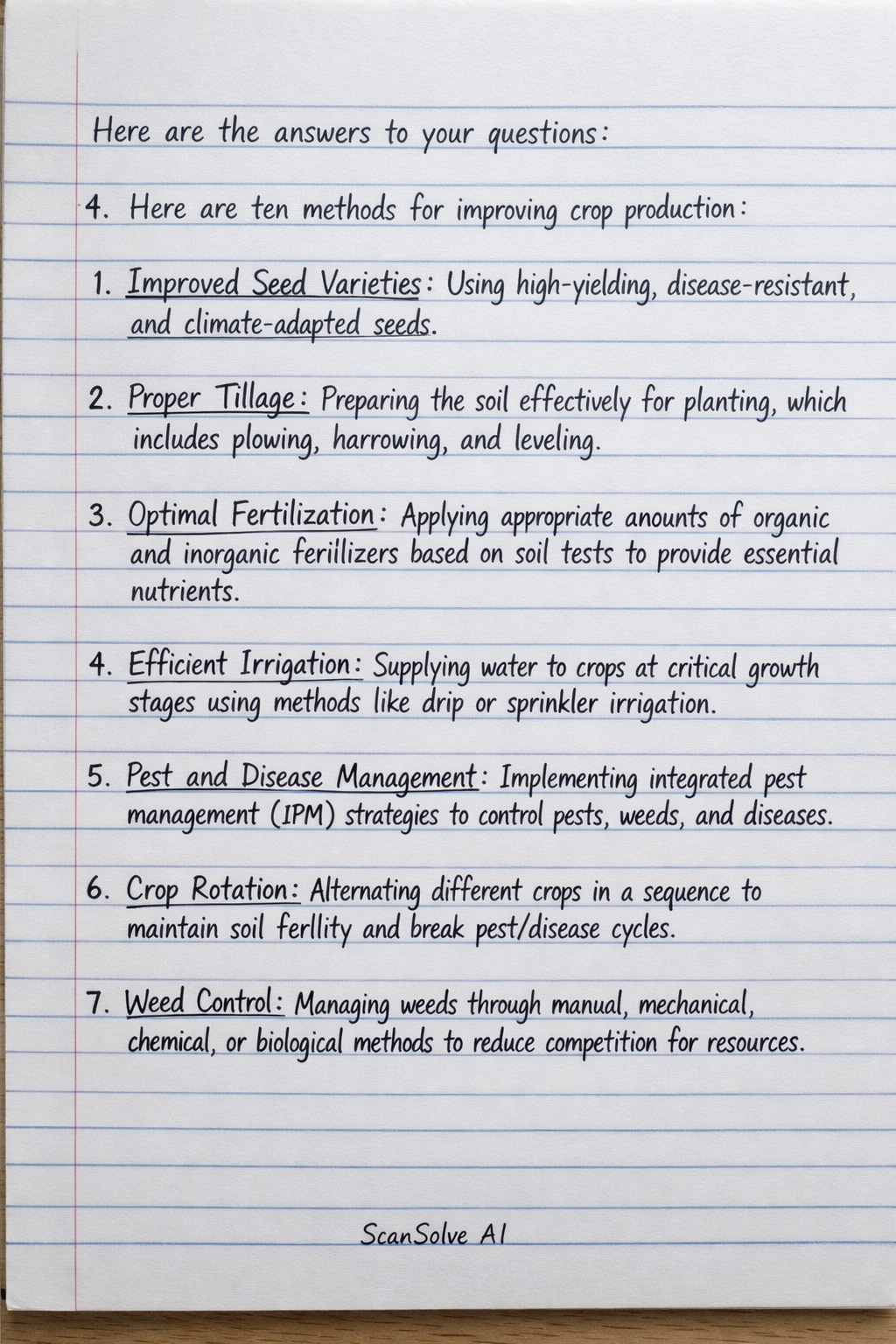
Here are ten methods for improving crop production:
ScanSolve AI Answer
Here are the answers to your questions:
-
Here are ten methods for improving crop production:
- Improved Seed Varieties: Using high-yielding, disease-resistant, and climate-adapted seeds.
- Proper Tillage: Preparing the soil effectively for planting, which includes plowing, harrowing, and leveling.
- Optimal Fertilization: Applying appropriate amounts of organic and inorganic fertilizers based on soil tests to provide essential nutrients.
- Efficient Irrigation: Supplying water to crops at critical growth stages using methods like drip or sprinkler irrigation.
- Pest and Disease Management: Implementing integrated pest management (IPM) strategies to control pests, weeds, and diseases.
- Crop Rotation: Alternating different crops in a sequence to maintain soil fertility and break pest/disease cycles.
- Weed Control: Managing weeds through manual, mechanical, chemical, or biological methods to reduce competition for resources.
- Timely Planting and Harvesting: Ensuring crops are planted and harvested at the optimal times for maximum yield and quality.
- Soil Conservation Practices: Implementing measures like contour plowing, terracing, and cover cropping to prevent soil erosion and degradation.
- Post-Harvest Management: Reducing losses after harvest through proper storage, handling, and processing techniques.
-
Here are twenty factors affecting plant growth and development:
- Light intensity
- Light duration (photoperiod)
- Temperature
- Water availability
- Soil pH
- Soil texture
- Soil structure
- Nutrient availability (e.g., Nitrogen, Phosphorus, Potassium)
- Carbon dioxide concentration
- Humidity
- Presence of pests
- Presence of diseases
- Weed competition
- Air pollution
- Salinity of soil
- Genetic makeup of the plant
- Presence of beneficial microorganisms
- Wind
- Drainage of soil
- Topography
-
Rocks are naturally occurring solid aggregates of one or more minerals or mineraloids. They form the Earth's outer solid layer, the lithosphere, and are classified based on their formation processes.
-
The three main types of rocks are:
- Igneous Rocks
- Sedimentary Rocks
- Metamorphic Rocks
-
Rocks are fundamental components of Earth's crust, formed through various geological processes. Igneous rocks originate from the cooling and solidification of molten magma or lava. Sedimentary rocks are formed from the accumulation and compaction of sediments, often containing fossils. Metamorphic rocks result from the transformation of existing rocks due to intense heat, pressure, or chemical alteration. They are crucial for understanding Earth's history, providing valuable resources, and shaping landscapes.
-
The mechanisms involved in the hazard of crop pests include:
- Direct feeding damage: Pests consume plant parts (leaves, stems, roots, fruits), reducing photosynthetic capacity and yield.
- Vectoring diseases: Pests transmit pathogens (viruses, bacteria, fungi) from infected plants to healthy ones.
- Contamination: Pests or their waste products can contaminate harvested crops, reducing quality and market value.
- Stunting growth: Pests can inject toxins or sap nutrients, leading to stunted growth and reduced plant vigor.
- Galling and deformation: Some pests cause abnormal growths (galls) or deform plant tissues, impairing function.
- Root damage: Pests feeding on roots can compromise water and nutrient uptake, leading to wilting and plant death.
-
Crop pests are organisms (like insects, mites, nematodes, rodents, or birds) that directly consume, damage, or compete with crops, leading to physical harm and yield loss. Their impact is often visible as holes, chewed leaves, or tunnels. Crop diseases, on the other hand, are caused by pathogens (such as fungi, bacteria, viruses, or oomycetes) that disrupt the plant's physiological processes, leading to symptoms like wilting, lesions, discoloration, or rot. The key difference is that pests cause physical damage through their actions, while diseases cause physiological dysfunction through infection. This distinction is crucial because management strategies differ significantly: pests are often controlled with insecticides or physical barriers, while diseases require fungicides, bactericides, or resistant varieties.
Still stuck on this one?
Ask a follow-up, and the answer starts from this question.
More Economics Questions
Handwritten Step-by-Step Solution
Get this as a handwritten image on WhatsApp — like a tutor wrote it for you.
Try on WhatsApp