
We read your photo as:
I) Economics and economic system
ScanSolve AI Answer
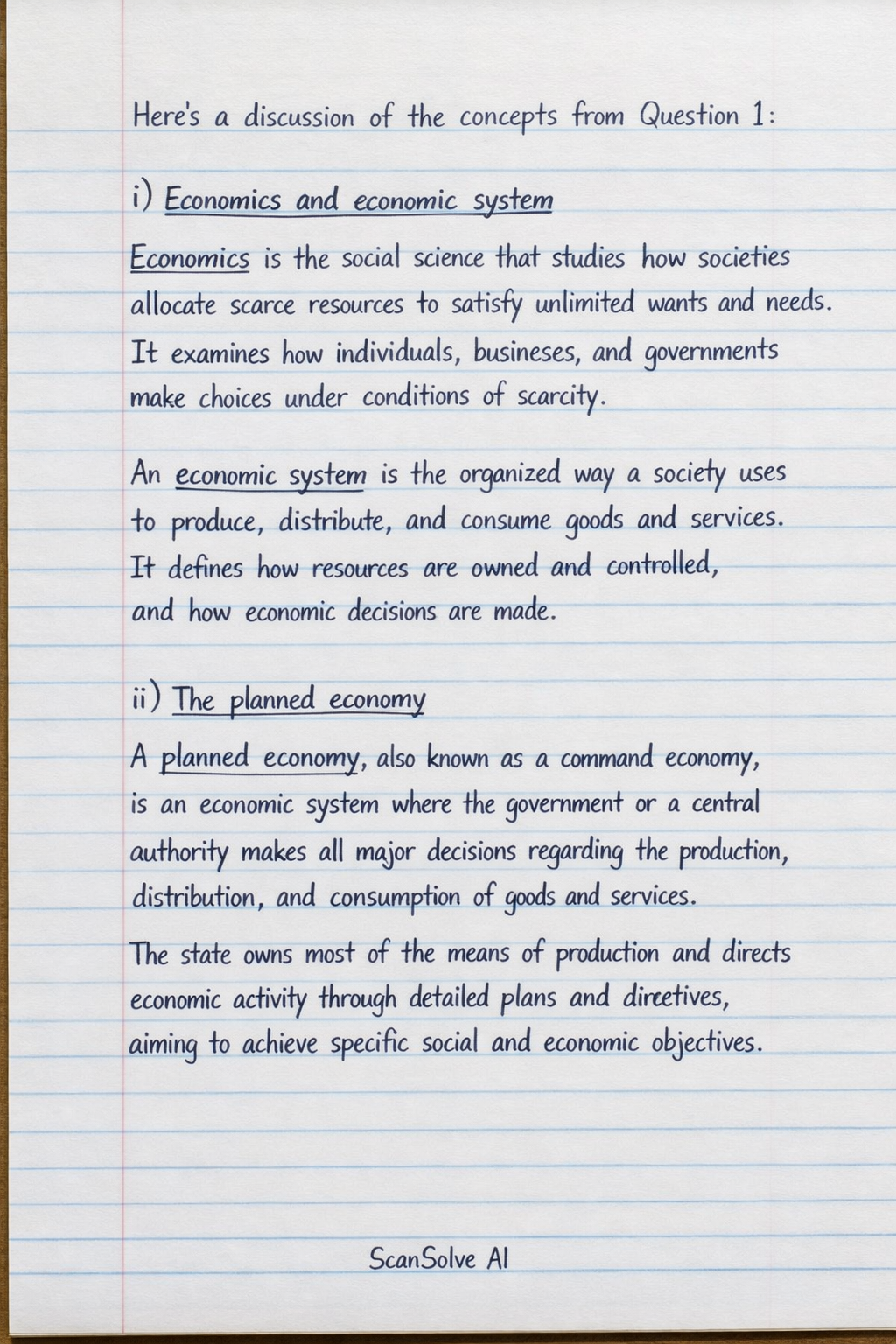
Here's a discussion of the concepts from Question 1:
i) Economics and economic system
Economics is the social science that studies how societies allocate scarce resources to satisfy unlimited wants and needs. It examines how individuals, businesses, and governments make choices under conditions of scarcity. An economic system is the organized way a society uses to produce, distribute, and consume goods and services. It defines how resources are owned and controlled, and how economic decisions are made.
ii) The planned economy
A planned economy, also known as a command economy, is an economic system where the government or a central authority makes all major decisions regarding the production, distribution, and consumption of goods and services. The state owns most of the means of production and directs economic activity through detailed plans and directives, aiming to achieve specific social and economic objectives.
iii) Factors of production
Factors of production are the basic resources used to produce goods and services. They are typically categorized into four main types:
- Land: Natural resources such as raw materials, fertile soil, and minerals.
- Labor: The human effort, both physical and mental, used in production.
- Capital: Man-made resources used in production, such as machinery, tools, buildings, and infrastructure.
- Entrepreneurship: The ability to combine the other factors of production, innovate, and take risks to create new goods and services.
iv) Opportunity cost
Opportunity cost is the value of the next best alternative that must be forgone when a choice is made. Because resources are scarce, choosing one option means giving up the benefits that could have been gained from the alternative. It is a fundamental concept in economics that highlights the trade-offs inherent in decision-making.
v) Society problem
The society problem, often referred to as the fundamental economic problem, stems from the basic condition of scarcity. Scarcity means that human wants for goods, services, and resources exceed what is available. This forces every society to make fundamental choices about:
- What to produce: Which goods and services are most desired?
- How to produce: What methods and resources will be used?
- For whom to produce: How will the goods and services be distributed among the population?
Still stuck on this one?
Ask a follow-up, and the answer starts from this question.
More Economics Questions
Handwritten Step-by-Step Solution
Get this as a handwritten image on WhatsApp — like a tutor wrote it for you.
Try on WhatsApp