
We read your photo as:
If the supply of petrol decreases, what will happen to demand and price?
ScanSolve AI Answer
Answer
Step-by-step solution
7 stepsHere are the solutions to the questions:
Part 14
If the supply of petrol decreases, with demand remaining constant, the price of petrol will increase. This higher price will then lead to a decrease in the quantity of petrol demanded.
The correct option is B.
Part 15· 2 steps
To find the total payable amount for Doris, we add her borrowed amount and the interest amount.
Identify Doris's borrowed amount and interest amount from the table.
Borrowed Amount (Doris) = K2000
Interest Amount (Doris) = K360Calculate the total payable amount.
The correct option is C.
Part 16· 2 steps
To find the interest amount Lucy requires to pay, we use her borrowed amount and the annual interest rate. We assume the interest is calculated for one year, consistent with Doris's data (K2000 at 18% for 1 year = K360 interest).
Identify Lucy's borrowed amount and the annual interest rate.
Borrowed Amount (Lucy) = K6000
Annual Interest Rate = 18% or 0.18Calculate the interest amount.
The correct option is A.
Part 17· 3 steps
John, Andy, and Peter contributed K2500 in a partnership business in the ratio of 2:4:6. We need to find John's contribution.
Calculate the total number of parts in the ratio.
Calculate the value of one part.
Calculate John's contribution (John's ratio is 2).
Rounding to the nearest whole number or matching the closest option, K417 is the best fit.
The correct option is A.
Try one yourself
A new problem that tests the same skill.
Still stuck on this one?
Ask a follow-up, and the answer starts from this question.
More Economics Questions
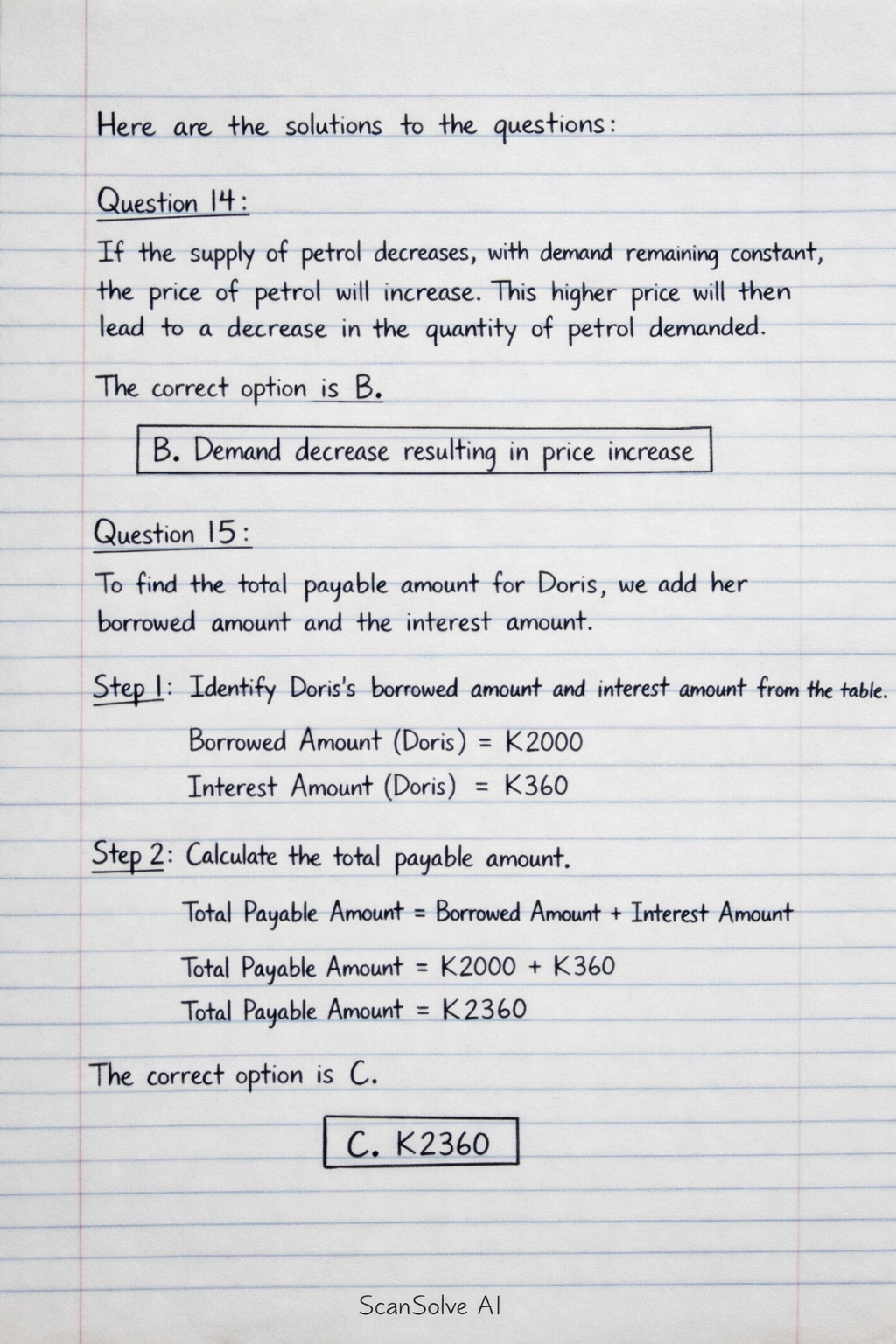
Handwritten Step-by-Step Solution
Get this as a handwritten image on WhatsApp — like a tutor wrote it for you.
Try on WhatsApp