
We read your photo as:
Using Efficiency theory, critically assess the five (5) arguments that 'decentralisation improves service delivery and accountability at the local level'. Examine Five (5) of Ghana's Decentralisation Policy thrust and how they can meet development goals (SDGs).
ScanSolve AI Answer
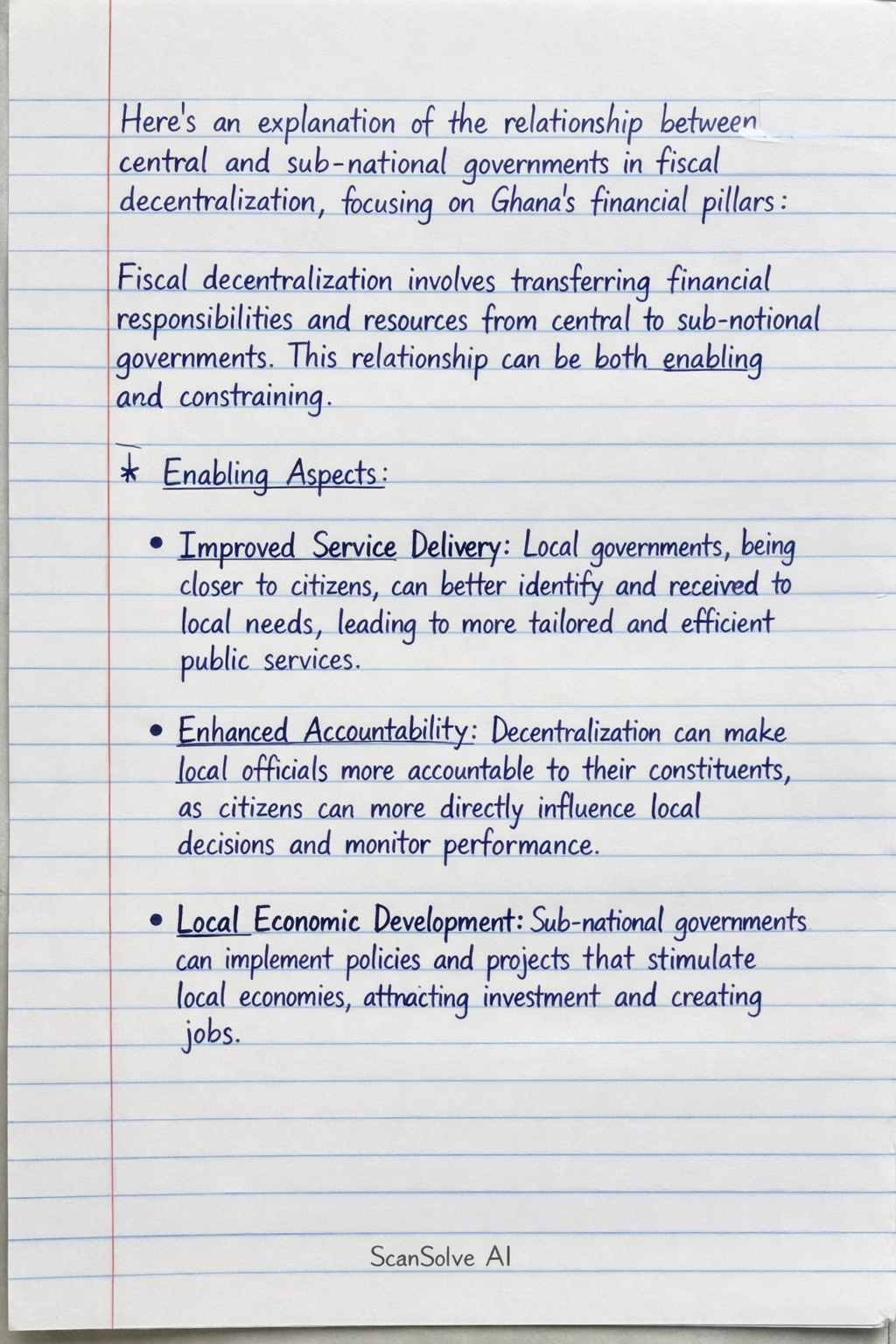
Here's an explanation of the relationship between central and sub-national governments in fiscal decentralization, focusing on Ghana's financial pillars:
Fiscal decentralization involves transferring financial responsibilities and resources from central to sub-national governments. This relationship can be both enabling and constraining.
-
Enabling Aspects:
- Improved Service Delivery: Local governments, being closer to citizens, can better identify and respond to local needs, leading to more tailored and efficient public services.
- Enhanced Accountability: Decentralization can make local officials more accountable to their constituents, as citizens can more directly influence local decisions and monitor performance.
- Local Economic Development: Sub-national governments can implement policies and projects that stimulate local economies, attracting investment and creating jobs.
-
Constraining Aspects:
- Fiscal Imbalances: Local governments often have limited revenue-generating capacity compared to their expenditure responsibilities, leading to reliance on central government transfers.
- Capacity Gaps: Sub-national governments may lack the administrative, technical, and financial management capacity to effectively manage devolved functions.
- Central Control: Even with decentralization, central governments often retain significant control over local finances through conditional grants, regulations, and oversight, limiting local autonomy.
The "pure" system of fiscal decentralization implies local governments have significant autonomy in raising and spending their own revenues, while a "non-pure" system involves substantial reliance on central government transfers and oversight. Ghana operates largely within a non-pure system, where central government support and regulation are significant.
Here are the four (4) assigned financial pillars that the Parliament of Ghana has provided for local government:
- Internally Generated Funds (IGF): These are revenues collected directly by the Metropolitan, Municipal, and District Assemblies (MMDAs) from local sources. Examples include property rates, market tolls, business operating permits, fees for services (e.g., waste management), and licenses. This pillar enables local governments to fund local initiatives and respond to specific community needs, but its potential is often constrained by the local economic base and collection efficiency.
- District Assemblies Common Fund (DACF): This is a statutory transfer from the central government to MMDAs. A fixed percentage (currently 5%) of national revenue is allocated to the DACF and distributed among MMDAs based on a formula that considers factors like population, poverty levels, and service needs. The DACF is a crucial enabling pillar, providing a predictable and significant source of funding for local development projects and recurrent expenditures, though its disbursement can sometimes be delayed.
- Grants from Central Government (Sectoral/Conditional Grants): These are funds provided by central government ministries, departments, and agencies (MDAs) to MMDAs for specific projects or programs within particular sectors (e.g., education, health, water, sanitation). These grants are often conditional, meaning they come with specific guidelines on how the funds should be used, which can be enabling by directing resources to national priorities at the local level but also constraining by limiting local discretion.
- Borrowing: MMDAs in Ghana have the legal capacity to borrow funds, primarily from financial institutions, to finance capital projects. However, this pillar is often constrained by strict central government regulations, the need for central government guarantees, and the limited creditworthiness of many MMDAs. When successfully utilized, borrowing can enable MMDAs to undertake large-scale infrastructure projects that cannot be funded solely through IGF or grants.
Still stuck on this one?
Ask a follow-up, and the answer starts from this question.
More Economics Questions
Handwritten Step-by-Step Solution
Get this as a handwritten image on WhatsApp — like a tutor wrote it for you.
Try on WhatsApp