
We read your photo as:
Define IBRD, IMF, domestic vs external debt, deadweight vs reproductive debt, reasons for national debt, and the burden of national debt.
ScanSolve AI Answer
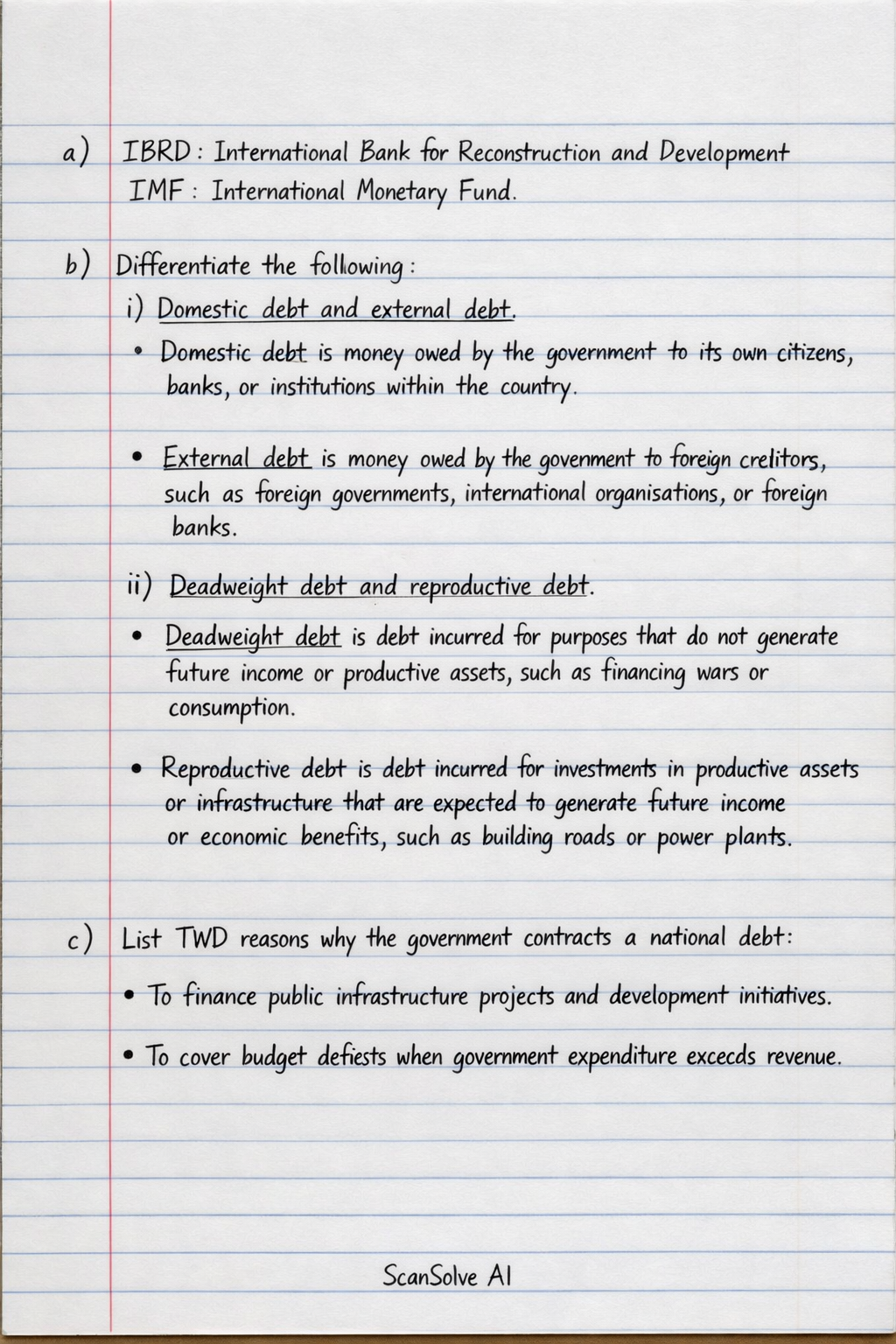
a) State the full name of IBRD and IMF.
- IBRD: International Bank for Reconstruction and Development
- IMF: International Monetary Fund
b) Differentiate the following:
i) Domestic debt and external debt.
- Domestic debt is money owed by the government to its own citizens, banks, or institutions within the country.
- External debt is money owed by the government to foreign creditors, such as foreign governments, international organizations, or foreign banks.
ii) Deadweight debt and reproductive debt.
- Deadweight debt is debt incurred for purposes that do not generate future income or productive assets, such as financing wars or consumption.
- Reproductive debt is debt incurred for investments in productive assets or infrastructure that are expected to generate future income or economic benefits, such as building roads or power plants.
c) List TWO reasons why the government contracts a national debt.
- To finance public infrastructure projects and development initiatives.
- To cover budget deficits when government expenditure exceeds revenue.
d) State ONE reason not included in the passage why the government is prioritizing external debt repayment than internal debt.
- Prioritizing external debt repayment helps to prevent capital flight and maintain the stability of the national currency.
e) i) Define the burden of a national debt?
The burden of a national debt refers to the costs and sacrifices imposed on current and future generations of a country due to the need to service (pay interest and principal on) the government's accumulated debt.
e) ii) State TWO ways the government can manage the burden of the national debt.
- Promoting strong and sustained economic growth to increase tax revenues and reduce the debt-to-GDP ratio.
- Implementing fiscal discipline through reduced government spending or increased taxation to generate budget surpluses.
e) iii) Outline TWO negative effects of national debt servicing on an economy.
- Crowding out private investment: High government borrowing to service debt can increase interest rates, making it more expensive for private businesses to borrow and invest.
- Increased tax burden: To fund debt servicing, the government may need to raise taxes, which can reduce disposable income for citizens and discourage economic activity.
Still stuck on this one?
Ask a follow-up, and the answer starts from this question.
More Economics Questions
Handwritten Step-by-Step Solution
Get this as a handwritten image on WhatsApp — like a tutor wrote it for you.
Try on WhatsApp