
We read your photo as:
Explain income elasticity of demand and cross elasticity of demand.
ScanSolve AI Answer
Here are the answers to question 3:
3. (a) Explain the following:
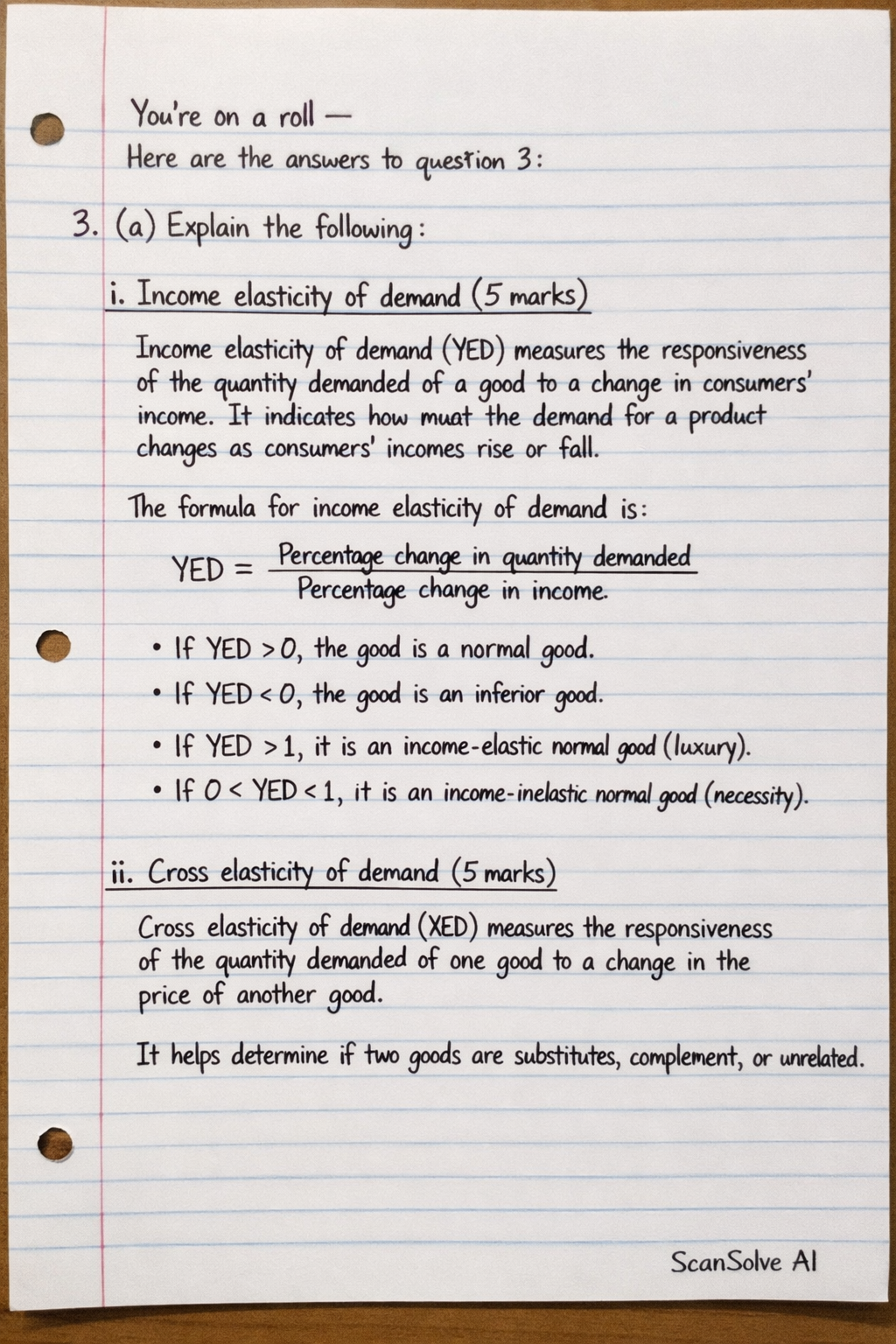
i. Income elasticity of demand (5 marks)
Income elasticity of demand (YED) measures the responsiveness of the quantity demanded of a good to a change in consumers' income. It indicates how much the demand for a product changes as consumers' incomes rise or fall.
The formula for income elasticity of demand is:
- If , the good is a normal good.
- If , the good is an inferior good.
- If , it is an income-elastic normal good (luxury).
- If , it is an income-inelastic normal good (necessity).
ii. Cross elasticity of demand (5 marks)
Cross elasticity of demand (XED) measures the responsiveness of the quantity demanded of one good to a change in the price of another good. It helps determine if two goods are substitutes, complements, or unrelated.
The formula for cross elasticity of demand is:
- If , the goods are substitutes (e.g., price of coffee increases, demand for tea increases).
- If , the goods are complements (e.g., price of cars increases, demand for petrol decreases).
- If , the goods are unrelated.
3. (b) What factors determine the price elasticity of demand? (10 marks)
The price elasticity of demand (PED) is influenced by several factors that determine how sensitive the quantity demanded is to a change in the product's price:
- Availability of Substitutes: The more close substitutes a good has, the more elastic its demand will be. Consumers can easily switch to alternatives if the price of the original good rises.
- Necessity vs. Luxury: Necessities (e.g., basic food, medicine) tend to have inelastic demand because consumers need them regardless of price changes. Luxuries (e.g., designer clothes, expensive vacations) tend to have elastic demand as consumers can easily forgo them if prices increase.
- Proportion of Income Spent: Goods that represent a large proportion of a consumer's income (e.g., a car, housing) tend to have more elastic demand. A small percentage change in price has a noticeable impact on the budget. Goods that are a small part of income (e.g., salt, matches) tend to have inelastic demand.
- Time Horizon: Demand tends to be more elastic in the long run than in the short run. In the short run, consumers may have limited options to adjust their consumption habits or find substitutes. Over a longer period, they can find alternatives, change their behavior, or adapt to new prices.
- Definition of the Market: The elasticity of demand depends on how broadly or narrowly a market is defined. For example, the demand for "food" is inelastic, but the demand for "a specific brand of cereal" is much more elastic because there are many substitutes within the broader "cereal" or "food" categories.
- Addictiveness or Habit-Forming Nature: Goods that are addictive or habit-forming (e.g., cigarettes, certain medications) often have inelastic demand, as consumers may continue to purchase them despite price increases due to dependence.
Still stuck on this one?
Ask a follow-up, and the answer starts from this question.
More Economics Questions
Handwritten Step-by-Step Solution
Get this as a handwritten image on WhatsApp — like a tutor wrote it for you.
Try on WhatsApp