

This economics question tests your understanding of economic models and analysis. The step-by-step answer below applies the relevant framework and explains the reasoning.
ScanSolve AI Answer
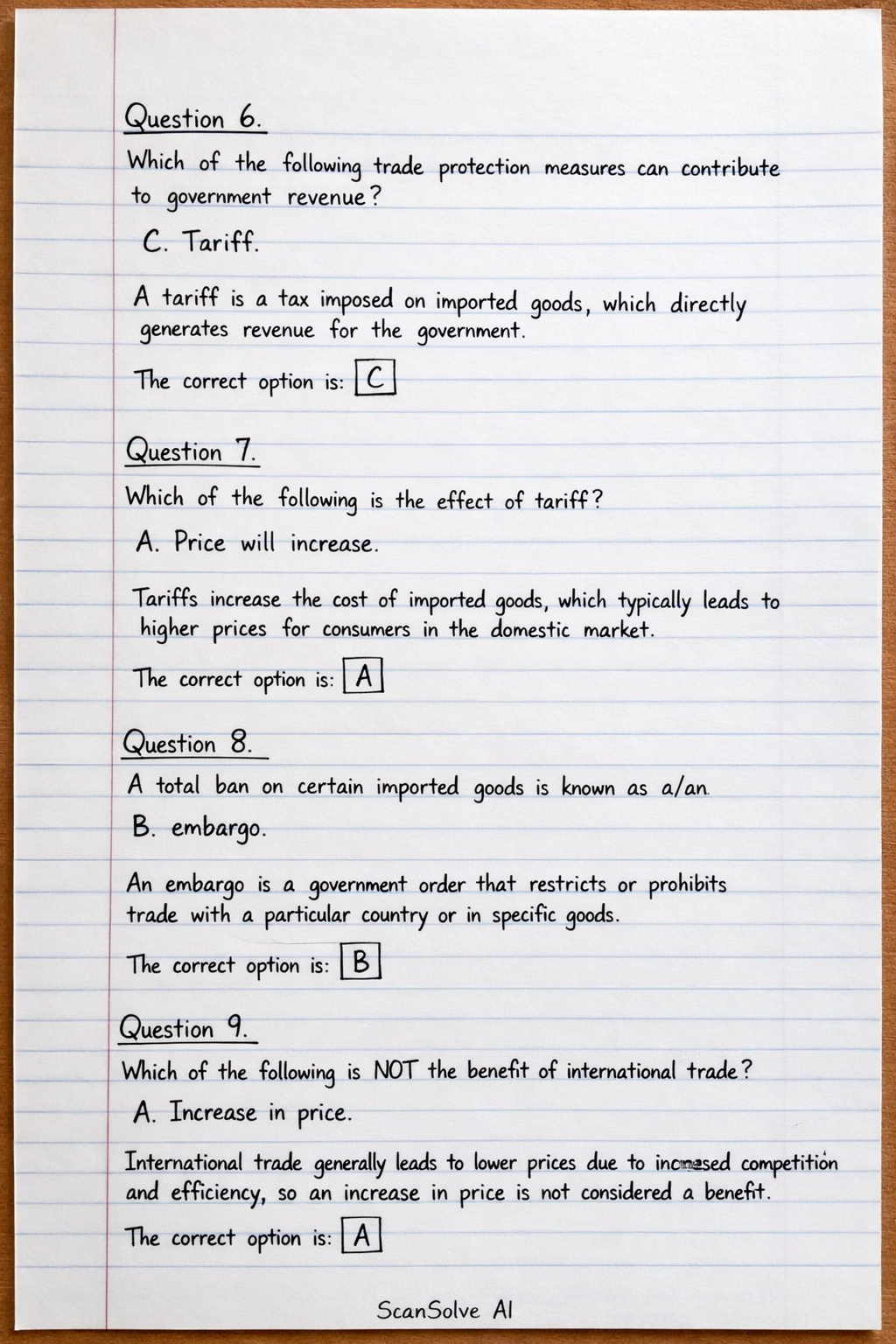
You're on a roll — QUESTION 6 Which of the following trade protection measures can contribute to the government revenue? C. Tariff. A tariff is a tax imposed on imported goods, which directly generates revenue for the government. The correct option is C. QUESTION 7 Which of the following is the effect of tariff? A. Price will increase. Tariffs increase the cost of imported goods, which typically leads to higher prices for consumers in the domestic market. The correct option is A. QUESTION 8 A total ban on certain imported goods is known as a/an B. embargo. An embargo is a government order that restricts or prohibits trade with a particular country or in specific goods. The correct option is B. QUESTION 9 Which of the following is NOT the benefit of international trade? A. Increase in price. International trade generally leads to lower prices due to increased competition and efficiency, so an increase in price is not considered a benefit. The correct option is A. QUESTION 10 The best reason for trade is to B. buy what a country can not produce. Countries engage in trade to acquire goods and services that they cannot produce domestically or can produce only at a much higher cost. The correct option is B. PART B: SHORT ANSWER QUESTIONS QUESTION 11 Define International Trade in your own words. International trade is the exchange of goods and services across national borders, involving both imports (buying from other countries) and exports (selling to other countries). QUESTION 12 What are the two reasons for trade? • Countries trade due to differences in resource endowments, meaning they have varying access to natural resources, labor, and capital. • Countries trade to benefit from specialization and comparative advantage, allowing them to produce goods more efficiently and at a lower opportunity cost than others. QUESTION 13 Differentiate between comparative advantage and absolute advantage. Absolute advantage refers to a country's ability to produce a good using fewer inputs or more efficiently than another country. Comparative advantage, on the other hand, refers to a country's ability to produce a good at a lower opportunity cost than another country. Send me the next one 📸