
We read your photo as:
(iv) D: Propose a logical alternative (e.g., Second-Best theory) to justify government intervention or a hybrid model for education financing in the Sierra Leonean context.
ScanSolve AI Answer
Step-by-step solution
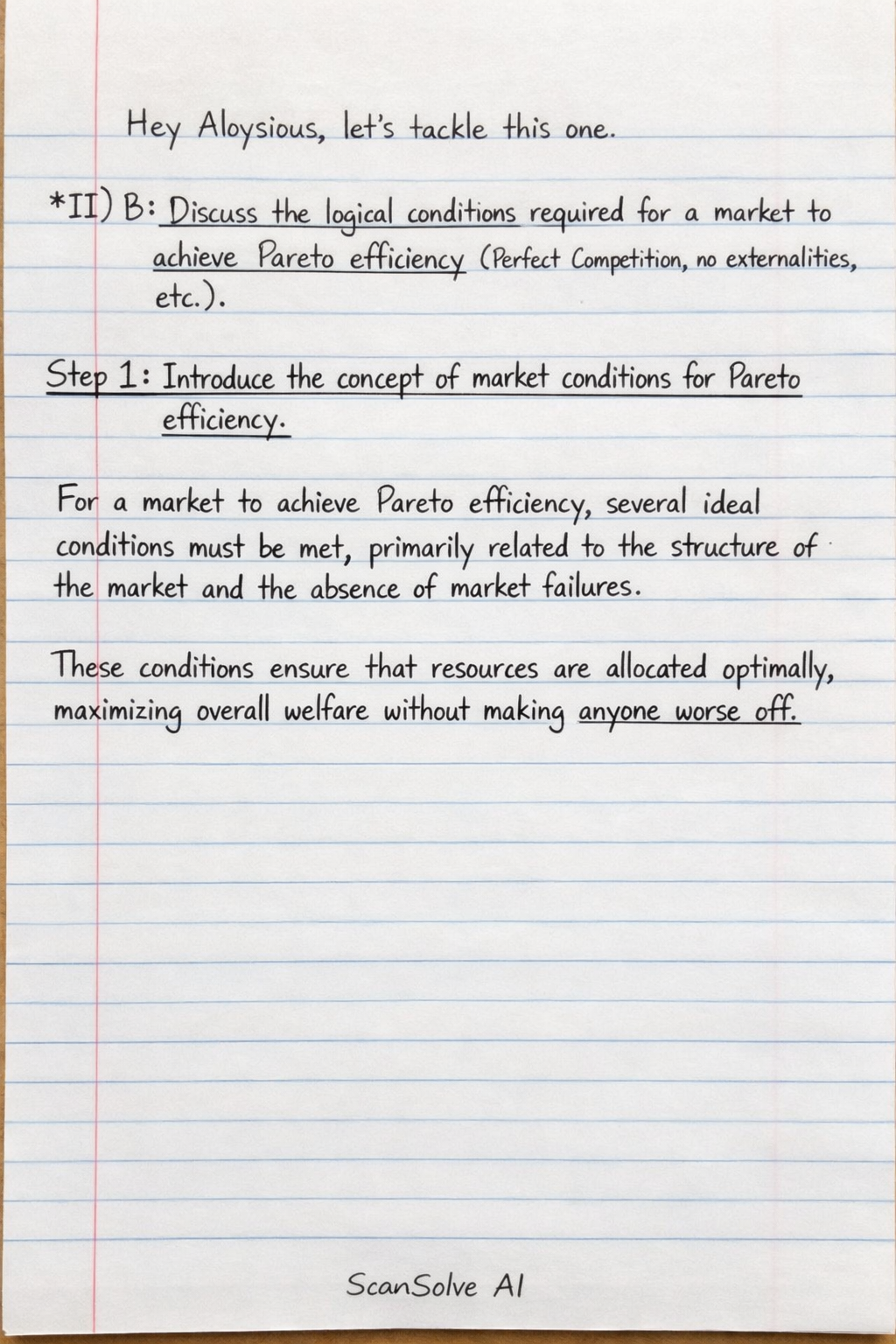
4 stepsHey Aloysious, let's tackle this one.
II) B: Discuss the logical conditions required for a market to achieve Pareto efficiency (Perfect Competition, no externalities, etc.).
Introduce the concept of market conditions for Pareto efficiency.
For a market to achieve Pareto efficiency, several ideal conditions must be met, primarily related to the structure of the market and the absence of market failures. These conditions ensure that resources are allocated optimally, maximizing overall welfare without making anyone worse off.
Discuss Perfect Competition.
One fundamental condition is perfect competition. This implies:
- A large number of buyers and sellers, none of whom can influence market prices.
- Homogeneous products, meaning all goods offered by different sellers are identical.
- Free entry and exit into the market, allowing resources to move to their most efficient uses.
- Perfect information, where all market participants have complete and accurate knowledge of prices, quality, and production methods. Under perfect competition, firms produce at the lowest possible cost, and prices reflect marginal costs, leading to an efficient allocation of resources.
Discuss the absence of externalities.
Another crucial condition is the absence of externalities. Externalities occur when the production or consumption of a good affects a third party not directly involved in the transaction, without compensation.
- Negative externalities (e.g., pollution) lead to overproduction because the social cost is not fully borne by the producer.
- Positive externalities (e.g., education, vaccinations) lead to underproduction because the social benefit is not fully captured by the consumer or producer. For Pareto efficiency, all costs and benefits must be internalized by the market participants, meaning there are no uncompensated side effects on third parties.
Mention other key conditions.
Other conditions include:
- Complete markets: Markets exist for all goods and services, including public goods and risk.
- Well-defined property rights: Clear ownership of resources and goods, allowing for efficient exchange.
- Rational agents: Individuals and firms make decisions to maximize their utility and profits, respectively. When these conditions are met, the market mechanism can lead to an allocation of resources where no one can be made better off without making someone else worse off.
Still stuck on this one?
Ask a follow-up, and the answer starts from this question.
More Economics Questions
Handwritten Step-by-Step Solution
Get this as a handwritten image on WhatsApp — like a tutor wrote it for you.
Try on WhatsApp