

This economics question tests your understanding of economic models and analysis. The step-by-step answer below applies the relevant framework and explains the reasoning.
ScanSolve AI Answer
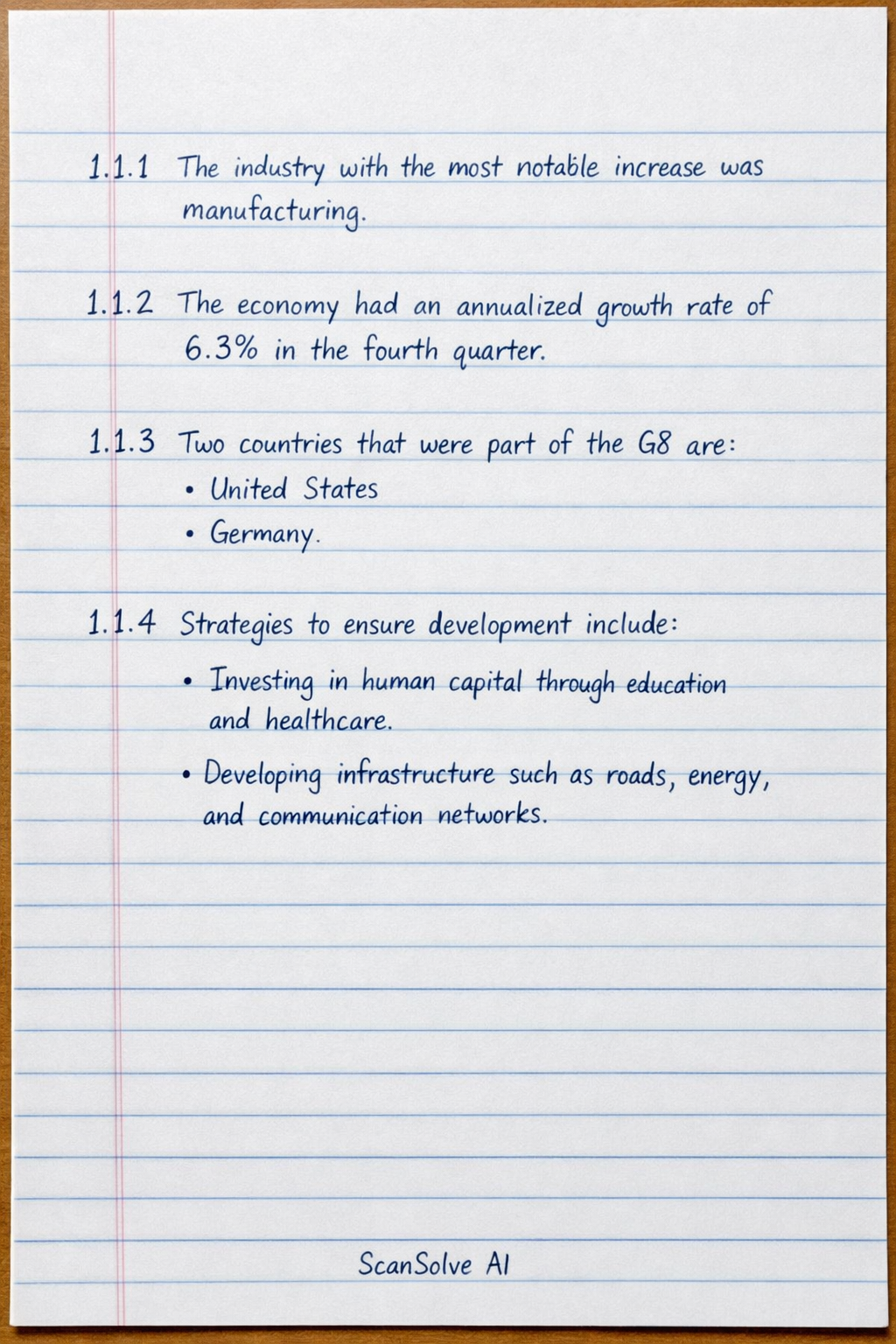
Here are the answers to your questions based on the provided case study and general economic knowledge: 1.1.1 The industry that had the most notable increase was manufacturing. 1.1.2 The case study states that the economy had an annualised growth rate of 6.3% in the fourth quarter. The text does not provide a single overall economic growth rate for South Africa in 2023, but this is the most recent annualised figure mentioned. 1.1.3 Two countries that were part of the G8 are: • United States • Germany 1.1.4 Strategies that can be used to ensure development include: • Investing in human capital through education and healthcare. • Developing infrastructure such as roads, energy, and communication networks. 1.1.5 • Economic growth refers to the quantitative increase in a country's real output of goods and services over time, typically measured by the Gross Domestic Product (GDP). • Economic development is a broader concept that encompasses improvements in the quality of life and living standards, including factors like education, health, income distribution, and environmental sustainability. It is a qualitative measure of progress. 1.1.6 South Africa is regarded as a developing country due to several factors: • High levels of income inequality and poverty, despite being an upper-middle-income economy. • High unemployment rates, particularly among youth. • Dependence on primary sector exports (like mining) and vulnerability to commodity price fluctuations. • Challenges in service delivery and infrastructure development in certain areas. 1.1.7 Inflation affects the standard of living by: • Reducing purchasing power: As prices rise, the same amount of money buys fewer goods and services, meaning people can afford less. • Eroding savings: The real value of savings decreases over time, impacting future financial security. • Disproportionately affecting fixed incomes: Individuals on fixed incomes, such as pensioners, experience a greater decline in their real income and standard of living. • Increasing uncertainty: High inflation can make it difficult for businesses and consumers to plan for the future, leading to reduced investment and consumption. 1.1.8 The impact of Covid-19 on economic growth was significant and largely negative: • Severe economic contraction: The case study states that "economic activity decreased by 7% in 2020 compared with 2019," which was "the biggest annual fall in economic activity the country has seen since at least 1946." • Lockdown restrictions: Stringent lockdowns halted many economic activities, leading to business closures, job losses, and reduced production across various sectors. • Disruption of supply chains: Global and domestic supply chains were severely disrupted, causing shortages and increased costs for goods. • Increased government spending and debt: Governments implemented stimulus packages and social relief measures, leading to higher public debt. • Sectoral impacts: While some sectors like manufacturing and trade showed resilience in later quarters, others, particularly those reliant on social interaction (e.g., tourism, hospitality), suffered immense losses. • Uncertainty and reduced investment: The pandemic created significant economic uncertainty, deterring both domestic and foreign investment. • Global economic downturn: The crisis was global, meaning export markets for South African goods and services were also negatively affected. Drop the next question.