
We read your photo as:
Explain monopolistic competition using examples of South African businesses, detailing product differentiation and market characteristics.
ScanSolve AI Answer
Answer
The assignment focuses on understanding monopolistic competition and its application to real-world businesses in South Africa.
Monopolistic competition is a market structure where many firms offer products or services that are similar but not perfect substitutes. This means products are differentiated through branding, quality, features, or marketing, giving each firm some degree of market power, but consumers still have many choices. Entry and exit into the market are relatively easy.
Here's how to approach the assignment based on the provided guide:
- Research South African businesses: Identify industries in South Africa that fit the description of monopolistic competition. Good examples often include fast-food restaurants, clothing stores, hair salons, or coffee shops. These industries have many sellers, differentiated products, and relatively low barriers to entry.
- Choose ONE business/product: Select a specific business (e.g., a particular coffee shop chain like Vida e Caffè or a clothing brand like Mr Price) or a combination of businesses within one of the identified industries.
- Align to characteristics: Discuss the general characteristics of monopolistic competition and explain how your chosen business/product aligns with each one.
- Product Differentiation: How does the business make its product unique from competitors (e.g., unique menu items, store ambiance, brand image)?
- Many Sellers: Are there many other businesses offering similar products/services?
- Easy Entry and Exit: Is it relatively easy for new firms to enter or existing firms to leave this market?
- Some Market Power: Does the business have some control over its price due to product differentiation, or is it a price taker?
- Non-price Competition: How does the business compete using advertising, branding, customer service, or product quality rather than just price?
- Discuss characteristics and non-conformance to imperfect market conditions: Monopolistic competition is a form of imperfect competition. Explain how the characteristics you've identified are acceptable under monopolistic competition. Then, highlight why these conditions are not totally conforming to other forms of imperfect competition (like oligopoly or monopoly) or even perfect competition. For example, unlike perfect competition, products are not homogeneous, and firms have some pricing power. Unlike a monopoly, there are many competitors, and entry barriers are low.
- Conclude on real-world situations and imperfect markets: Summarize how factors like consumer preferences, advertising, innovation, and branding in the real world lead to product differentiation and the existence of imperfect markets, specifically monopolistic competition.
The mark allocation guides the depth of your discussion for each section:
- The Analysis of alignment to monopolistic competition conditions (20 marks) requires the most detailed explanation, focusing on how your chosen business exemplifies the market structure.
- The Conclusion real-world situations (10 marks) should provide a thoughtful summary of the broader implications.
- Characteristics of monopolistic competition (8 marks) should clearly define and explain each characteristic.
Still stuck on this one?
Ask a follow-up, and the answer starts from this question.
More Economics Questions
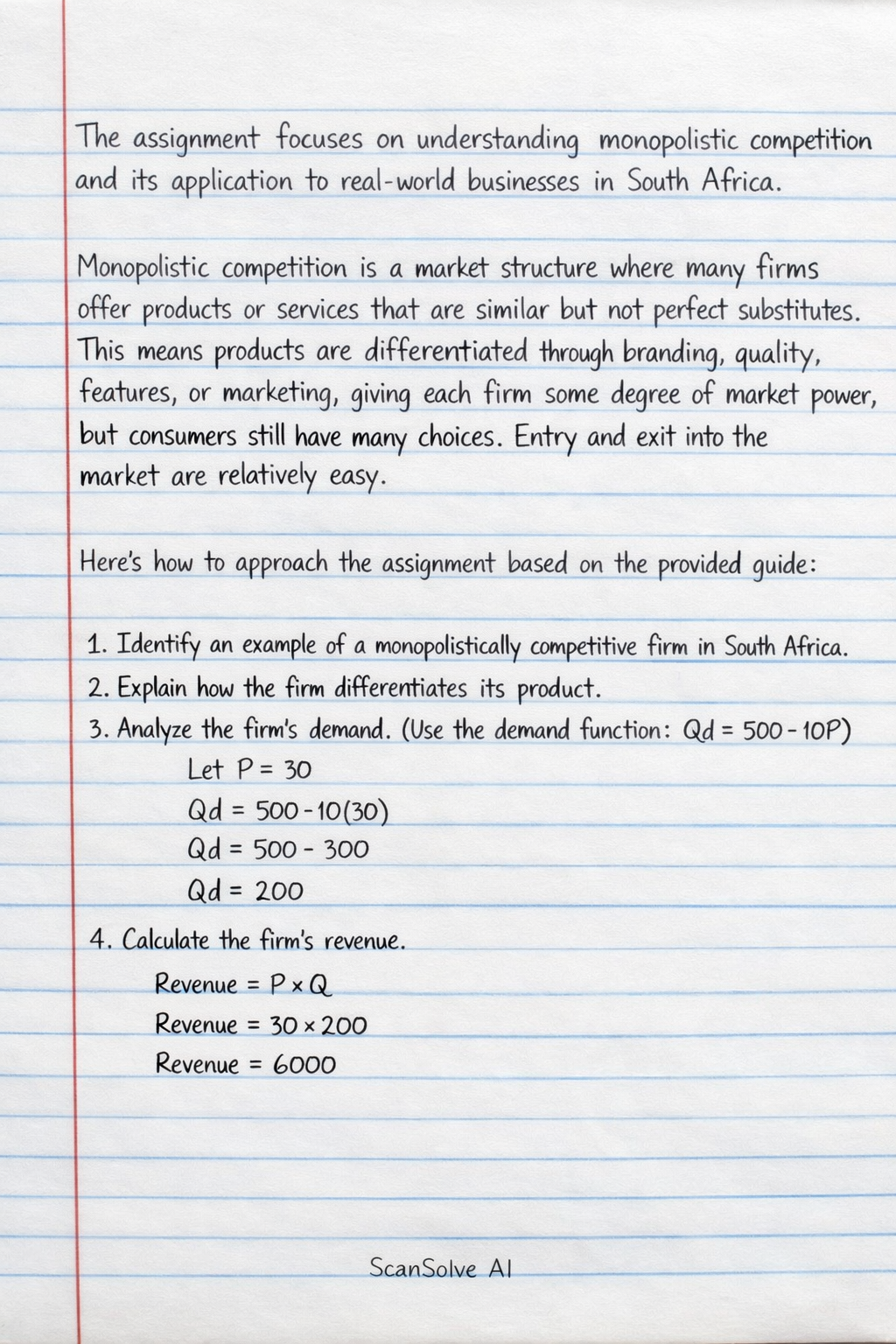
Handwritten Step-by-Step Solution
Get this as a handwritten image on WhatsApp — like a tutor wrote it for you.
Try on WhatsApp