
We read your photo as:
Define National Income and Economic Growth, and explain four factors influencing National Income.
ScanSolve AI Answer
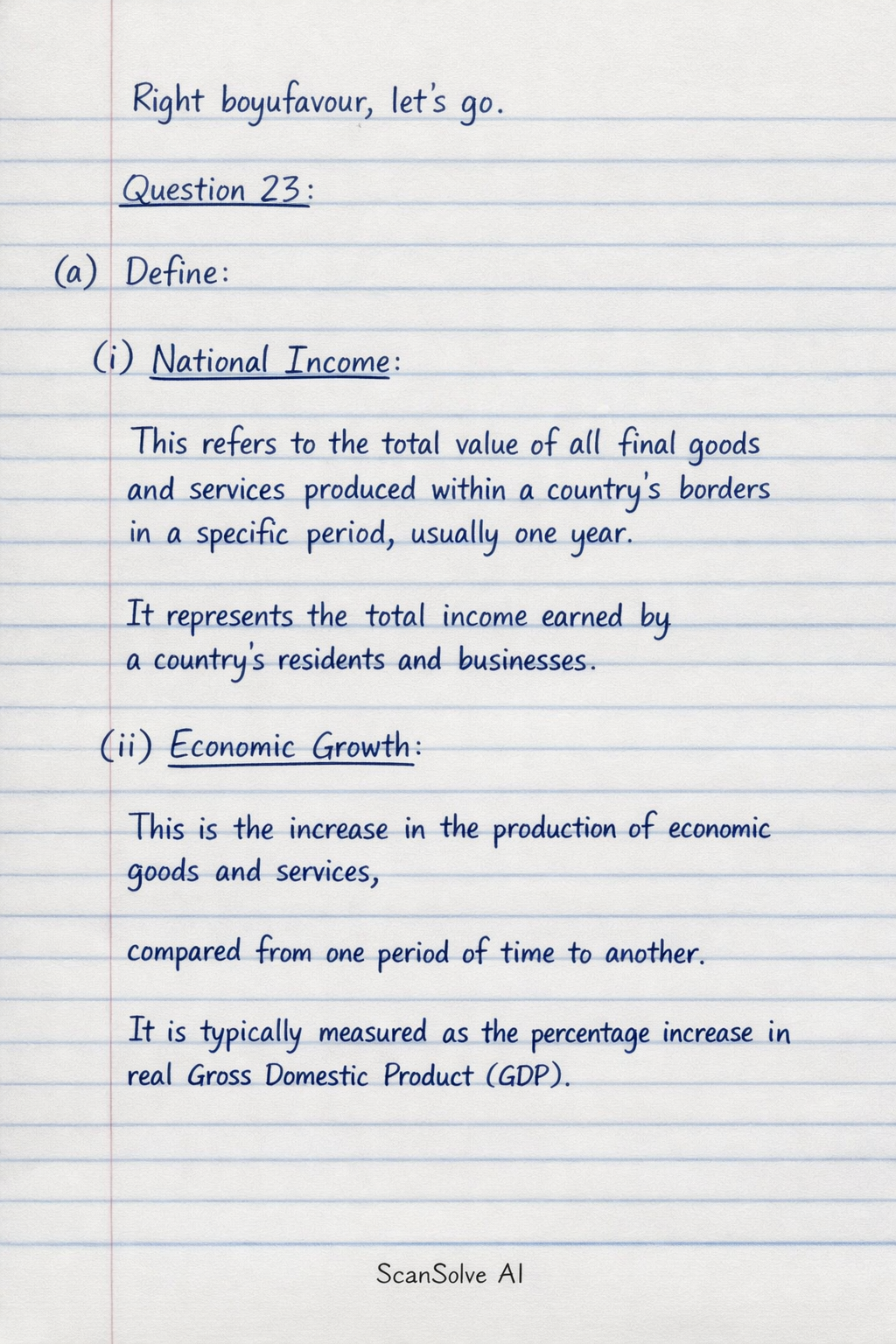
Question 23:
-
23 (a) Define:
- (i) National Income: This refers to the total value of all final goods and services produced within a country's borders in a specific period, usually one year. It represents the total income earned by a country's residents and businesses.
- (ii) Economic Growth: This is the increase in the production of economic goods and services, compared from one period of time to another. It is typically measured as the percentage increase in real Gross Domestic Product (GDP).
-
23 (b) Explain four (4) factors that can influence the size of National Income.
- Quantity and Quality of Natural Resources: A country with abundant and high-quality natural resources (e.g., fertile land, minerals, oil) can produce more goods and services, leading to a higher national income. Efficient management and utilization of these resources are also crucial.
- Capital Formation: Investment in physical capital such as machinery, factories, infrastructure (roads, power plants), and technology increases a country's productive capacity. Higher capital formation leads to increased output and thus a larger national income.
- Human Resources (Labor): The size, skill level, education, and health of a country's workforce significantly impact its productivity. A well-trained, healthy, and motivated labor force can produce more efficiently, contributing to a higher national income.
- Technological Advancement: Improvements in technology lead to more efficient production methods, new products, and increased output per worker. Adopting and innovating technology can significantly boost a country's productive capacity and national income.
-
23 (c) State and explain three (3) advantages of economic growth to a Country.
- Improved Standard of Living: Economic growth generally leads to higher average incomes, allowing people to afford more goods and services, better housing, healthcare, and education, thereby improving their overall quality of life.
- Increased Employment Opportunities: As an economy grows, businesses expand and new industries emerge, creating more jobs. This reduces unemployment and provides more people with income-earning opportunities.
- Increased Government Revenue: A growing economy generates more income and profits, leading to higher tax revenues for the government. This allows the government to invest more in public services like infrastructure, education, and healthcare, benefiting the entire population.
Question 24:
-
24 (a) Distinguish between a public company and a public corporation.
- A public company is a business entity whose shares are traded on a stock exchange and can be bought by the general public. It is typically owned by private shareholders and aims to maximize profit for them.
- A public corporation (or state-owned enterprise) is a business or organization established and owned by the government to provide public services or goods, often operating on a non-profit or public interest basis.
-
24 (b) Explain how the following factors would influence the location of a named industry in a country: Let's consider a cement manufacturing industry.
- (i) Nearness to the source of raw materials: Cement production requires bulky and heavy raw materials like limestone, clay, and gypsum. Locating a cement factory near the quarries where these raw materials are extracted significantly reduces transportation costs, which are a major component of the total cost. This makes the final product more competitive.
- (ii) Nearness to the market: While raw materials are crucial, proximity to the market (areas with high construction activity) is also important for cement. Cement is a heavy product, and transporting it over long distances to consumers can be expensive. Locating closer to urban centers or regions with high demand minimizes distribution costs and ensures timely delivery to customers.
-
24 (c) Distinguish between plantation agriculture and small holder schemes.
- Plantation agriculture involves large-scale farming, often specializing in a single cash crop (monoculture) like rubber, tea, or palm oil. It typically uses modern machinery, significant capital investment, and a large, often hired, labor force, primarily for export markets.
- Small holder schemes involve small-scale farming, usually by individual families or communities, often growing a variety of crops (diversified) for subsistence or local markets. They typically rely on traditional methods, family labor, and limited capital.
Question 25:
-
25 (a) Explain four (4) attributes of good money.
- Durability: Good money must be able to withstand wear and tear from frequent handling and circulation. For example, coins and banknotes are designed to last.
- Portability: It should be easy to carry around and transfer from one person to another. This is why money is typically in convenient sizes and weights.
- Divisibility: Money must be capable of being divided into smaller units without losing its value, allowing for transactions of varying amounts. For instance, a dollar can be divided into cents.
- Scarcity (Limited Supply): Money must be relatively scarce and not easily reproducible to maintain its value. If money were too abundant, it would lose its purchasing power.
-
25 (b) Define the following:
- (i) Monetary Policy: This refers to actions undertaken by a central bank to influence the availability and cost of money and credit to help promote national economic goals. It typically involves managing interest rates and the money supply.
- (ii) Fiscal Policy: This is the use of government spending and taxation to influence the economy. Governments use fiscal policy to stabilize the economy, promote growth, and reduce unemployment or inflation.
- (iii) Physical Policy: This term is not standard in economics. However, if interpreted in a broad sense, it could refer to government policies related to the management and development of physical resources and infrastructure, such as land use planning, energy policy, or public works projects.
-
25 (c) Briefly explain the following concepts:
- (i) Inflation: This is a sustained increase in the general price level of goods and services in an economy over a period of time. It means that money loses its purchasing power, and each unit of currency buys fewer goods and services than before.
- (ii) Unemployment: This occurs when people who are actively searching for employment are unable to find work. It is typically measured as the percentage of the labor force that is jobless.
Still stuck on this one?
Ask a follow-up, and the answer starts from this question.
More Economics Questions
Handwritten Step-by-Step Solution
Get this as a handwritten image on WhatsApp — like a tutor wrote it for you.
Try on WhatsApp