
We read your photo as:
Which of the following is a direct tax? a) Income Tax b) Wealth Tax c) Sales Tax d) Excise Duty
ScanSolve AI Answer
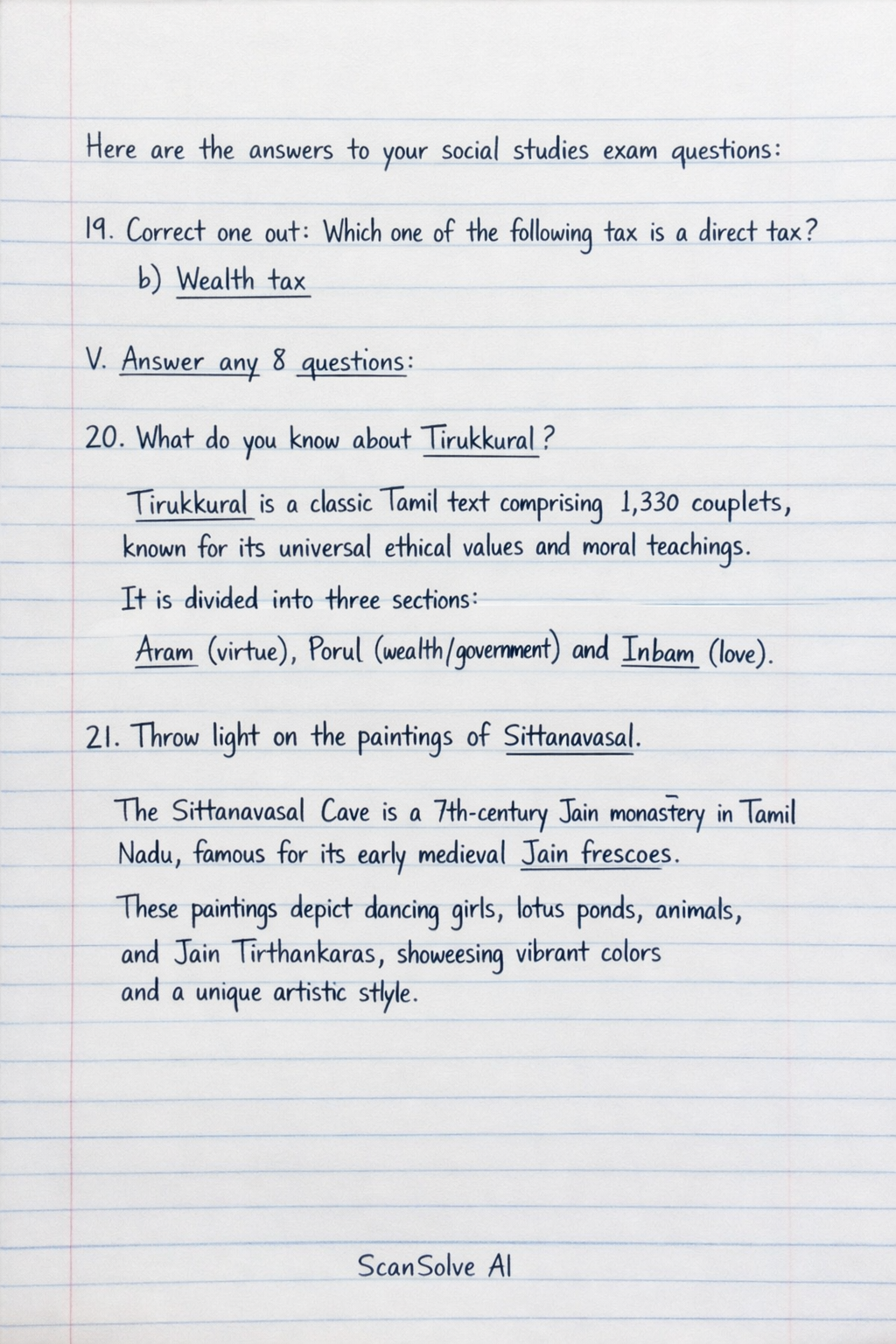
Here are the answers to your social studies exam questions:
19. Correct one out: Which one of the following tax is a direct tax?
b) Wealth tax
V. Answer any 8 questions:
20. What do you know about Tirumural?
Tirukkural is a classic Tamil text comprising 1,330 couplets, known for its universal ethical values and moral teachings. It is divided into three sections: Aram (virtue), Porul (wealth/government), and Inbam (love).
21. Throw light on the paintings of Sittanavasal.
The Sittanavasal Cave is a 7th-century Jain monastery in Tamil Nadu, famous for its early medieval Jain frescoes. These paintings depict dancing girls, lotus ponds, animals, and Jain Tirthankaras, showcasing vibrant colors and a unique artistic style.
22. Explain the three divisions of Tripitaka.
The Tripitaka (Tipitaka) is the traditional collection of Buddhist scriptures, divided into three main sections:
- Vinaya Pitaka: Contains rules and regulations for the monastic community.
- Sutta Pitaka: Comprises the discourses and teachings of Buddha.
- Abhidhamma Pitaka: Deals with the philosophical and psychological analysis of Buddhist doctrines.
23. What is called "4 o'clock rains"?
"4 o'clock rains" refers to convectional rainfall, which commonly occurs in equatorial regions. Intense surface heating causes air to rise, cool, condense, and form cumulonimbus clouds, leading to heavy rainfall, often in the late afternoon.
24. Distinguish between The Rocky mountain and the Appalachian mountain.
The Rocky Mountains are young, rugged, and high mountains in western North America, formed by tectonic plate collision. The Appalachian Mountains are older, lower, and more eroded mountains in eastern North America, formed by ancient continental collisions.
25. What is an Atlas?
An atlas is a collection of maps, typically bound into a book. It provides geographical information, statistics, and other relevant data for the Earth, specific regions, or particular themes.
26. Name any four different industry which goes under industrial disaster frequently.
Four industries frequently prone to industrial disasters are:
- Chemical industry
- Oil and gas industry
- Mining industry
- Nuclear power industry
27. What is gender equality?
Gender equality means that all individuals, regardless of gender, have equal rights, responsibilities, and opportunities. It ensures that the diverse behaviors, aspirations, and needs of women and men are equally valued and considered.
28. What is market?
A market is a place or system where buyers and sellers interact to exchange goods, services, or information. It facilitates transactions and determines prices based on the forces of supply and demand.
29. Why taxes are imposed?
Taxes are imposed by governments primarily to fund public services and infrastructure, such as education, healthcare, defense, and roads. They also help redistribute wealth, regulate economic activity, and stabilize the economy.
VI. Answer the following in detail:
30. a) What impact did Bhakti movement make on Indian society.
The Bhakti movement significantly impacted Indian society by promoting social equality and challenging the rigid caste system. It emphasized devotion to a personal God, making religion accessible to all, including lower castes and women. It also fostered the development of regional languages and literature, and encouraged communal harmony.
31. a) Write about comparison of map and Globe.
A map is a two-dimensional representation of the Earth's surface, while a globe is a three-dimensional spherical model of the Earth. Maps offer greater detail for smaller areas and are portable but always involve distortion. Globes accurately represent the Earth's shape, relative sizes, and distances without distortion, but are less portable and cannot show fine details for small regions.
32. a) List out the documents necessary for an Indian while driving.
The documents necessary for an Indian while driving typically include:
- Driving License
- Registration Certificate (RC)
- Pollution Under Control (PUC) Certificate
- Vehicle Insurance Certificate
VII. Map Marking:
a) On the outline map of India mark the following.
I cannot directly mark on a map, but here are the descriptions of the locations:
- Delhi: The capital city of India, located in northern India.
- Thanjavur: A city in the state of Tamil Nadu, South India, famous for the Brihadeeswarar Temple.
- Bay of Bengal: A large bay forming the northeastern part of the Indian Ocean, bordering India to its west.
- Kanchipuram: An ancient city in the state of Tamil Nadu, South India, known for its temples and silk sarees.
b) Mark the following places on the world map.
I cannot directly mark on a map, but here are the descriptions of the locations:
a) Pacific Ocean: The largest and deepest ocean, located between Asia/Australia and the Americas.
b) USA: United States of America, a country primarily located in North America.
c) Arctic Ocean: The smallest and shallowest ocean, located around the North Pole.
d) Gulf of Mexico: A large ocean basin and marginal sea of the Atlantic Ocean, largely encircled by North America.
e) Brazil: The largest country in South America, located in eastern South America.
Still stuck on this one?
Ask a follow-up, and the answer starts from this question.
More Economics Questions
Handwritten Step-by-Step Solution
Get this as a handwritten image on WhatsApp — like a tutor wrote it for you.
Try on WhatsApp