
We read your photo as:
Which of the following scenario will reduce money supply in the economy? A decrease in government expenditure reduces the amount of money injected into the economy, thereby reducing the overall money
ScanSolve AI Answer
Answers
4 partsStep-by-step solution
4 stepsPart 7
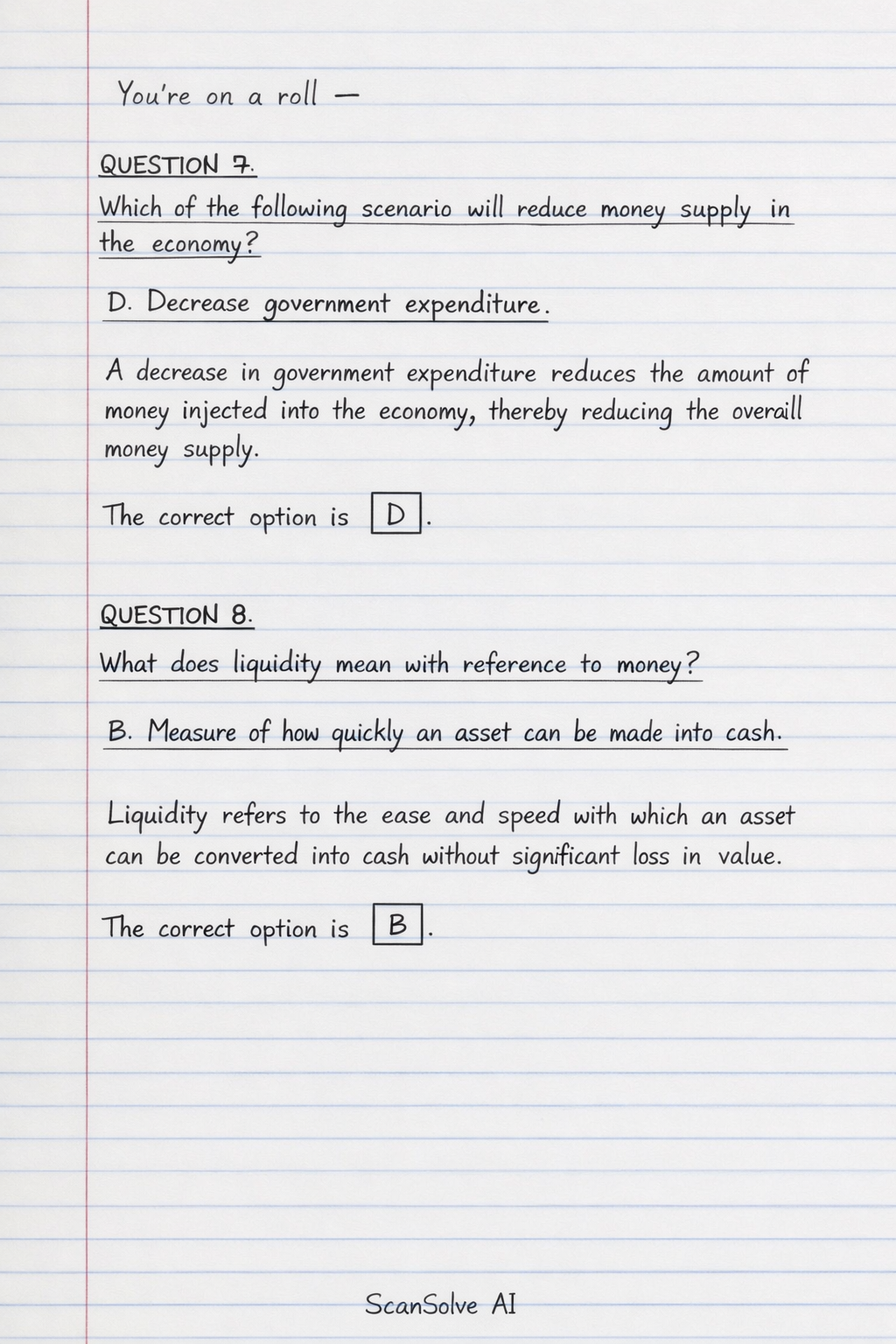
Which of the following scenario will reduce money supply in the economy?
D. Decrease government expenditure.
A decrease in government expenditure reduces the amount of money injected into the economy, thereby reducing the overall money supply.
The correct option is .
Part 8
What does liquidity mean with reference to money?
B. Measure of how quickly an asset can be made into cash.
Liquidity refers to the ease and speed with which an asset can be converted into cash without significant loss in value.
The correct option is .
Part 9
What would be the credit creation multiplier?
Identify the given ratio.
The Liquid Asset ratio is , which is 0.20. This ratio represents the fraction of deposits that banks must hold as reserves.
Calculate the credit creation multiplier.
The credit creation multiplier (or money multiplier) is given by the formula:
The credit creation multiplier is 5.
The correct option is .
Part 10
What would be the final increase in deposit after the full credit creation process is complete?
Identify the initial deposit and the multiplier.
The initial deposit is K 1000.
The credit creation multiplier is 5 (from Question 9).Calculate the final increase in deposit.
The final increase in deposit is calculated by multiplying the initial deposit by the credit creation multiplier:
The final increase in deposit is K 5000.
The correct option is .
Part b
SHORT ANSWER QUESTIONS
Part 11
What is a balance sheet?
A balance sheet is a financial statement that provides a snapshot of a company's financial position at a specific point in time, detailing its assets, liabilities, and owner's equity.
Part 12
List two functions of commercial banks
- Accepting deposits from individuals and businesses (e.g., savings accounts, current accounts).
- Providing loans and advances to individuals and businesses for various purposes.
Try one yourself
A new problem that tests the same skill.
Still stuck on this one?
Ask a follow-up, and the answer starts from this question.
More Economics Questions
Handwritten Step-by-Step Solution
Get this as a handwritten image on WhatsApp — like a tutor wrote it for you.
Try on WhatsApp