

This economics question tests your understanding of economic models and analysis. The step-by-step answer below applies the relevant framework and explains the reasoning.
ScanSolve AI Answer
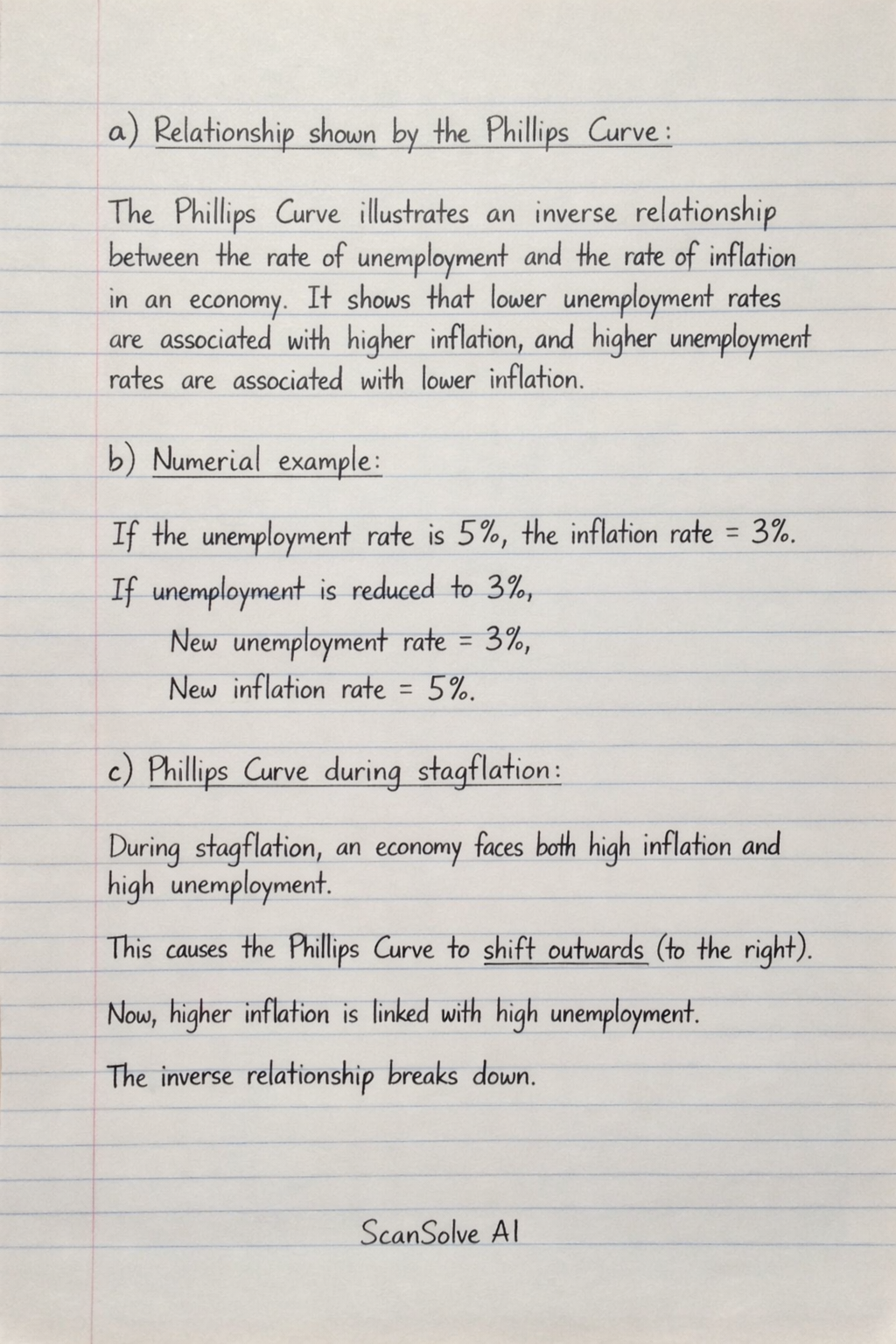
Hey KIMBE — ready when you are. a) Relationship shown by the Phillips Curve: The Phillips Curve illustrates an inverse relationship between the rate of unemployment and the rate of inflation in an economy. It suggests that lower unemployment rates are associated with higher inflation, and higher unemployment rates are associated with lower inflation. b) Numerical example: If the unemployment rate is 5%, the inflation rate might be 3%. If the government implements policies to reduce unemployment to 3%, the inflation rate might then rise to 5%. c) Phillips Curve during stagflation: During stagflation, an economy experiences both high inflation and high unemployment simultaneously. This phenomenon causes the short-run Phillips Curve to shift outwards or to the right, indicating that a higher inflation rate is now associated with any given unemployment rate, or vice versa, breaking the traditional inverse relationship. Send me the next one 📸