
We read your photo as:
Define Price Elasticity of Supply (PES) and explain why the PES of cement is typically very low, especially in the short run.
ScanSolve AI Answer
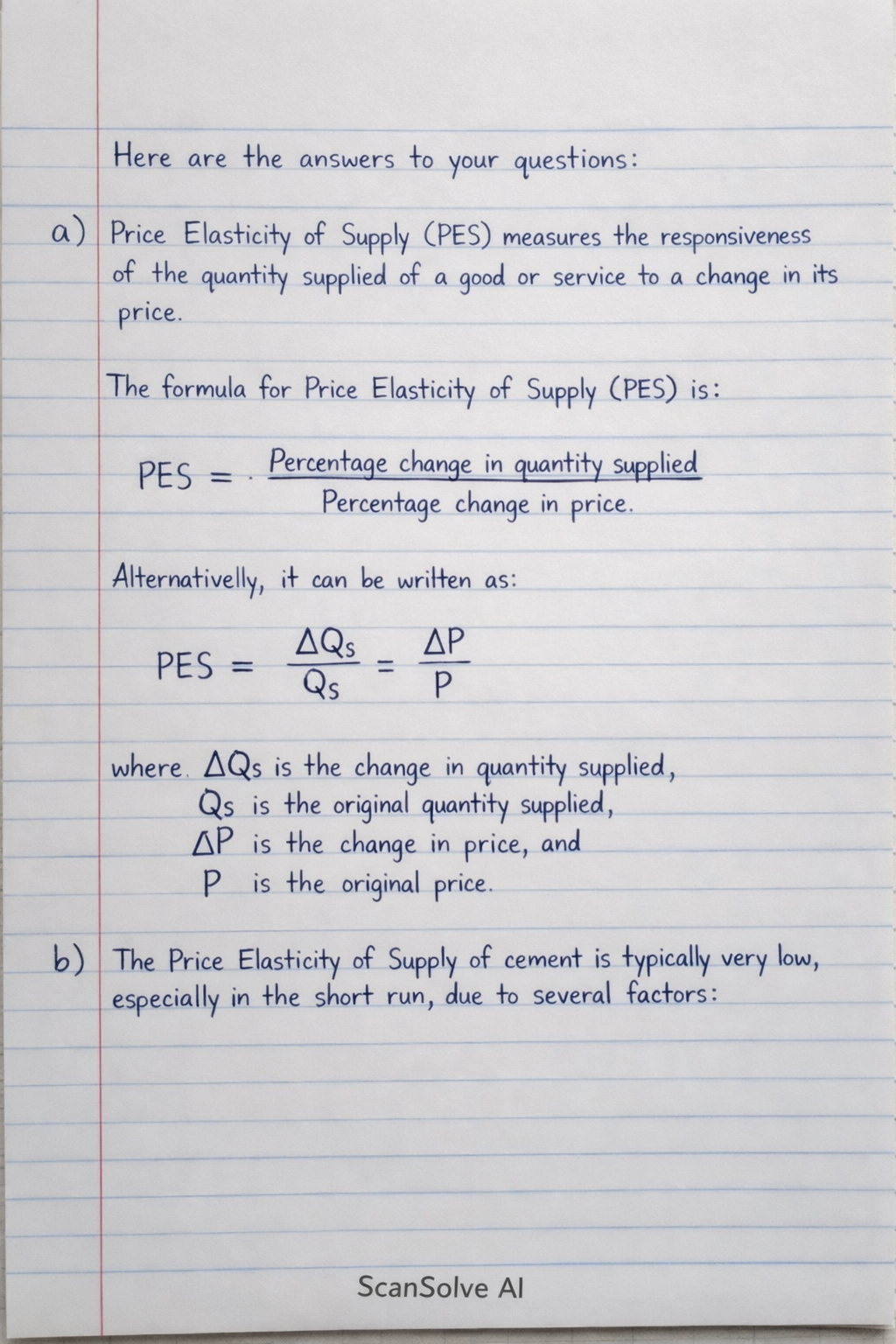
Here are the answers to your questions:
a) Price Elasticity of Supply (PES) measures the responsiveness of the quantity supplied of a good or service to a change in its price.
The formula for Price Elasticity of Supply (PES) is:
Alternatively, it can be written as:
where is the change in quantity supplied, is the original quantity supplied, is the change in price, and is the original price.
b) The Price Elasticity of Supply of cement is typically very low, especially in the short run, due to several factors:
- High Capital Investment and Long Production Time: Cement production requires massive, specialized machinery and infrastructure (like kilns and grinding mills) that cannot be easily or quickly expanded. Building new plants or significantly increasing capacity takes a long time and substantial investment.
- Limited Availability of Raw Materials: Key raw materials like limestone and clay are geographically specific. While abundant, increasing their extraction and processing quickly to meet sudden demand spikes can be challenging.
- Difficulty in Storage: While cement can be stored, it has a limited shelf life once exposed to moisture, and large-scale storage can be costly. This limits the ability of producers to hold large inventories to respond to immediate price changes.
- Inelasticity of Inputs: The specialized nature of inputs (e.g., specific types of energy, skilled labor for plant operation) means their supply might also be inelastic in the short run, making it hard to ramp up production quickly.
These factors mean that cement producers cannot rapidly adjust the quantity of cement supplied in response to price changes, leading to a low (inelastic) Price Elasticity of Supply.
Still stuck on this one?
Ask a follow-up, and the answer starts from this question.
More Economics Questions
Handwritten Step-by-Step Solution
Get this as a handwritten image on WhatsApp — like a tutor wrote it for you.
Try on WhatsApp