
We read your photo as:
Define public finance, identify sources of revenue for national and county governments, and explain two fiscal policy tools.
ScanSolve AI Answer
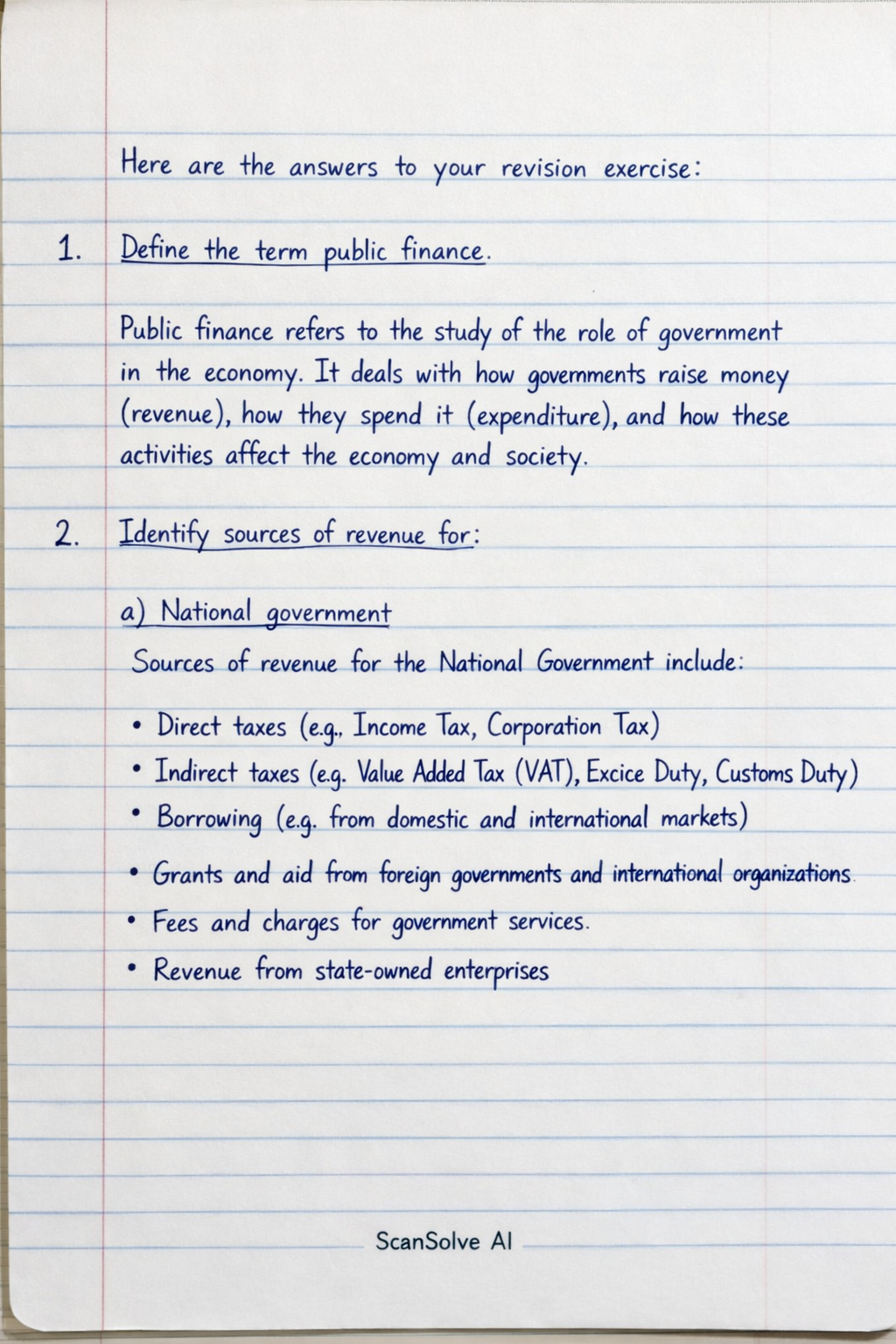
Here are the answers to your revision exercise:
-
Define the term public finance. Public finance refers to the study of the role of government in the economy. It deals with how governments raise money (revenue), how they spend it (expenditure), and how these activities affect the economy and society.
-
Identify sources of revenue for:
-
a) National government Sources of revenue for the National Government include:
- Direct taxes (e.g., Income Tax, Corporation Tax)
- Indirect taxes (e.g., Value Added Tax (VAT), Excise Duty, Customs Duty)
- Borrowing (e.g., from domestic and international markets)
- Grants and aid from foreign governments and international organizations
- Fees and charges for government services
- Revenue from state-owned enterprises
-
b) County government Sources of revenue for County Governments include:
- Equitable share of national revenue (transfers from the National Government)
- Property rates
- Business permits and licenses
- Cess (local taxes on agricultural produce)
- User charges and fees for services (e.g., parking fees, hospital fees)
- Borrowing (with approval from the National Government)
- Grants from the National Government or other donors
-
-
Which are the two types of public expenditure? The two main types of public expenditure are:
- Recurrent expenditure: This covers the day-to-day running costs of the government, such as salaries, administrative expenses, maintenance of public facilities, and interest payments on public debt.
- Development expenditure (or Capital expenditure): This involves spending on long-term projects that aim to increase the productive capacity of the economy, such as infrastructure development (roads, schools, hospitals), investments in state-owned enterprises, and research and development.
-
In which ways does the National Government control the use of public finance? The National Government controls the use of public finance through several mechanisms:
- Budgetary process: The National Treasury prepares the national budget, which is approved by Parliament, setting limits and priorities for spending.
- Legislation: Parliament enacts laws that govern financial management, procurement, and auditing of public funds.
- Auditing: Institutions like the Office of the Auditor-General conduct audits to ensure public funds are used efficiently, effectively, and legally.
- Fiscal policy: The National Treasury uses fiscal policies (taxation and spending) to influence the economy and manage public debt.
- Oversight bodies: Parliamentary committees (e.g., Public Accounts Committee, Public Investments Committee) provide oversight on government spending.
- Central Bank: The Central Bank manages government accounts and implements monetary policy, which indirectly affects public finance.
-
Identify challenges faced by the government in sourcing revenue. Challenges faced by the government in sourcing revenue include:
- Tax evasion and avoidance: Individuals and businesses may illegally avoid paying taxes or legally minimize their tax obligations.
- Narrow tax base: Over-reliance on a small segment of the population or a few sectors for tax revenue.
- Corruption: Misappropriation of collected revenue or bribery in tax collection departments.
- Informal sector: Difficulty in taxing the large informal economy.
- Economic downturns: Recessions or slow economic growth reduce taxable income and consumption, leading to lower revenue collection.
- High cost of collection: The administrative cost of collecting taxes can be substantial, especially for certain types of taxes.
- Political interference: Political pressure can sometimes hinder effective tax administration.
-
What are the functions of the Commission on Revenue Allocation? The functions of the Commission on Revenue Allocation (CRA) in Kenya include:
- Making recommendations on the equitable sharing of revenue raised nationally between the National and County Governments.
- Making recommendations on the basis for equitable sharing of revenue among county governments.
- Making recommendations on other matters concerning the financing of, and financial management by, county governments.
- Defining and enhancing the revenue bases of the National and County Governments.
- Ensuring that the financial needs of marginalized communities are addressed.
- Monitoring and reviewing the implementation of its recommendations.
-
Give the disadvantages of relying on foreign aid as a source of revenue. Disadvantages of relying on foreign aid as a source of revenue include:
- Dependency: It can create a culture of dependency, reducing a country's incentive to develop its own sustainable revenue sources.
- Conditionalities: Aid often comes with conditions attached by donor countries or organizations, which may not align with the recipient country's development priorities or sovereignty.
- Volatility and unpredictability: Aid flows can be inconsistent and unpredictable, making long-term planning difficult.
- Corruption: Aid can sometimes fuel corruption if not properly managed, with funds being diverted rather than used for intended purposes.
- Distortion of local markets: Influx of foreign goods or services through aid can sometimes undermine local industries.
- Debt burden: Some forms of aid are loans, which can increase a country's foreign debt burden.
- Lack of accountability to citizens: Governments receiving aid may become more accountable to donors than to their own citizens.
Still stuck on this one?
Ask a follow-up, and the answer starts from this question.
More Economics Questions
Handwritten Step-by-Step Solution
Get this as a handwritten image on WhatsApp — like a tutor wrote it for you.
Try on WhatsApp