
We read your photo as:
Explain the purpose of water tariffs, how to calculate the VAT exclusive tariff, and the total cost of water for a household in Maruleng Municipality.
ScanSolve AI Answer
Answer
Step-by-step solution
6 stepsPart 2.1
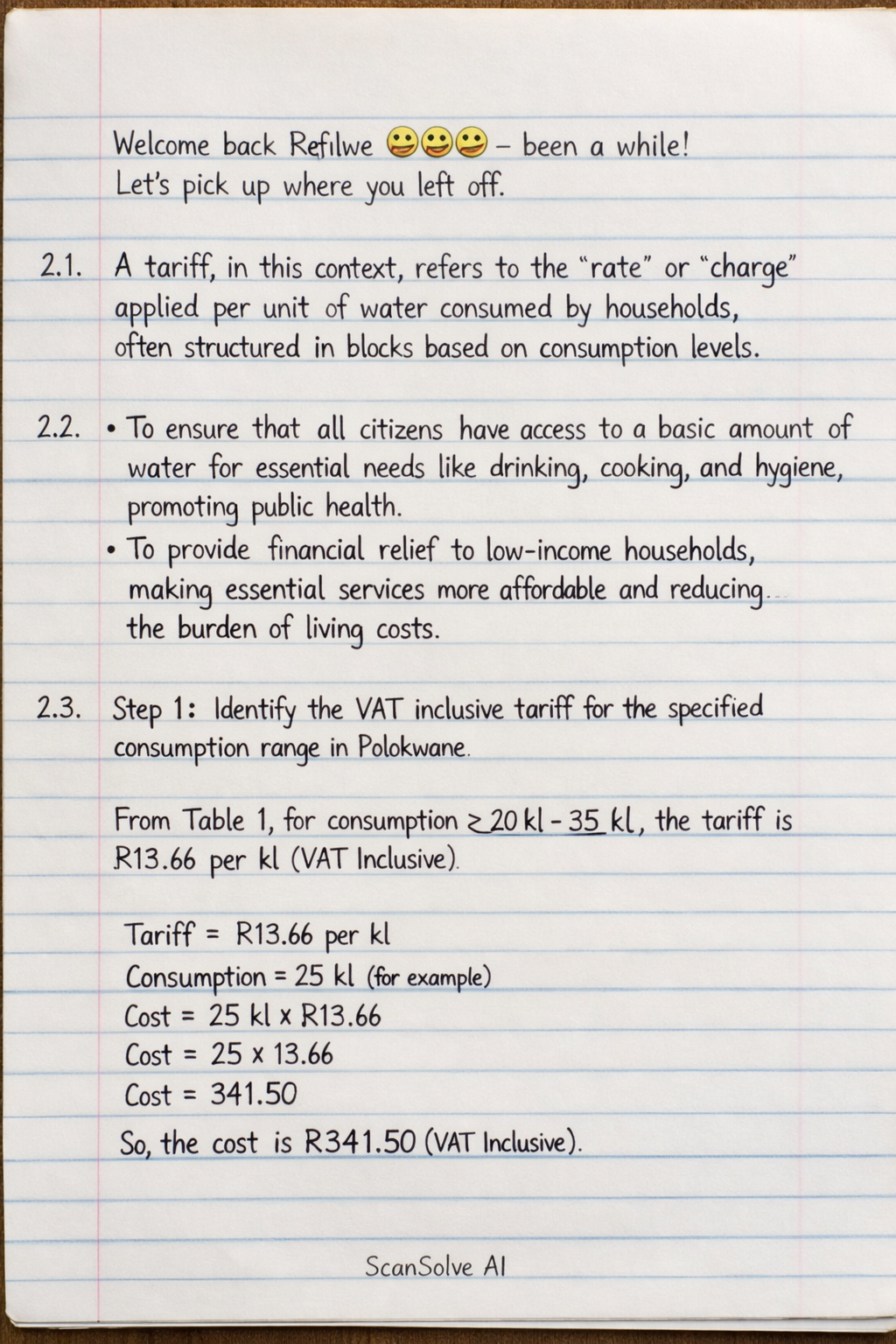
A tariff, in this context, refers to the rate or charge applied per unit of water consumed by households, often structured in blocks based on consumption levels.
Part 2.2
- To ensure that all citizens have access to a basic amount of water for essential needs like drinking, cooking, and hygiene, promoting public health.
- To provide financial relief to low-income households, making essential services more affordable and reducing the burden of living costs.
Part 2.3
Identify the VAT inclusive tariff for the specified consumption range in Polokwane.
From Table 1, for consumption , the tariff is R13.66 per kl (VAT Inclusive).
Calculate the tariff excluding VAT.
VAT is 15%. To exclude VAT, divide the VAT inclusive price by .
Rounding to two decimal places:
Part 2.4· 4 steps
Calculate the total cost (VAT exclusive) for 62 kl in Maruleng Municipality using Table 2.
- First 6 kl:
- Next 24 kl (from to ):
- Next 30 kl (from to ):
- Remaining 2 kl (from to ):
- Additional charge for using more than : R90.80
Sum the costs to get the total VAT exclusive amount.
Add VAT (15%) to the total VAT exclusive cost.
Rounding to two decimal places:
Compare the calculated amount with the amount Dr.
Khosa paid.
Dr. Khosa paid R619.92. The calculated correct amount is R610.49.
Since R619.92 R610.49, the municipality did not charge him correctly.The municipality charged Dr. Khosa incorrectly.
Try one yourself
A new problem that tests the same skill.
Still stuck on this one?
Ask a follow-up, and the answer starts from this question.
More Economics Questions
Handwritten Step-by-Step Solution
Get this as a handwritten image on WhatsApp — like a tutor wrote it for you.
Try on WhatsApp