

This economics question tests your understanding of economic models and analysis. The step-by-step answer below applies the relevant framework and explains the reasoning.
ScanSolve AI Answer
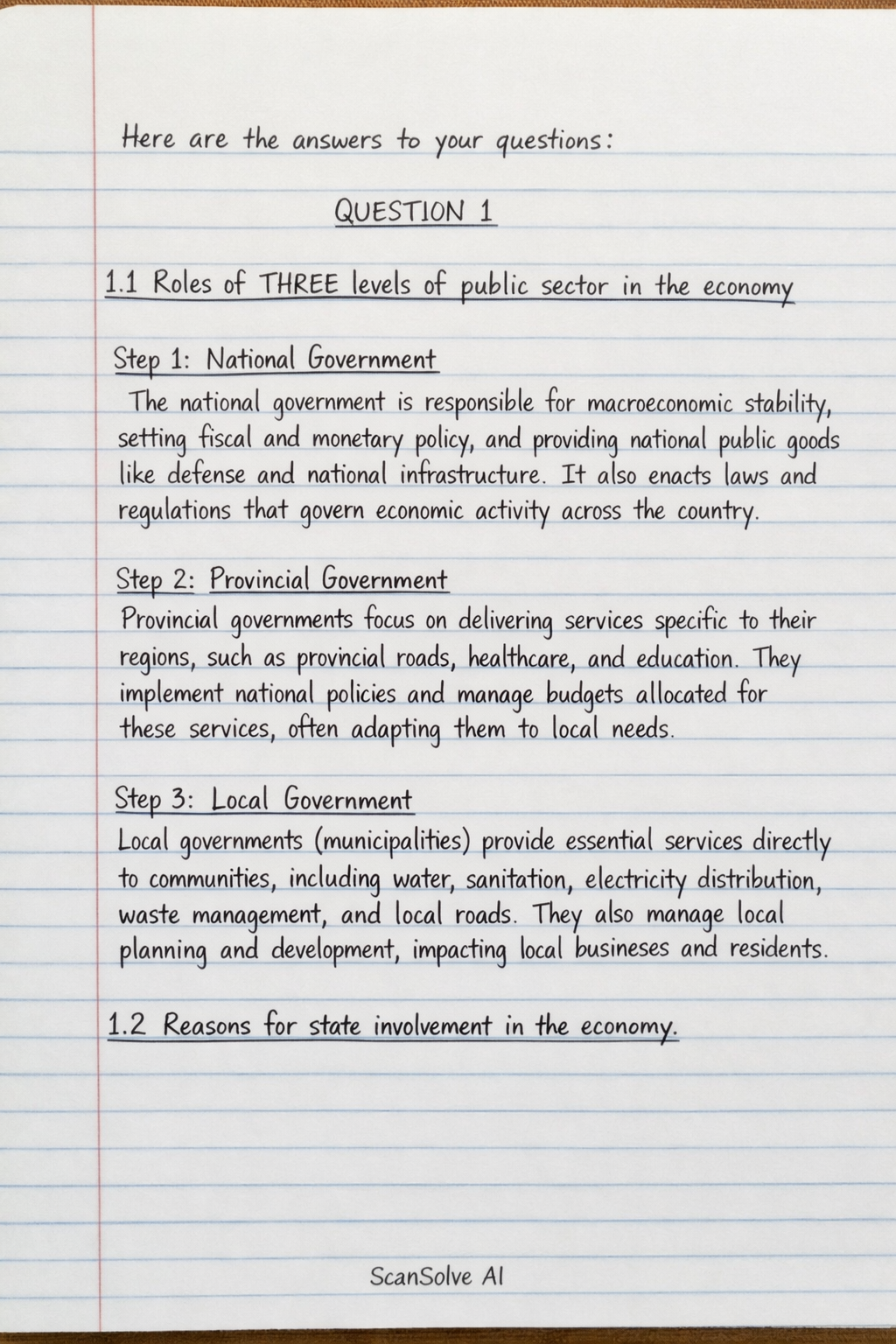
Here are the answers to your questions: QUESTION 1 1.1 Roles of THREE levels of public sector in the economy Step 1: National Government The national government is responsible for macroeconomic stability, setting fiscal and monetary policy, and providing national public goods like defense and national infrastructure. It also enacts laws and regulations that govern economic activity across the country. Step 2: Provincial Government Provincial governments focus on delivering services specific to their regions, such as provincial roads, healthcare, and education. They implement national policies and manage budgets allocated for these services, often adapting them to local needs. Step 3: Local Government Local governments (municipalities) provide essential services directly to communities, including water, sanitation, electricity distribution, waste management, and local roads. They also manage local planning and development, impacting local businesses and residents. 1.2 Reasons for state involvement in the economy Step 1: Market Failure The state intervenes to correct market failures, which occur when free markets fail to allocate resources efficiently. Examples include providing public goods (like streetlights or national defense) that the private sector wouldn't supply sufficiently, and addressing externalities such as pollution. Step 2: Income Redistribution Governments aim to reduce income inequality and poverty through various mechanisms like progressive taxation, social grants, and unemployment benefits. This ensures a basic standard of living for all citizens and promotes social cohesion. Step 3: Economic Stability and Growth The state uses fiscal and monetary policies to stabilize the economy, control inflation, reduce unemployment, and promote sustainable economic growth. This involves managing government spending, taxation, and interest rates to influence overall economic activity. Step 4: Regulation and Consumer Protection Governments regulate industries to prevent monopolies, ensure fair competition, and protect consumers from unsafe products or unfair business practices. This includes setting standards for product safety, environmental protection, and labor laws. QUESTION 2 2.1 Impact of maximum and minimum prices Product 1: Maximum Price (e.g., Rent Control) Step 1: Policy Description A maximum price, or price ceiling, is a legal limit on how high a price can be charged for a good or service. For example, rent control sets a maximum rent that landlords can charge for housing. This policy is typically implemented to make essential goods or services more affordable for consumers. Step 2: Graphical Representation On a supply and demand graph, a maximum price is set below the equilibrium price. This creates a situation where the quantity demanded exceeds the quantity supplied, leading to a shortage. The demand curve would intersect the price ceiling at a higher quantity than the supply curve. Step 3: Economic Impact The primary impact is a shortage of the product, as suppliers are less willing to produce at the lower price, while more consumers are willing to buy. This can lead to non-price rationing (e.g., waiting lists), reduced quality of goods, and the emergence of black markets where goods are sold illegally at higher prices. For example, rent control can lead to a lack of available housing and reduced maintenance by landlords. Product 2: Minimum Price (e.g., Agricultural Products like Maize) Step 1: Policy Description A minimum price, or price floor, is a legal limit on how low a price can be charged for a good or service. For example, governments might set a minimum price for agricultural products like maize to ensure farmers receive a stable and adequate income. Step 2: Graphical Representation On a supply and demand graph, a minimum price is set above the equilibrium price. This results in the quantity supplied exceeding the quantity demanded, leading to a surplus. The supply curve would intersect the price floor at a higher quantity than the demand curve. Step 3: Economic Impact The main impact is a surplus of the product, as producers are encouraged to supply more at the higher price, while consumers demand less. This can lead to government intervention to buy up the surplus (at taxpayer expense), storage costs, and potential waste. For example, a minimum price for maize could lead to large stockpiles of unsold grain and higher food prices for consumers. QUESTION 3 3.1 Effects of minimum wage policy Step 1: Definition and Intended Benefits Minimum wage is the lowest hourly, daily, or monthly remuneration that employers may legally pay to workers. Its primary goal is to reduce poverty, improve living standards for low-wage workers, and potentially boost aggregate demand as workers have more disposable income. Step 2: Potential Positive Effects For workers who retain their jobs, a minimum wage increase means higher income, which can reduce poverty and inequality. It may also increase worker morale and productivity, and reduce staff turnover, saving employers training costs. Step 3: Potential Negative Effects A significant concern is that a minimum wage set above the market equilibrium wage for unskilled labor can lead to job losses or reduced hiring, as businesses may cut staff or automate tasks to offset higher labor costs. It can also lead to higher prices for goods and services as businesses pass on increased labor costs to consumers, potentially contributing to inflation. 3.2 Impact of subsidies in the South African economy Step 1: Definition of Subsidies Subsidies are financial aid or support extended by a government to an economic sector (or institution, business, or individual) typically with the aim of promoting economic and social policy. They can take various forms, such as direct payments, tax breaks, or interest-free loans. Step 2: Intended Positive Impacts Subsidies can lower production costs for businesses, leading to lower prices for consumers and increased consumption of specific goods or services. They can also protect nascent industries, promote exports, encourage job creation, and ensure the provision of essential services. For example, agricultural subsidies in South Africa aim to support food security and farmer livelihoods. Step 3: Real-Life Examples in South Africa • Agricultural Subsidies: The South African government provides various forms of support to farmers, including input subsidies (e.g., for fertilizers or seeds) and drought relief, to ensure food security and maintain rural employment. • Public Transport Subsidies: Commuter rail (e.g., Metrorail) and bus services receive subsidies to keep fares affordable for low-income commuters, making transport accessible and reducing traffic congestion. • Industrial Development Subsidies: Programs like the Manufacturing Incentive Programme (MIP) or the Critical Infrastructure Programme (CIP) offer grants and tax incentives to encourage investment, innovation, and job creation in specific industrial sectors. Step 4: Potential Negative Impacts While beneficial, subsidies can be costly to taxpayers and may lead to market distortions by artificially supporting inefficient industries. They can also create dependency, discourage innovation, and lead to trade disputes if they give domestic industries an unfair advantage over international competitors. Send me the next one 📸