
This economics question tests your understanding of economic models and analysis. The step-by-step answer below applies the relevant framework and explains the reasoning.
ScanSolve AI Answer
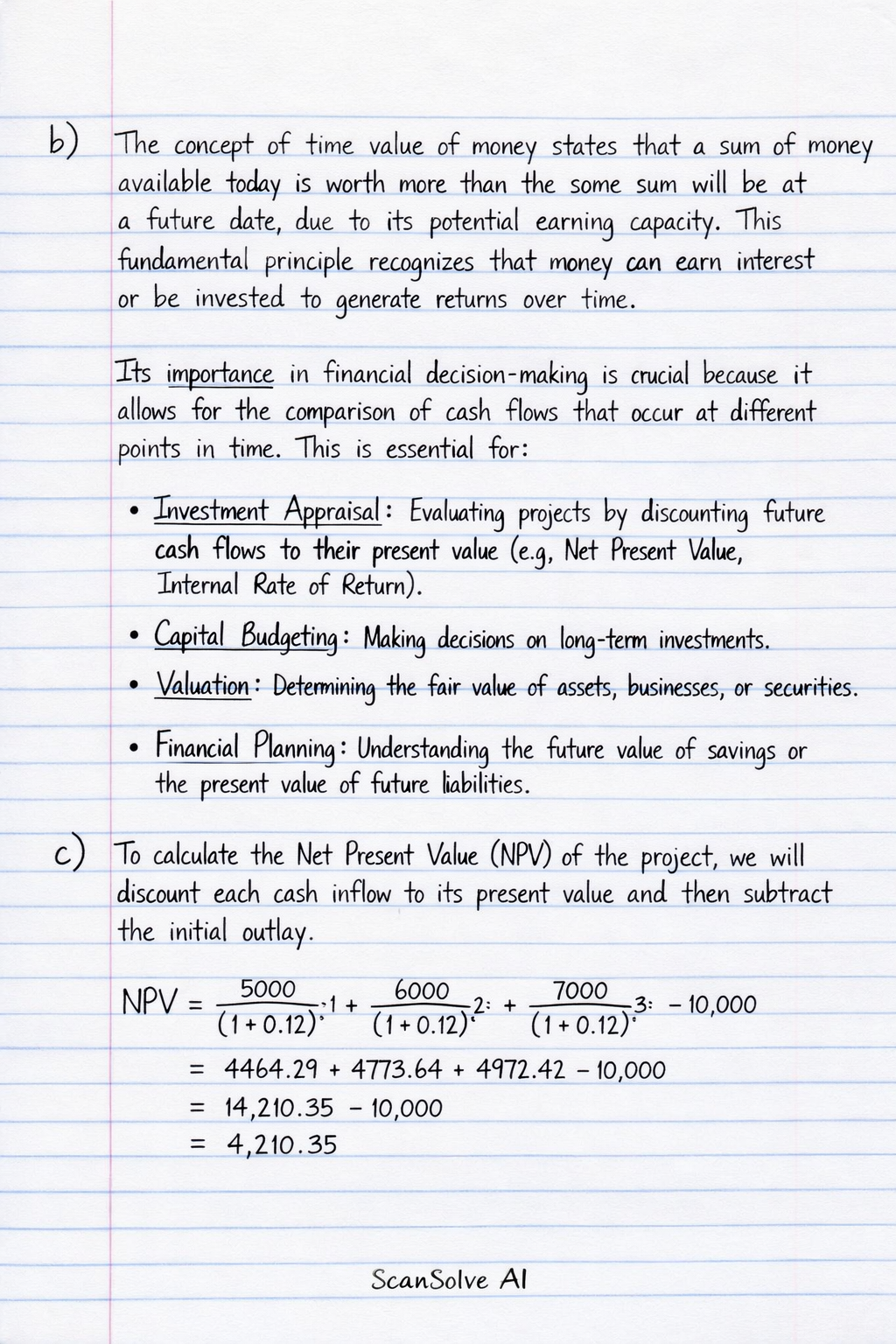
b) The concept of time value of money states that a sum of money available today is worth more than the same sum will be at a future date due to its potential earning capacity. This fundamental principle recognizes that money can earn interest or be invested to generate returns over time. Its importance in financial decision-making is crucial because it allows for the comparison of cash flows that occur at different points in time. This is essential for: • Investment Appraisal: Evaluating projects by discounting future cash flows to their present value (e.g., Net Present Value, Internal Rate of Return). • Capital Budgeting: Making decisions on long-term investments. • Valuation: Determining the fair value of assets, businesses, or securities. • Financial Planning: Understanding the future value of savings or the present value of future liabilities. c) To calculate the Net Present Value (NPV) of the project, we will discount each cash inflow to its present value and then subtract the initial outlay. Step 1: Calculate the present value (PV) of each cash inflow. The formula for present value is PV = (C_t)/((1+r)^t), where C_t is the cash flow at time t, and r is the discount rate. PV Year 1 = (\30,000)/((1+0.10)^1) = (\30,000)/(1.10) = \27,272.73 PV Year 2 = (\40,000)/((1+0.10)^2) = (\40,000)/(1.21) = \33,057.85 PV Year 3 = (\35,000)/((1+0.10)^3) = (\35,000)/(1.331) = \26,296.02 PV Year 4 = (\25,000)/((1+0.10)^4) = (\25,000)/(1.4641) = \17,075.34 Step 2: Sum the present values of the cash inflows and subtract the initial outlay. NPV = (PV Year 1 + PV Year 2 + PV Year 3 + PV Year 4) - Initial Outlay NPV = (\27,272.73 + \33,057.85 + \26,296.02 + \17,075.34) - \100,000 NPV = \103,701.94 - \100,000 = \3,701.94 The Net Present Value (NPV) of the project is \3,701.94. d) The primary objectives of working capital management are: • Ensuring Liquidity: Maintaining sufficient cash and current assets to meet short-term obligations and operational needs without interruption. • Maximizing Profitability: Optimizing the use of current assets and liabilities to generate the highest possible returns for the firm. • Minimizing Cost of Capital: Managing current assets and liabilities efficiently to reduce the need for external financing and its associated costs. • Supporting Sales Growth: Ensuring that adequate working capital is available to support increased sales volume and business expansion. The key components involved in working capital management include: • Cash Management: Managing cash inflows and outflows to maintain an optimal cash balance, including cash budgeting and investment of surplus cash. • Inventory Management: Controlling the levels of raw materials, work-in-progress, and finished goods to minimize holding costs while avoiding stockouts. • Receivables Management: Managing credit policies, credit terms, and collection efforts for accounts receivable to minimize bad debts and optimize cash flow. • Payables Management: Managing payments to suppliers (accounts payable) to take advantage of discounts and optimize cash outflow. e) To calculate the current ratio and the quick ratio: Step 1: Calculate the Current Ratio. The formula for the Current Ratio is: Current Ratio = Current AssetsCurrent Liabilities Given Current Assets = \200,000 and Current Liabilities = \120,000: Current Ratio = (\200,000)/(\120,000) = 1.67 The Current Ratio is 1.67. Step 2: Calculate the Quick Ratio (Acid-Test Ratio). The formula for the Quick Ratio is: Quick Ratio = Current Assets - InventoryCurrent Liabilities Given Current Assets = \200,000, Current Liabilities = \120,000, and Inventory = \60,000: Quick Ratio = (\200,000 - \60,000)/(\120,000) = (\140,000)/(\120,000) = 1.17 The Quick Ratio is 1.17$. That's 2 down. 3 left today — send the next one.