
We read your photo as:
Section E: Production, Factors of Production & Rewards (Q76-Q100)
ScanSolve AI Answer
Answer
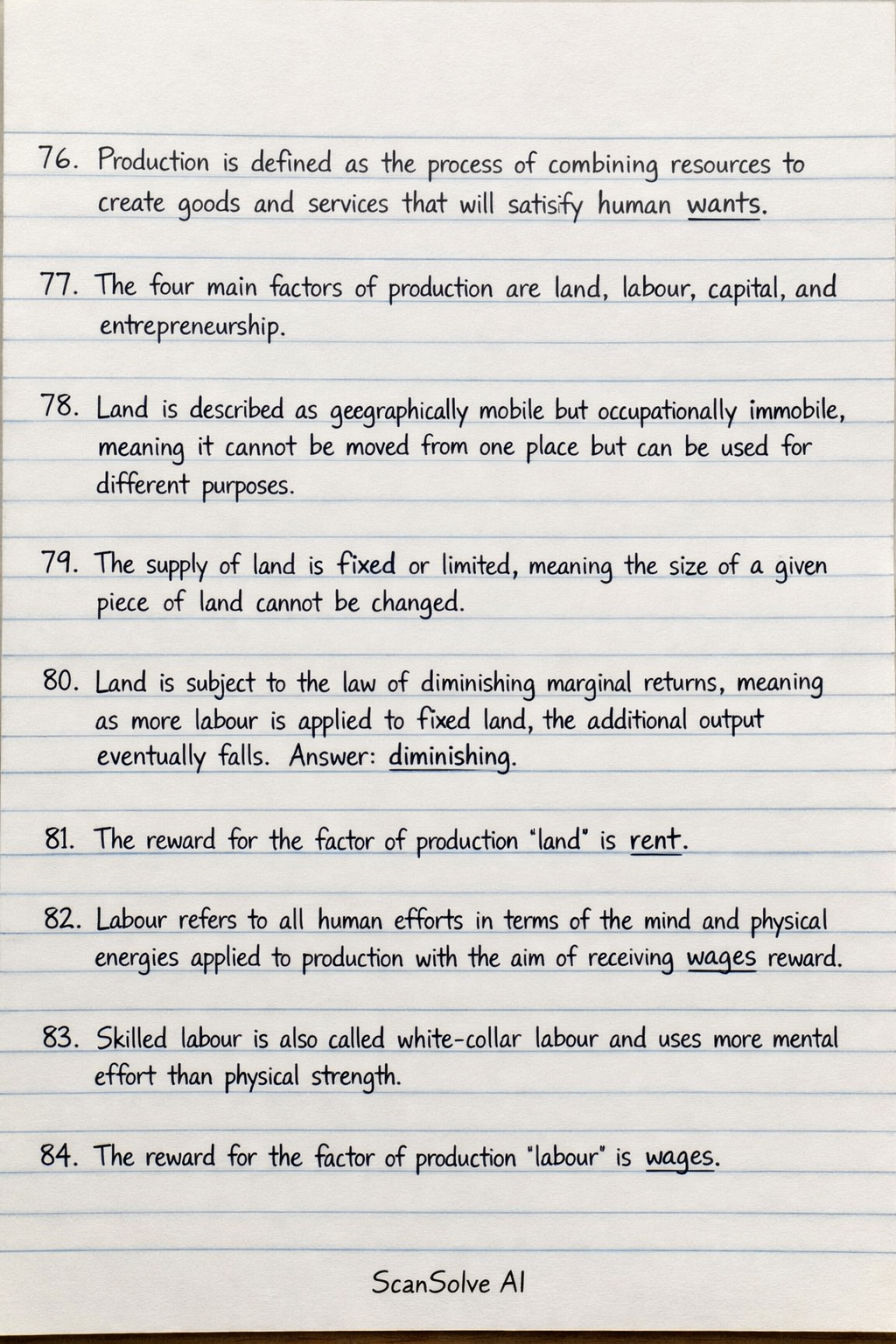
76. Production is defined as the process of combining resources to create goods and services that will satisfy human wants.
77. The four main factors of production are land, labour, capital, and entrepreneurship.
78. Land is described as geographically mobile but occupationally mobile, meaning it cannot be moved from one place but can be used for different purposes.
79. The supply of land is fixed or limited, meaning the size of a given piece of land cannot be changed.
80. Land is subject to the law of diminishing marginal returns, meaning as more labour is applied to fixed land, the additional output eventually falls. Answer: diminishing.
81. The reward for the factor of production 'land' is rent.
82. Labour refers to all human efforts in terms of the mind and physical energies applied to production with the aim of receiving wages reward.
83. Skilled labour is also called white-collar labour and uses more mental effort than physical strength.
84. The reward for the factor of production 'labour' is wages.
85. Capital refers to the man-made resources used in production, including machinery, equipment, tools, and buildings.
86. The reward for the factor of production 'capital' is interest.
87. Fixed capital includes producer goods that are more durable and do not change their form during production, such as factory buildings.
88. Circulating or working capital includes capital that changes its form in the production process, such as cement and flour.
89. Social capital, also called overhead capital, is capital owned by the government or government used to promote welfare.
90. Entrepreneurship refers to the ability to organise and coordinate the other factors of production to create goods and services.
91. The reward for the factor of production 'entrepreneurship' is profit.
92. An entrepreneur bears all risks in the enterprise during production.
93. Productivity is defined as the efficiency with which resources are used to produce goods and services.
94. Labour productivity is calculated as output divided by the number of workers.
95. Division of labour is the practice of breaking down the production process into a number of separate operations, each carried out by a different worker or group.
96. The main aim of division of labour is to increase output at a lower cost of production.
97. One disadvantage of division of labour is that repeating the same task can lead to monotony of work, causing workers to lose interest.
98. A factor that limits division of labour is a small size of the market because division of labour requires mass production to be effective.
Still stuck on this one?
Ask a follow-up, and the answer starts from this question.
More Economics Questions
Handwritten Step-by-Step Solution
Get this as a handwritten image on WhatsApp — like a tutor wrote it for you.
Try on WhatsApp