
We read your photo as:
Describe the stages of the economic cycle and their characteristics.
ScanSolve AI Answer
Answer
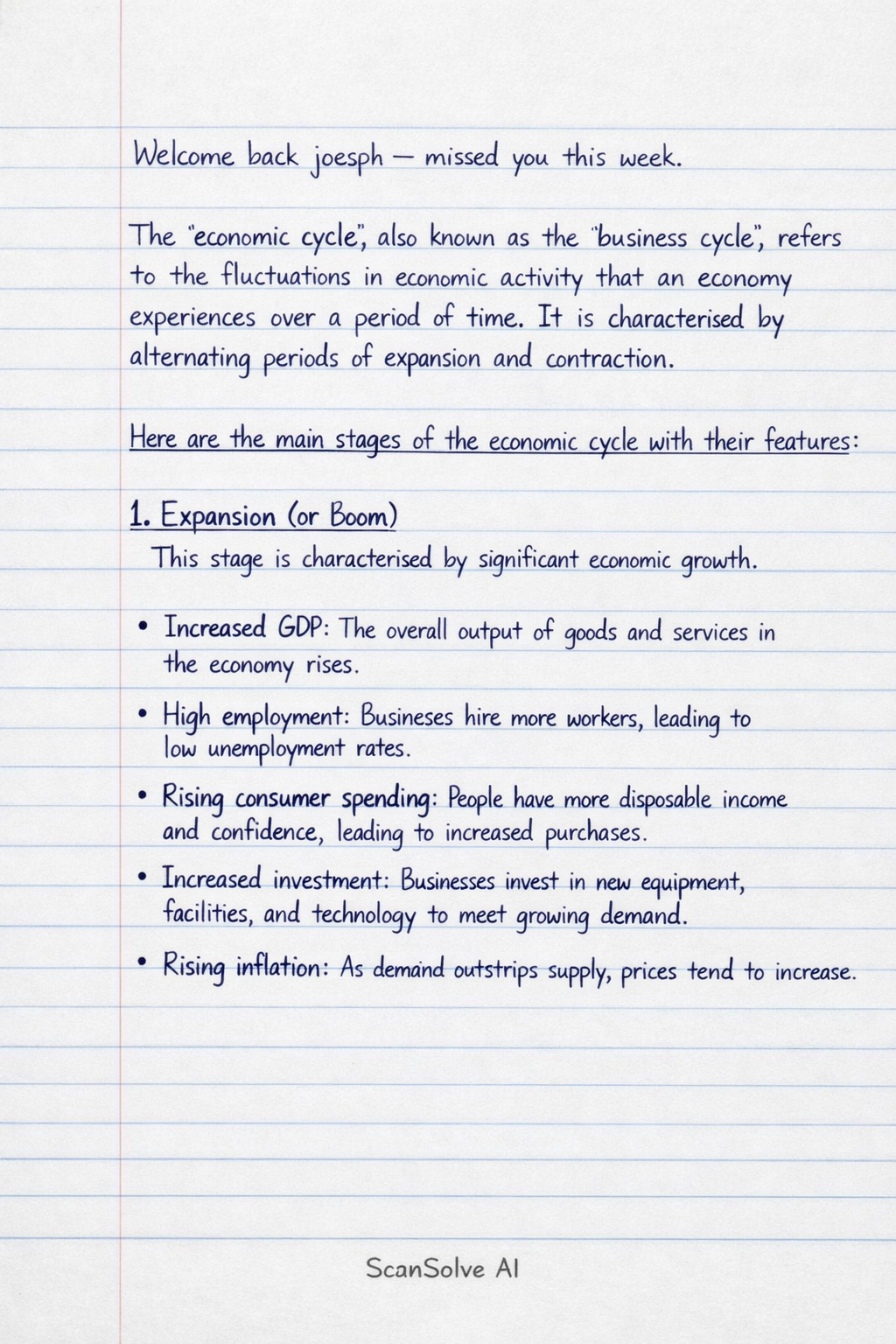
The economic cycle, also known as the business cycle, refers to the fluctuations in economic activity that an economy experiences over a period of time. It is characterized by alternating periods of expansion and contraction.
Here are the main stages of the economic cycle with their features:
-
1. Expansion (or Boom) This stage is characterized by significant economic growth.
- Increased GDP: The overall output of goods and services in the economy rises.
- High employment: Businesses hire more workers, leading to low unemployment rates.
- Rising consumer spending: People have more disposable income and confidence, leading to increased purchases.
- Increased investment: Businesses invest in new equipment, facilities, and technology to meet growing demand.
- Rising inflation: As demand outstrips supply, prices tend to increase.
-
2. Peak The peak is the highest point of the economic expansion, where economic activity reaches its maximum.
- Maximum GDP: The economy is producing at or near its full capacity.
- Full employment: Unemployment is at its lowest possible level.
- High inflation: Prices are rising rapidly, and there might be concerns about overheating.
- High interest rates: Central banks may raise rates to curb inflation.
- Overconfidence: Businesses and consumers might become overly optimistic, leading to speculative investments.
-
3. Contraction (or Recession) This stage follows the peak and is marked by a general slowdown in economic activity.
- Decreased GDP: Economic output declines for two consecutive quarters or more.
- Rising unemployment: Businesses cut back on production and lay off workers.
- Decreased consumer spending: People become more cautious, reducing purchases.
- Reduced investment: Businesses postpone or cancel expansion plans.
- Deflationary pressures: Prices may stabilize or even fall due to reduced demand.
-
4. Trough The trough is the lowest point of the economic contraction, marking the end of a recession and the beginning of recovery.
- Minimum GDP: Economic activity is at its lowest point.
- High unemployment: Unemployment rates are at their highest.
- Low consumer confidence: Consumers are pessimistic about the future.
- Low investment: Businesses are reluctant to invest due to uncertainty.
- Low inflation or deflation: Prices are stable or falling, and interest rates are typically low to stimulate the economy.
Still stuck on this one?
Ask a follow-up, and the answer starts from this question.
More Economics Questions
Handwritten Step-by-Step Solution
Get this as a handwritten image on WhatsApp — like a tutor wrote it for you.
Try on WhatsApp