

This economics question tests your understanding of economic models and analysis. The step-by-step answer below applies the relevant framework and explains the reasoning.
ScanSolve AI Answer
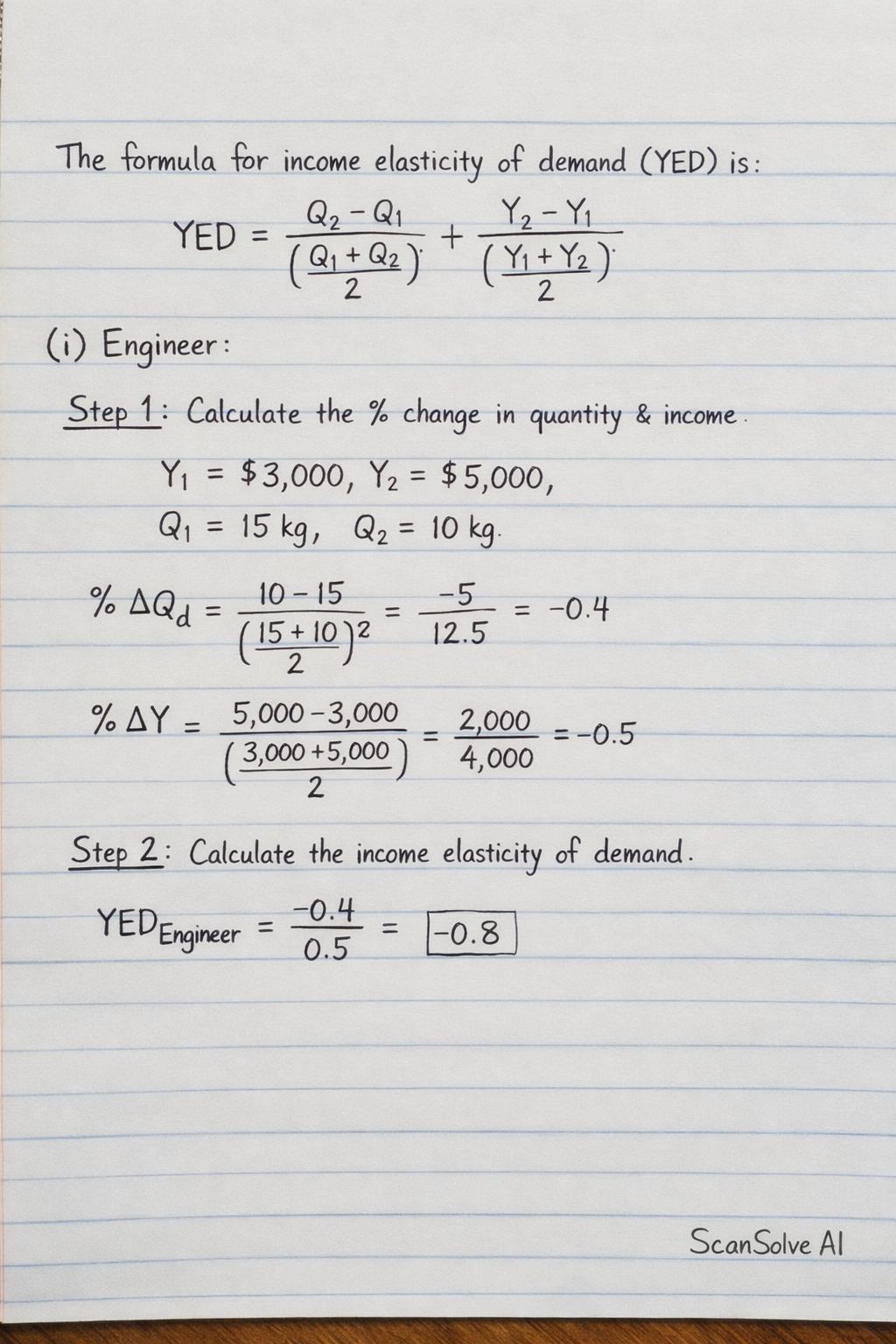
a) The formula for income elasticity of demand (YED) is: YED = (Q_2 - Q_1)/((Q_1 + Q_2)/2)(Y_2 - Y_1)/((Y_1 + Y_2)/2) Where Q_1 and Q_2 are old and new quantities demanded, and Y_1 and Y_2 are old and new incomes. (i) Engineer: Step 1: Calculate the percentage change in quantity demanded and income. Y_1 = \3,000, Y_2 = \5,000 Q_1 = 15 kg, Q_2 = 10 kg \% Q_d = (10 - 15)/((15 + 10)/2) = (-5)/(12.5) = -0.4 \% Y = (5,000 - 3,000)/((3,000 + 5,000)/2) = (2,000)/(4,000) = 0.5 Step 2: Calculate the income elasticity of demand. YED_Engineer = (-0.4)/(0.5) = -0.8 (ii) Nurse: Step 1: Calculate the percentage change in quantity demanded and income. Y_1 = \2,500, Y_2 = \4,000 Q_1 = 8 kg, Q_2 = 12 kg \% Q_d = (12 - 8)/((8 + 12)/2) = (4)/(10) = 0.4 \% Y = (4,000 - 2,500)/((2,500 + 4,000)/2) = (1,500)/(3,250) = (6)/(13) ≈ 0.4615 Step 2: Calculate the income elasticity of demand. YED_Nurse = (0.4)/(6/13) = (0.4 × 13)/(6) = (5.2)/(6) = (13)/(15) ≈ 0.87 b) (i) Engineer: Since the income elasticity of demand is negative (-0.8), wheat is an inferior good to the Engineer. (ii) Nurse: Since the income elasticity of demand is positive (0.87) and less than 1, wheat is a normal good (specifically, a necessity) to the Nurse. c) (i) Engineer: Wheat is an inferior good to the Engineer because as the Engineer's income increased, the quantity of wheat demanded decreased. Consumers typically reduce their consumption of inferior goods when their income rises, opting for higher-quality alternatives. (ii) Nurse: Wheat is a normal good to the Nurse because as the Nurse's income increased, the quantity of wheat demanded also increased. Consumers typically increase their consumption of normal goods as their income rises. d) (i) Engineer: Step 1: Calculate the average tax rate for old and new incomes. Old income: \3,000, tax rate 15\%. Tax paid: \3,000 × 0.15 = \450. Average tax rate: (\450)/(\3,000) × 100\% = 15\%. New income: \5,000, tax rate 10\%. Tax paid: \5,000 × 0.10 = \500. Average tax rate: (\500)/(\5,000) × 100\% = 10\%. Step 2: Identify the system of taxation. As the Engineer's income increased from \3,000 to \5,000, the average tax rate decreased from 15\% to 10\%. This indicates a regressive tax system. Reason: In a regressive tax system, the average tax rate decreases as income increases. (ii) Nurse: Step 1: Calculate the average tax rate for old and new incomes. Old income: \2,500, tax rate 8\%. Tax paid: \2,500 × 0.08 = \200. Average tax rate: (\200)/(\2,500) × 100\% = 8\%. New income: \4,000, tax rate 10\%. Tax paid: \4,000 × 0.10 = \400. Average tax rate: (\400)/(\4,000) × 100\% = 10\%. Step 2: Identify the system of taxation. As the Nurse's income increased from \2,500 to \4,000, the average tax rate increased from 8\% to 10\%. This indicates a progressive tax system. Reason: In a progressive tax system, the average tax rate increases as income increases. That's 2 down. 3 left today — send the next one.