

This economics question tests your understanding of economic models and analysis. The step-by-step answer below applies the relevant framework and explains the reasoning.
ScanSolve AI Answer
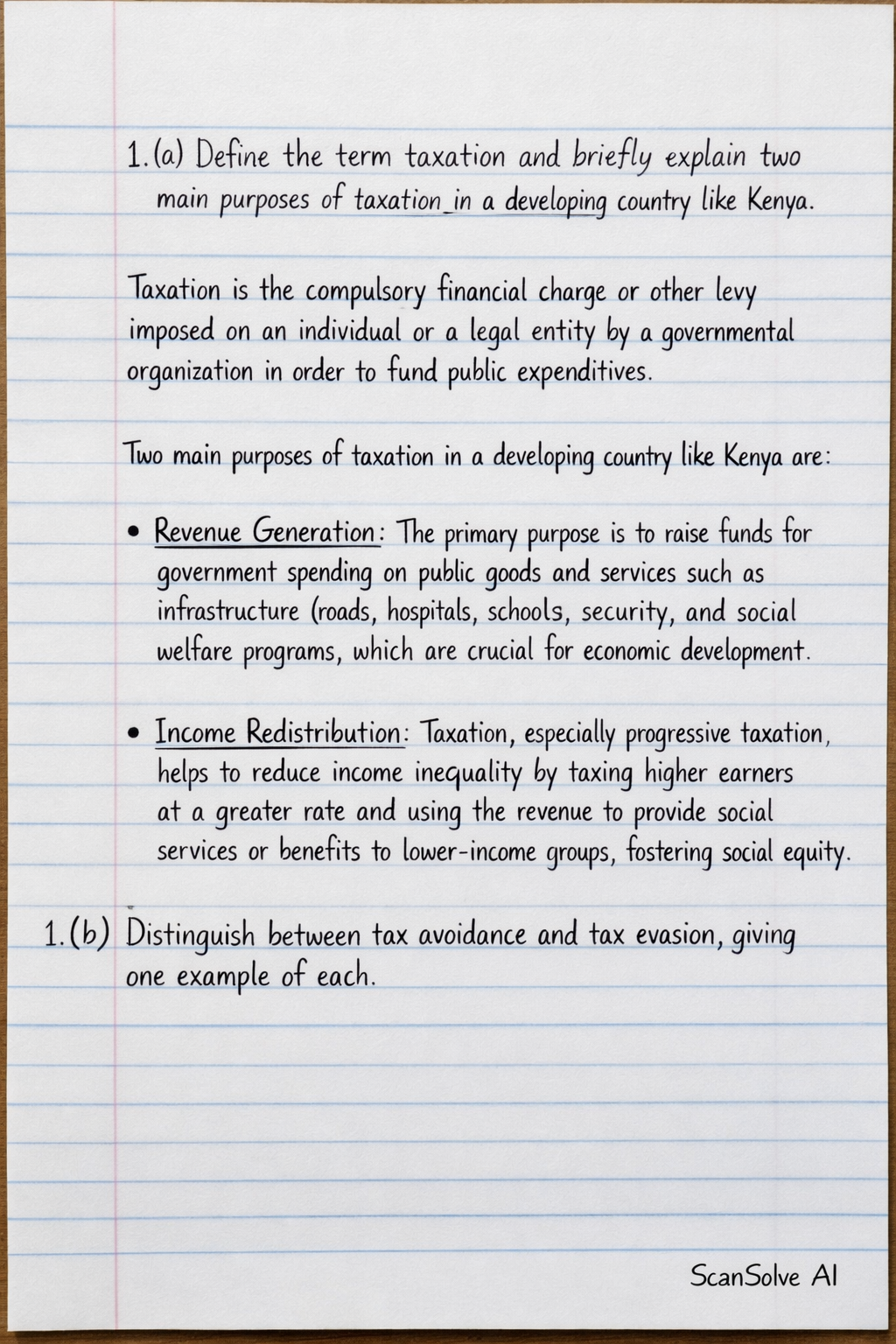
1. (a) Define the term taxation and briefly explain two main purposes of taxation in a developing country like Kenya. Taxation is the compulsory financial charge or other levy imposed on an individual or a legal entity by a governmental organization in order to fund public expenditures. Two main purposes of taxation in a developing country like Kenya are: Revenue Generation: The primary purpose is to raise funds for government spending on public goods and services such as infrastructure (roads, hospitals, schools), security, and social welfare programs, which are crucial for economic development. Income Redistribution: Taxation, especially progressive taxation, helps to reduce income inequality by taxing higher earners at a greater rate and using the revenue to provide social services or benefits to lower-income groups, fostering social equity. 1. (b) Distinguish between tax avoidance and tax evasion, giving one example of each. Tax Avoidance: This is the legal act of minimizing tax liability by taking advantage of loopholes, deductions, exemptions, and incentives within the tax law. It involves structuring financial affairs in a way that reduces the amount of tax legally owed. Example:* Investing in a tax-advantaged retirement savings plan or making charitable donations that are tax-deductible. Tax Evasion: This is the illegal act of deliberately misrepresenting or concealing financial information from tax authorities to avoid paying taxes. It involves breaking tax laws to reduce or eliminate tax obligations. Example:* Failing to declare all income earned from a business or employment, or claiming false deductions. 2. (a) Briefly describe the role of the Kenya Revenue Authority (KRA) in the administration of tax in Kenya. The Kenya Revenue Authority (KRA) is the principal revenue collector for the Government of Kenya. Its main role is to assess, collect, and account for all revenues due to the government, in accordance with the tax laws and regulations. KRA also advises the government on matters concerning the administration of and collection of taxes, facilitates legitimate trade, and enforces compliance to ensure fairness and equity in the tax system. 2. (b) Explain two major tax incentives available to companies operating within Export Processing Zones (EPZs). Companies operating within Export Processing Zones (EPZs) in Kenya benefit from several tax incentives designed to promote export-oriented investment and employment. Two major incentives are: 10-Year Tax Holiday: EPZ enterprises are granted a 10-year corporate income tax holiday, meaning they are exempt from paying corporate income tax for the first ten years of operation. After this period, a reduced corporate tax rate of 25% applies. Exemption from Customs and Excise Duties: EPZ enterprises are exempt from customs duties, value-added tax (VAT), and excise duties on imported raw materials, machinery, and other inputs used directly in the production of goods for export. This reduces their production costs and enhances their competitiveness in international markets. 3. Identify and briefly explain three canons (principles) of a good taxation system as advocated by Adam Smith. Adam Smith, in his book "The Wealth of Nations," laid down four canons of taxation. Three of them are: Canon of Equality (Equity): This principle states that individuals should contribute to the support of the government in proportion to their respective abilities, meaning in proportion to the revenue which they enjoy under the protection of the state. It advocates for fairness in taxation, often interpreted as progressive taxation. Canon of Certainty: The tax that each individual is bound to pay ought to be certain, and not arbitrary. The time of payment, the manner of payment, the quantity to be paid, ought all to be clear and plain to the contributor, and to every other person. This ensures transparency and predictability in the tax system. Canon of Convenience: Every tax ought to be levied at the time, or in the manner, which is most likely to be convenient for the contributor to pay it. For example, income tax is often deducted at source (PAYE) when income is received, making it convenient for taxpayers. 4. (a) Discuss any two measures the Kenyan government uses to combat tax evasion. The Kenyan government employs various measures to combat tax evasion: Enhanced Technology and Data Analytics: KRA has invested in advanced technological systems, such as iTax, which allows for online filing and payment of taxes, and integrates data from various sources (e.g., banks, land registries, customs). This enables cross-referencing of information to identify discrepancies and potential evasion. Stricter Enforcement and Penalties: The government has strengthened its enforcement mechanisms, including conducting audits, investigations, and prosecutions of tax evaders. Stiff penalties, fines, and even imprisonment are imposed on individuals and businesses found guilty of tax evasion, acting as a deterrent. 4. (b) Highlight two common types of tax fraud in Kenya's customs and excise system. Two common types of tax fraud in Kenya's customs and excise system are: Under-declaration of Value/Quantity: Importers or exporters deliberately declare a lower value or quantity of goods than the actual amount to reduce the amount of customs duties, VAT, or excise taxes payable. This leads to significant revenue loss for the government. Misclassification of Goods: Goods are intentionally classified under a tariff code that attracts lower customs duties or is exempt from certain taxes, even though their true nature falls under a higher-taxed category. This fraudulent practice aims to circumvent higher tax obligations. 5. (a) Outline the structure and mandate of the Tax Appeals Tribunal in resolving tax disputes. The Tax Appeals Tribunal (TAT) in Kenya is an independent quasi-judicial body established under the Tax Appeals Tribunal Act. Structure: The TAT consists of a Chairperson and several members, all appointed by the President. The members typically have expertise in law, accounting, economics, or taxation. It operates independently of the Kenya Revenue Authority (KRA). Mandate: The primary mandate of the TAT is to hear and determine appeals arising from tax decisions made by the Commissioner of the KRA. When a taxpayer is aggrieved by an assessment or decision by the KRA, they can appeal to the TAT. The Tribunal reviews the facts and legal arguments presented by both the taxpayer and the KRA, and then issues a binding decision. Its role is to provide an impartial and accessible forum for resolving tax disputes, ensuring fairness and adherence to tax laws. Last free one today — make it count tomorrow, or type /upgrade for unlimited.