
We read your photo as:
Explain the term 'market' and calculate government costs related to price controls and elasticity of demand for bread, using data from Table 2.
ScanSolve AI Answer
Answer
Step-by-step solution
8 stepsPart 5
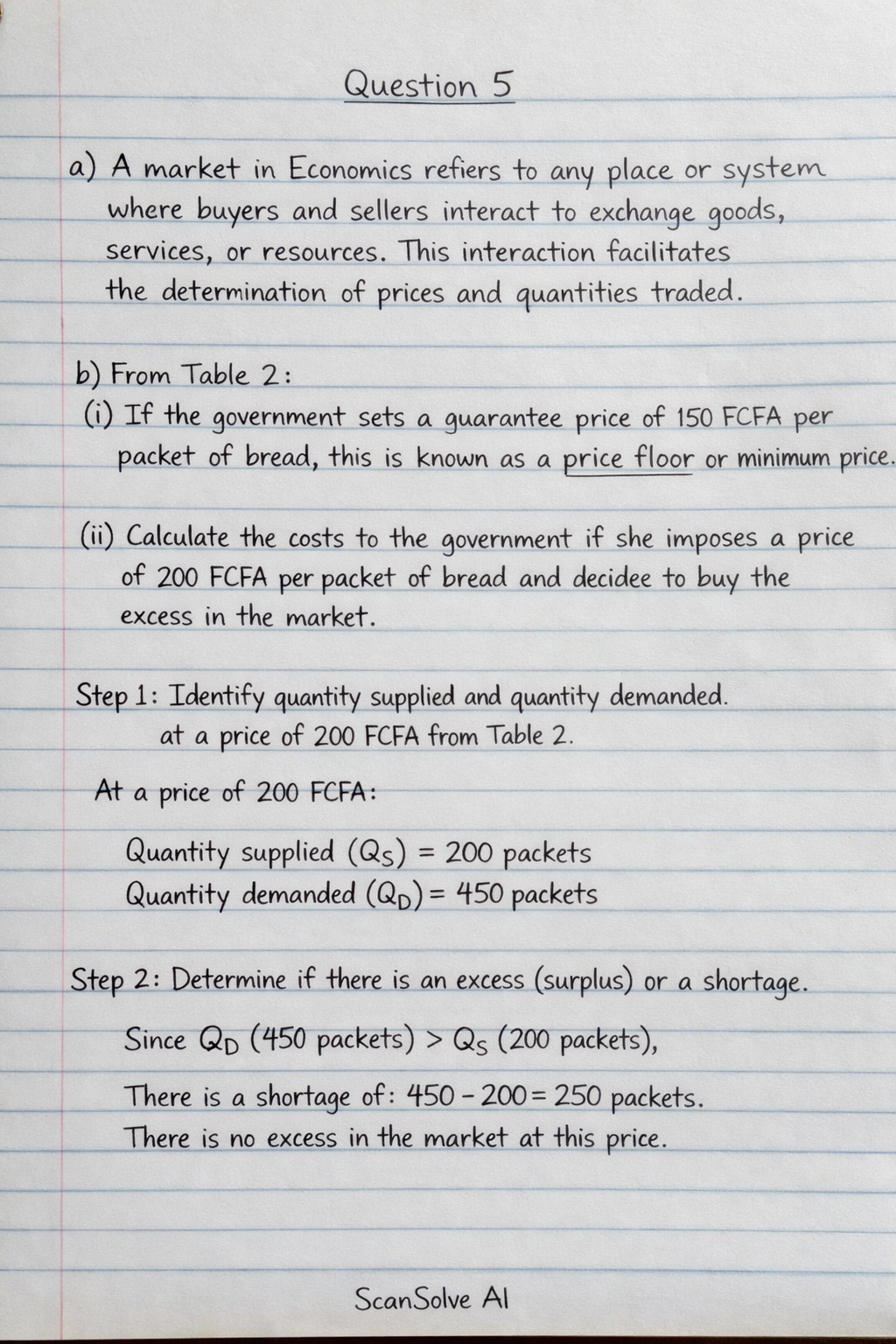
a) A market in Economics refers to any place or system where buyers and sellers interact to exchange goods, services, or resources. This interaction facilitates the determination of prices and quantities traded.
Part b
From Table 2
-
i) If the government sets a guarantee price of 150 FCFA per packet of bread, this is known as a price floor or minimum price.
-
ii) Calculate the costs to the government, if she imposes a price of 200 FCFA per packet of bread and decides to buy the excess in the market.
Identify quantity supplied and quantity demanded at a price of 200 FCFA from Table 2.
At a price of 200 FCFA: Quantity supplied ($Q_S$) = 200 packets Quantity demanded ($Q_D$) = 450 packetsDetermine if there is an excess (surplus) or a shortage.
Since $Q_D$ (450 packets) is greater than $Q_S$ (200 packets), there is a shortage of $450 - 200 = 250$ packets. There is no excess in the market at this price.Calculate the cost to the government for buying the excess.
As there is no excess to buy, the cost to the government is 0 FCFA. The cost to the government is $\boxed{\text{0 FCFA}}$.- iii) Calculate the price elasticity of demand if price of bread falls from 250 FCFA to 200 FCFA per packet and identify whether it is elastic or inelastic.
Identify initial and final prices and quantities demanded from Table 2.
Initial Price ($P_1$) = 250 FCFA Final Price ($P_2$) = 200 FCFA Initial Quantity Demanded ($Q_1$) = 300 packets (at 250 FCFA) Final Quantity Demanded ($Q_2$) = 450 packets (at 200 FCFA)Calculate the percentage change in quantity demanded using the midpoint formula.
$$ \Delta Q = Q_2 - Q_1 = 450 - 300 = 150 $$ $$ \text{Average } Q = \frac{Q_1 + Q_2}{2} = \frac{300 + 450}{2} = \frac{750}{2} = 375 $$ $$ \% \Delta Q_D = \frac{\Delta Q}{\text{Average } Q} = \frac{150}{375} = 0.4 $$Calculate the percentage change in price using the midpoint formula.
$$ \Delta P = P_2 - P_1 = 200 - 250 = -50 $$ $$ \text{Average } P = \frac{P_1 + P_2}{2} = \frac{250 + 200}{2} = \frac{450}{2} = 225 $$ $$ \% \Delta P = \frac{\Delta P}{\text{Average } P} = \frac{-50}{225} \approx -0.2222 $$Calculate the price elasticity of demand ().
$$ PED = \frac{\% \Delta Q_D}{\% \Delta P} = \frac{0.4}{-0.2222} \approx -1.80 $$Determine if the demand is elastic or inelastic.
The absolute value of the price elasticity of demand is $|-1.80| = 1.80$.
Since $|PED| > 1$, the demand is **elastic**.

The price elasticity of demand is approximately $\boxed{-1.80}$.
The demand is **elastic**.
Try one yourself
A new problem that tests the same skill.
Still stuck on this one?
Ask a follow-up, and the answer starts from this question.
More Economics Questions
Handwritten Step-by-Step Solution
Get this as a handwritten image on WhatsApp — like a tutor wrote it for you.
Try on WhatsApp