
We read your photo as:
What are the different types of demand, and provide examples for each?
ScanSolve AI Answer
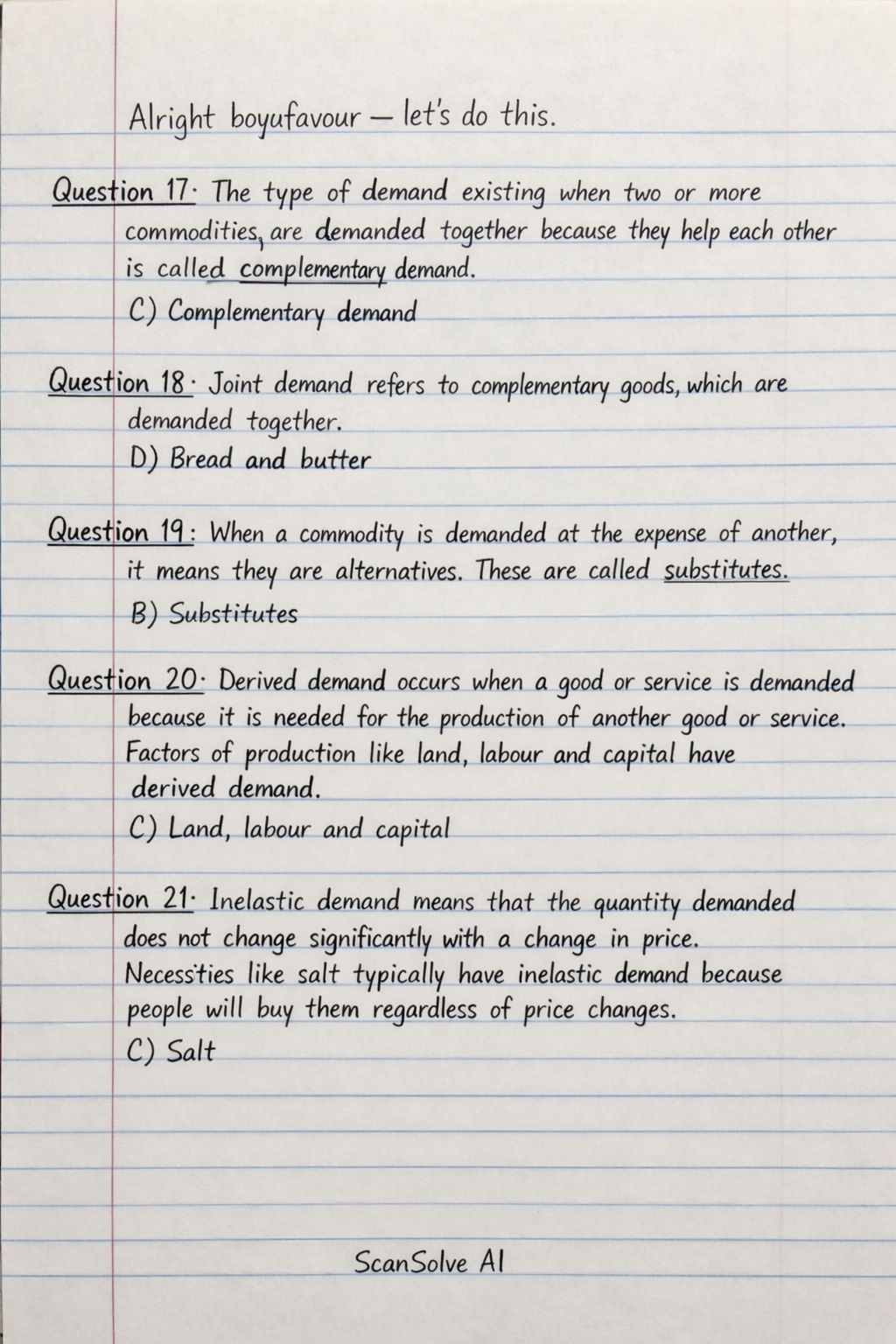
Question 17: The type of demand existing when two or more commodities are demanded together because they help each other is called complementary demand.
- C) Complementary demand
Question 18: Joint demand refers to complementary goods, which are demanded together.
- D) Bread and butter
Question 19: When a commodity is demanded at the expense of another, it means they are alternatives. These are called substitutes.
- B) Substitutes
Question 20: Derived demand occurs when a good or service is demanded because it is needed for the production of another good or service. Factors of production like land, labour, and capital have derived demand.
- C) Land, labour and capital
Question 21: Inelastic demand means that the quantity demanded does not change significantly with a change in price. Necessities like salt typically have inelastic demand because people will buy them regardless of price changes.
- C) Salt
Question 22: If the quantity demanded of a commodity remains the same regardless of its price, the demand is perfectly inelastic.
- C) Perfect inelastic
Question 23: For perfectly inelastic demand, the Price Elasticity of Demand (PED) is equal to 0, because there is no change in quantity demanded even with a change in price.
- A) PED = 0
Question 24: Minimum prices (price floors) are set above the equilibrium price, typically to ensure that producers receive a higher price for their goods. Therefore, producers stand to gain most.
- A) Producers
Still stuck on this one?
Ask a follow-up, and the answer starts from this question.
More Economics Questions
Handwritten Step-by-Step Solution
Get this as a handwritten image on WhatsApp — like a tutor wrote it for you.
Try on WhatsApp