
We read your photo as:
What are the key features and objectives of the Non-Aligned Movement, COMESA, SADC, and AMU?
ScanSolve AI Answer
Here are notes on the topics from your image:
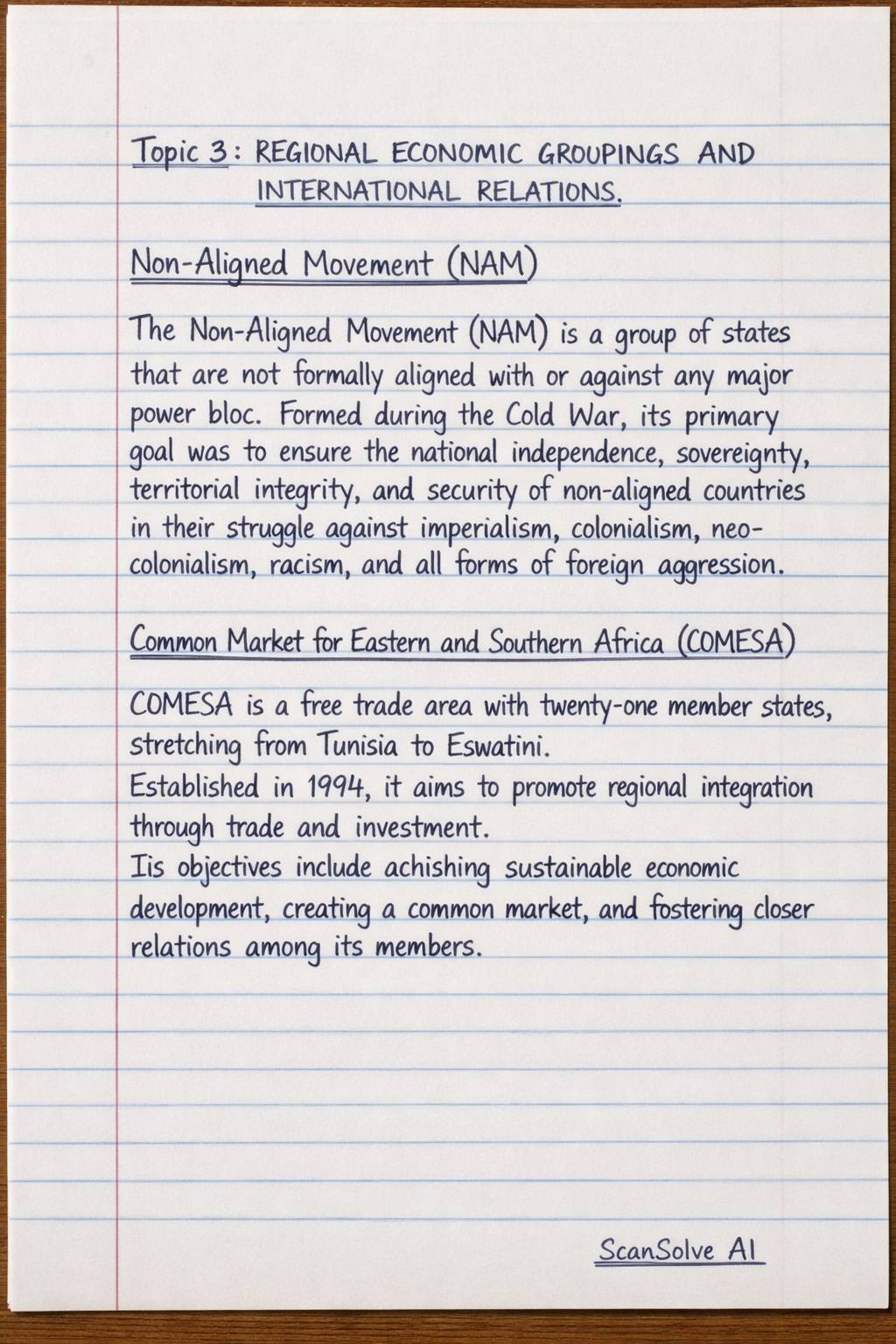
Topic 3: REGIONAL ECONOMIC GROUPINGS AND INTERNATIONAL RELATIONS
Non-Aligned Movement (NAM)
The Non-Aligned Movement (NAM) is a group of states that are not formally aligned with or against any major power bloc. Formed during the Cold War, its primary goal was to ensure the national independence, sovereignty, territorial integrity, and security of non-aligned countries in their struggle against imperialism, colonialism, neo-colonialism, racism, and all forms of foreign aggression.
Common Market for Eastern and Southern Africa (COMESA)
COMESA is a free trade area with twenty-one member states, stretching from Tunisia to Eswatini. Established in 1994, it aims to promote regional integration through trade and investment. Its objectives include achieving sustainable economic development, creating a common market, and fostering closer relations among its members.
Southern African Development Community (SADC)
The Southern African Development Community (SADC) is an inter-governmental organization headquartered in Gaborone, Botswana. Its goal is to further socio-economic cooperation and integration, as well as political and security cooperation among 16 Southern African states. It focuses on poverty eradication, economic growth, and regional peace and security.
Arab Maghreb Union (AMU)
The Arab Maghreb Union (AMU) is a trade agreement aiming for economic and future political unity among Arab countries of the Maghreb in North Africa: Algeria, Libya, Mauritania, Morocco, and Tunisia. Established in 1989, its objectives include strengthening ties among member states and promoting regional stability and economic development.
Topic 4: SOVEREIGNTY AND CONSTITUTIONALISM IN E.A
Sovereignty
Sovereignty refers to the supreme authority within a territory. In the context of East Africa, it signifies the independent power of a state to govern itself without external interference. It encompasses both internal sovereignty (the state's authority over its citizens) and external sovereignty (its independence in international relations).
Constitutionalism
Constitutionalism is the idea that government power is limited by a constitution. It implies adherence to a system of fundamental laws and principles that establish the framework of government, define its powers, and guarantee the rights of citizens. In East Africa, it aims to prevent arbitrary rule and ensure governance according to established legal norms.
The will of the people and the power of the parliament
In democratic systems, the will of the people is expressed through elections, where citizens choose representatives to govern on their behalf. The parliament (or legislature) is the institution where these representatives exercise legislative power, making laws that reflect the people's will. In East Africa, the parliament is central to law-making and oversight of the executive.
The rights of the minority groups in E.A
Minority groups in East Africa often face challenges related to representation, discrimination, and access to resources. Protecting their rights involves ensuring equal treatment under the law, promoting cultural preservation, and guaranteeing political participation. Constitutions and legal frameworks in East African countries often include provisions to safeguard these rights.
Freedom of the press and constitutionalism
Freedom of the press is a fundamental aspect of constitutionalism, allowing media outlets to report news and express opinions without censorship or undue government interference. In East Africa, a free press is crucial for holding governments accountable, informing the public, and fostering democratic discourse, thereby strengthening constitutional governance.
Topic 5: POST-INDEPENDENCE IDEOLOGIES IN E.A
Ujamaa policy in Tanzania
Ujamaa (Swahili for 'familyhood' or 'communalism') was a socialist policy implemented in Tanzania by President Julius Nyerere from the late 1960s. It aimed to achieve self-reliance, rural development, and social equality through collective farming villages and nationalization of industries. While promoting unity, it faced economic challenges and was largely abandoned by the mid-1980s.
Kenyatta's Harambee Philosophy in Kenya
Harambee (Swahili for 'pulling together') was a philosophy promoted by Kenya's first President, Jomo Kenyatta. It encouraged collective self-help efforts and community participation in development projects, such as building schools, hospitals, and roads. It emphasized unity and cooperation among Kenyans to achieve national development goals.
Asian activities in post-colonial E.A.
After independence, Asians in East Africa, who had historically played a significant role in commerce and administration, faced varying degrees of discrimination and economic policies that impacted their status. In some countries, like Uganda under Idi Amin, they were expelled, leading to significant economic disruption. In others, they continued to contribute to the economy, though often navigating complex political landscapes.
Topic 6: SEPARATION AND ETHNIC NATIONALISM IN AFRICA
Civil wars in Sudan 1995 - 2005
The Second Sudanese Civil War (1983-2005) was a prolonged conflict primarily between the central government of Sudan and the Sudan People's Liberation Army (SPLA) in the south. It was fueled by religious, ethnic, and economic grievances, particularly over resources and the imposition of Sharia law. The war resulted in millions of deaths and displacement, eventually leading to the Comprehensive Peace Agreement in 2005 and the independence of South Sudan in 2011.
The civil war / Genocide in Rwanda - 1990 - 1994
The Rwandan Civil War (1990-1994) culminated in the 1994 Genocide against the Tutsi. The conflict was primarily between the Hutu-dominated government and the Rwandan Patriotic Front (RPF), largely composed of Tutsi refugees. The genocide saw the systematic slaughter of approximately 800,000 Tutsis and moderate Hutus over 100 days, driven by ethnic hatred and political extremism.
Katanga Secession 1960 - 1963
The Katanga Secession was a political crisis in the newly independent Republic of Congo (now Democratic Republic of Congo) from 1960 to 1963. The mineral-rich province of Katanga, led by Moïse Tshombe and supported by Belgian and Western interests, declared independence from the central government. This led to a violent conflict, involving UN peacekeeping forces, before Katanga was reintegrated into Congo.
Still stuck on this one?
Ask a follow-up, and the answer starts from this question.
More Economics Questions
Handwritten Step-by-Step Solution
Get this as a handwritten image on WhatsApp — like a tutor wrote it for you.
Try on WhatsApp