
We read your photo as:
There is a maxim by economist that "the birth of money is the death of system." (Discuss)
ScanSolve AI Answer
Step-by-step solution
3 stepsUnderstand the barter system.
The barter system is an economic arrangement where goods and services are exchanged directly for other goods and services without the use of a common medium of exchange like money. Its fundamental flaw is the requirement of a double coincidence of wants, meaning that for a trade to happen, each party must possess what the other desires and simultaneously want what the other has to offer.
The emergence of money.
The introduction of money revolutionized trade by serving as a universal medium of exchange. With money, individuals no longer needed to find someone who specifically wanted their goods and had the exact goods they desired in return. Instead, they could sell their goods for money and then use that money to purchase any goods or services from any seller.
The decline of barter.
Money's ability to overcome the double coincidence of wants made transactions vastly more efficient. Beyond being a medium of exchange, money also functions as a unit of account, providing a common measure of value for all goods and services, and a store of value, allowing wealth to be saved and used in the future. These advantages made the barter system obsolete, as money facilitated specialization, increased trade, and fostered economic development, effectively leading to its "death."
Still stuck on this one?
Ask a follow-up, and the answer starts from this question.
More Economics Questions
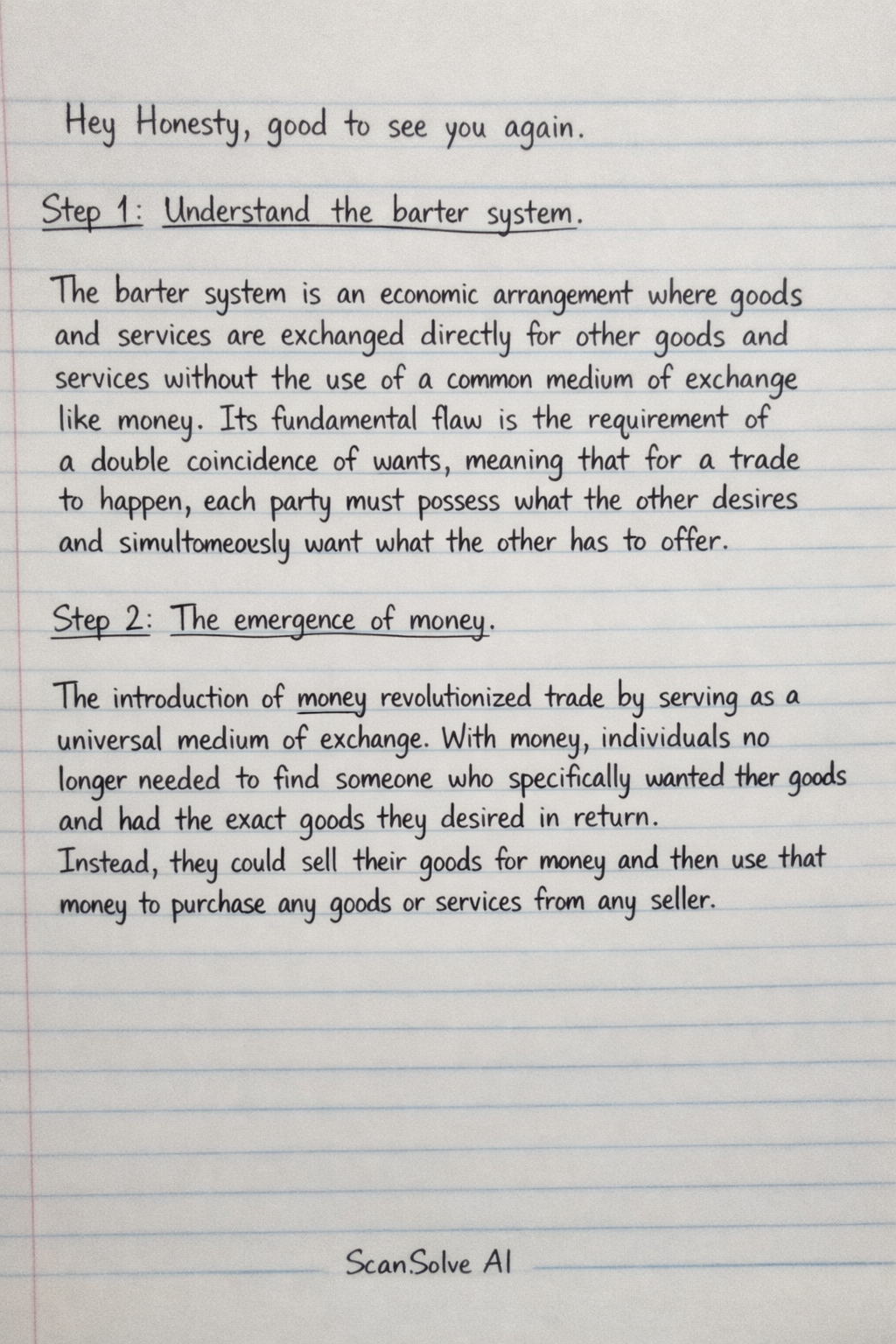
Handwritten Step-by-Step Solution
Get this as a handwritten image on WhatsApp — like a tutor wrote it for you.
Try on WhatsApp