
We read your photo as:
Define trade, international trade, comparative advantage, trade protection, and list a disadvantage of free trade.
ScanSolve AI Answer
Answers
5 partsQUESTION 1
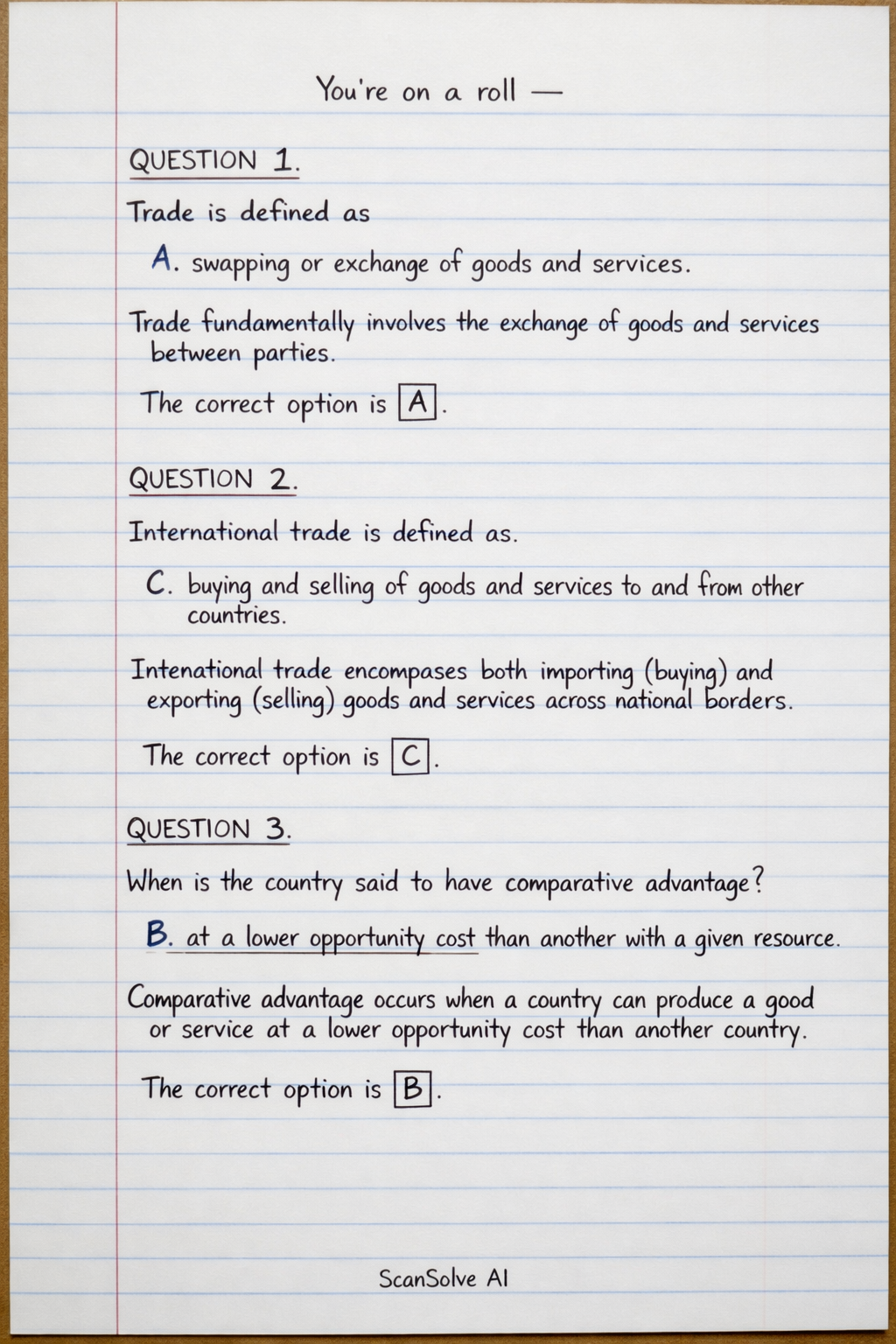
Trade is defined as
A. swapping or exchange of goods and services.
Trade fundamentally involves the exchange of goods and services between parties.
The correct option is .
QUESTION 2
International trade is defined as
C. buying and selling of goods and services to and from other countries.
International trade encompasses both importing (buying) and exporting (selling) goods and services across national borders.
The correct option is .
QUESTION 3
When is the country said to have comparative advantage?
B. at a lower opportunity cost than another with a given resource.
Comparative advantage occurs when a country can produce a good or service at a lower opportunity cost than another country.
The correct option is .
QUESTION 4
Trade protection is
A. a measure taken by the government to impose artificial barriers to trade.
Trade protection refers to government policies that restrict international trade, such as tariffs or quotas, to protect domestic industries.
The correct option is .
QUESTION 5
Which of the following is the disadvantage of free trade?
D. It may lead to a rise in short term unemployment.
While free trade has many benefits, a potential disadvantage is that domestic industries unable to compete with foreign goods may decline, leading to job losses in the short term.
The correct option is .
Try one yourself
A new problem that tests the same skill.
Still stuck on this one?
Ask a follow-up, and the answer starts from this question.
More Economics Questions
Handwritten Step-by-Step Solution
Get this as a handwritten image on WhatsApp — like a tutor wrote it for you.
Try on WhatsApp