
We read your photo as:
Define variable cost, average total cost, and economies of scale. Explain why the marginal revenue curve lies below the average revenue curve in imperfectly competitive markets. Why can't values A, B,
ScanSolve AI Answer
3.2.1
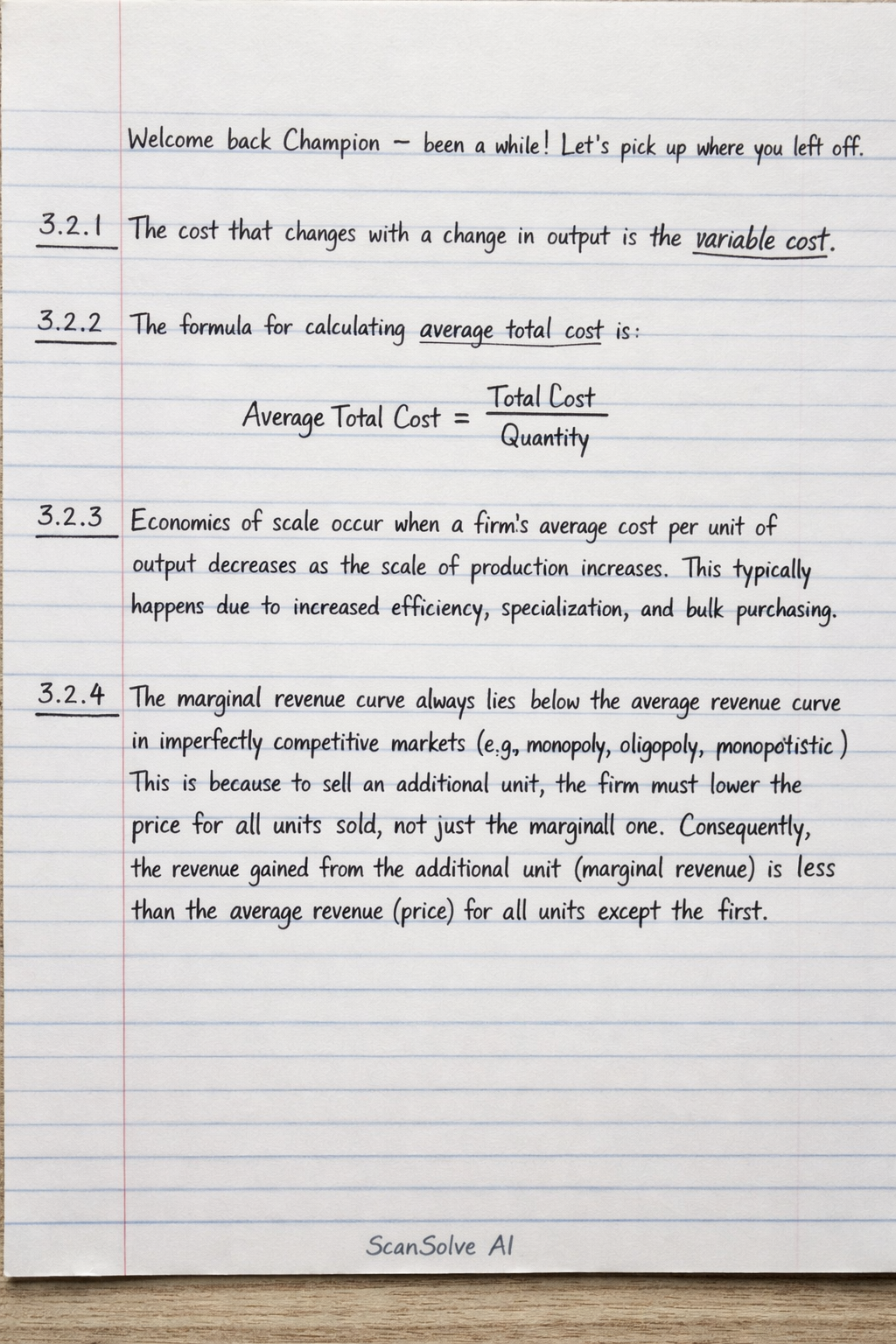
The cost that changes with a change in output is the variable cost.
3.2.2
The formula for calculating average total cost is:
3.2.3
Economies of scale occur when a firm's average cost per unit of output decreases as the scale of production increases. This typically happens due to increased efficiency, specialization, and bulk purchasing.
3.2.4
The marginal revenue curve always lies below the average revenue curve in imperfectly competitive markets (e.g., monopoly, oligopoly, monopolistic competition). This is because to sell an additional unit, the firm must lower the price for all units sold, not just the marginal one. Consequently, the revenue gained from the additional unit (marginal revenue) is less than the average revenue (price) for all units except the first.
3.2.5
The values of A, B, and C cannot be determined from the provided table as there are no numerical values given for any of the cost categories or quantities. To calculate A, B, and C, at least one numerical value (e.g., fixed cost, total cost, or marginal cost at a specific quantity) would be required to establish a base for calculations.
Still stuck on this one?
Ask a follow-up, and the answer starts from this question.
More Economics Questions
Handwritten Step-by-Step Solution
Get this as a handwritten image on WhatsApp — like a tutor wrote it for you.
Try on WhatsApp