
We read your photo as:
With the use of diagrams, distinguish between "price floor" and "price ceiling" legislation.
ScanSolve AI Answer
Here are the answers to your economics questions:
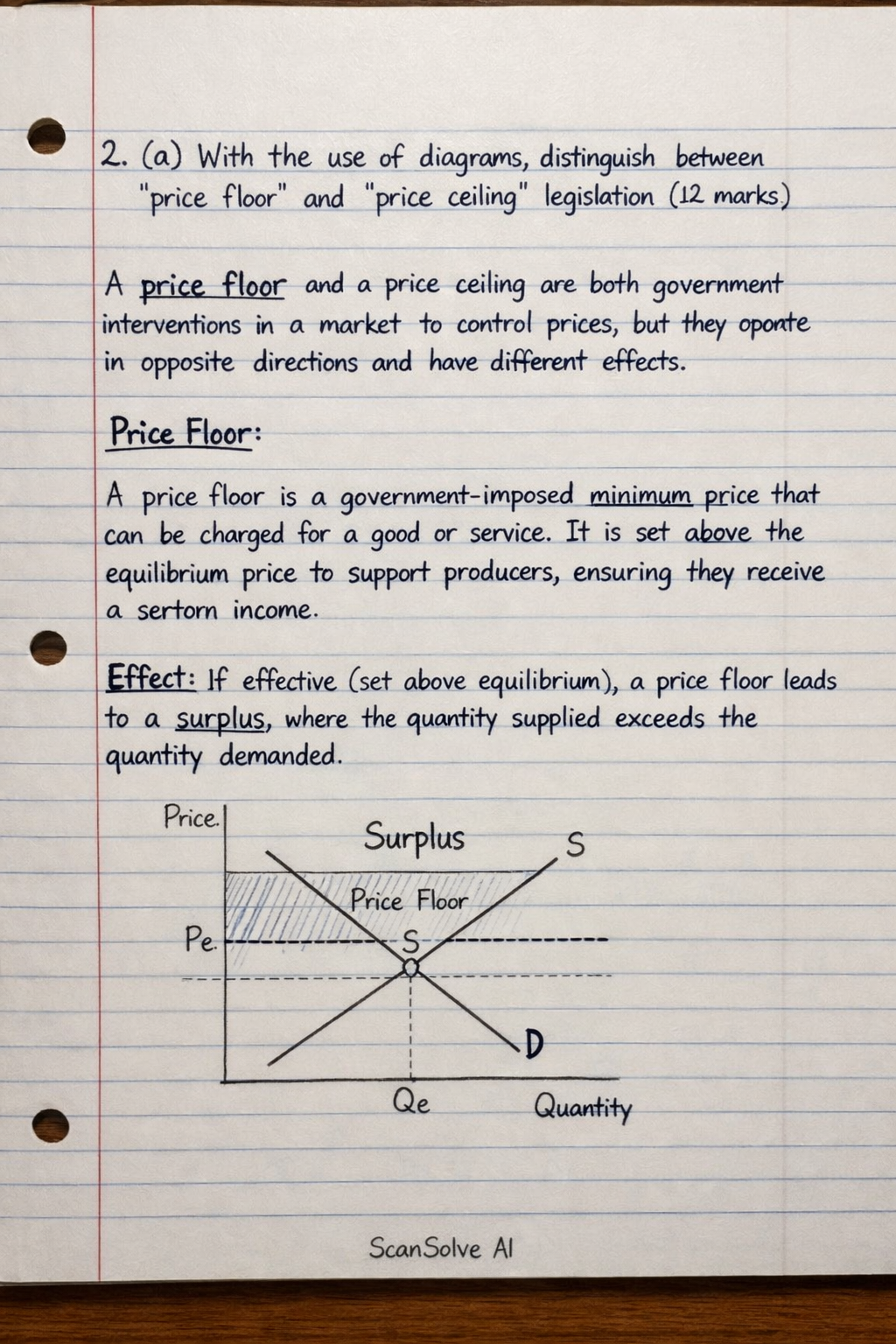
2. (a) With the use of diagrams, distinguish between "price floor" and "price ceiling" legislation (12 marks)
A price floor and a price ceiling are both government interventions in a market to control prices, but they operate in opposite directions and have different effects.
-
Price Floor: A price floor is a government-imposed minimum price that can be charged for a good or service. It is set above the equilibrium price to support producers, ensuring they receive a certain income.
- Effect: If effective (set above equilibrium), a price floor leads to a surplus, where the quantity supplied exceeds the quantity demanded.
- Diagram Description: Imagine a standard supply and demand graph with price on the vertical axis and quantity on the horizontal axis. The demand curve slopes downwards, and the supply curve slopes upwards, intersecting at the equilibrium price () and quantity (). A horizontal line representing the price floor () would be drawn above . At , the quantity supplied () would be greater than the quantity demanded (), illustrating the surplus.
-
Price Ceiling: A price ceiling is a government-imposed maximum price that can be charged for a good or service. It is set below the equilibrium price to protect consumers by making essential goods more affordable.
- Effect: If effective (set below equilibrium), a price ceiling leads to a shortage, where the quantity demanded exceeds the quantity supplied.
- Diagram Description: On the same type of supply and demand graph, a horizontal line representing the price ceiling () would be drawn below . At , the quantity demanded () would be greater than the quantity supplied (), illustrating the shortage.
(Note: In an exam setting, you would draw these diagrams clearly labeling axes, curves, equilibrium points, and the price floor/ceiling lines, along with the resulting surplus or shortage.)
2. (b) Explain the economic implications of a price ceiling legislation (8 marks)
Price ceiling legislation, when set below the market equilibrium price, has several significant economic implications:
- Shortages: The most direct implication is a persistent shortage of the good or service. The artificially low price increases demand while simultaneously discouraging producers from supplying as much, leading to a gap between quantity demanded and quantity supplied.
- Black Markets: Due to the shortage, consumers unable to purchase the good at the official price may turn to black markets. Here, the good is sold illegally at prices often much higher than the price ceiling, and sometimes even above the original equilibrium price.
- Reduced Quality: Producers facing lower prices may cut costs to maintain profitability, leading to a reduction in the quality of the product or service. For example, landlords under rent control might neglect property maintenance.
- Inefficient Allocation: The limited supply under a price ceiling is often allocated inefficiently. Goods may not go to those who value them most or need them most, but rather to those who are first in line, have connections, or are simply lucky.
- Reduced Investment and Supply: The lower prices reduce the incentive for new firms to enter the market or for existing firms to expand production. This can lead to reduced investment and a worsening of supply problems in the long run.
- Non-price Rationing: Since price can no longer effectively ration the scarce good, other non-price rationing mechanisms emerge, such as long queues, waiting lists, favoritism, or even corruption.
Still stuck on this one?
Ask a follow-up, and the answer starts from this question.
More Economics Questions
Handwritten Step-by-Step Solution
Get this as a handwritten image on WhatsApp — like a tutor wrote it for you.
Try on WhatsApp