

This English question involves literary analysis, grammar, or writing skills. The detailed response below provides a well-structured answer with supporting evidence and clear explanations.
ScanSolve AI Answer
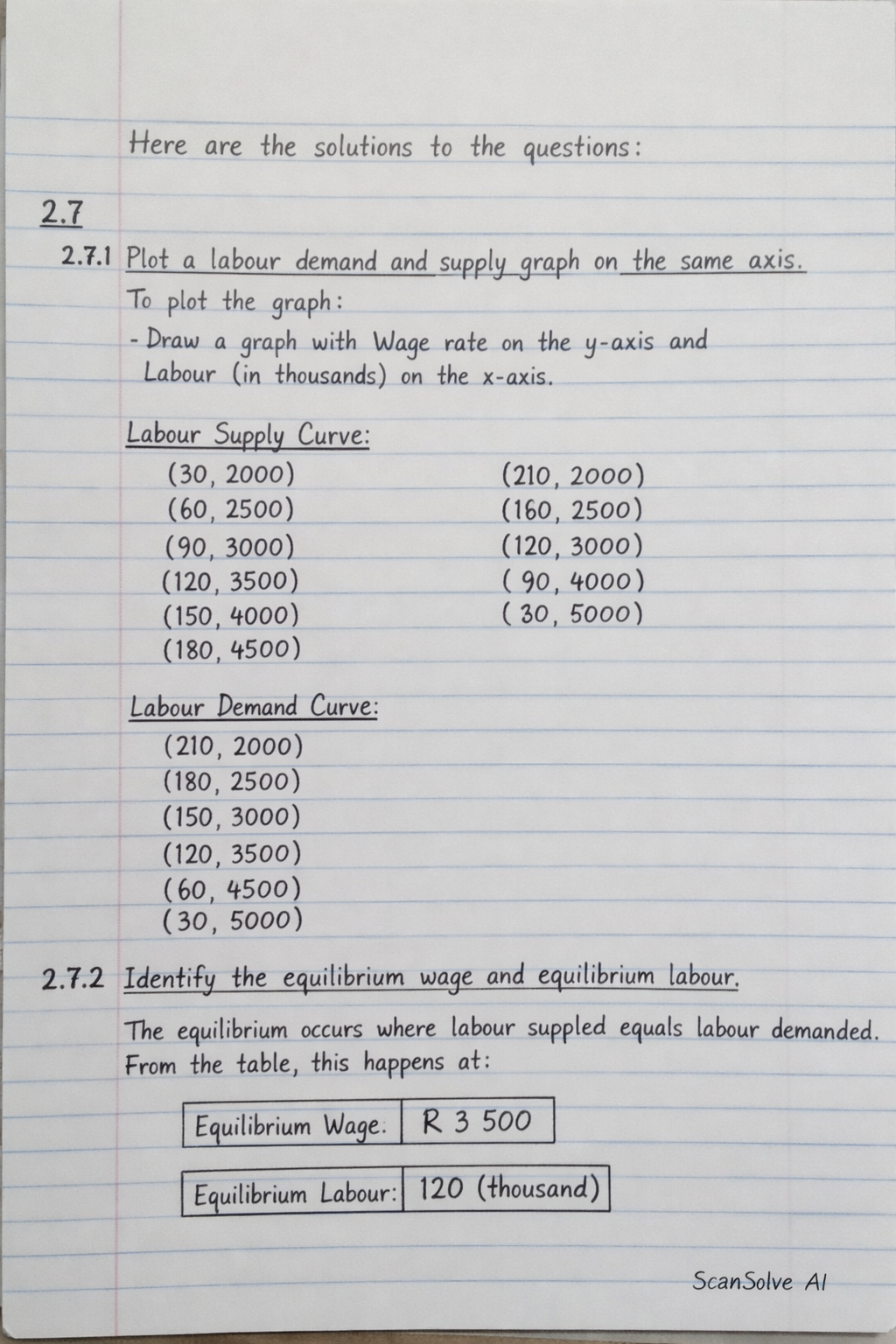
Here are the solutions to the questions: 2.7 2.7.1 Plot a labour demand and supply graph on the same axis. To plot the graph: Draw a graph with the Wage rate on the y-axis and Labour (in thousands)* on the x-axis. Labour Supply Curve: Plot the following points and connect them to form the labour supply curve: (30, 2000) (60, 2500) (90, 3000) (120, 3500) (150, 4000) (180, 4500) (210, 5000) Labour Demand Curve: Plot the following points and connect them to form the labour demand curve: (210, 2000) (180, 2500) (150, 3000) (120, 3500) (90, 4000) (60, 4500) (30, 5000) 2.7.2 Identify the equilibrium wage and equilibrium labour. The equilibrium occurs where labour supplied equals labour demanded. From the table, this happens at: Equilibrium Wage: R3 500 Equilibrium Labour: 120 (thousand) 2.7.3 Calculate the shortage in labour demand if the wage rate was 3 000. At a wage rate of R3 000: Labour supplied = 90 (thousand) Labour demanded = 150 (thousand) Shortage = Labour demanded - Labour supplied Shortage = 150 - 90 = 60 (thousand) The shortage in labour demand is 60 (thousand). QUESTION 3 3.1 List FIVE types of inflation Demand-pull inflation* Cost-push inflation* Hyperinflation* Creeping inflation* Galloping inflation* 3.2 Explain the concept Bank rate (repurchase rate) The bank rate (also known as the repurchase rate or repo rate) is the interest rate at which a country's central bank lends money to commercial banks. It is a key monetary policy tool used to influence interest rates throughout the economy, control inflation, and manage economic growth. 3.3 Give THREE components of money used in South Africa. Notes and coins in circulation* Demand deposits* (e.g., cheque accounts) Short-term and medium-term deposits* (e.g., savings accounts, fixed deposits up to 6 months) 3.4 Identify the functions of money from the following statements. 3.4.1 Elsie bought a pair of shoes from Edgar's on credit. Medium of exchange* 3.4.2 People prefer cars from Mercedes-Benz as compared to Toyota cars. Unit of account* 3.4.3 I bought bread and milk for the children. Medium of exchange* 3.4.4 She is so rich she can buy whatever she wants. Store of value* 3.4.5 Mandla has kept the R2000 for the whole month. Store of value* 3.5 List FOUR factors that can lead to inequality of wages. Differences in education and skills* Differences in experience* Discrimination* (e.g., based on gender, race, or age) Occupational choice and risk* (e.g., dangerous jobs, highly specialized professions)