
We read your photo as:
Analyze the legend of "Gipir and Labongo" by answering: a) List characters, b) Discuss a character's personality, and c) How does Gipir feel upon finding the dead elephant?
English
ScanSolve AI Answer
Step-by-step solution
6 stepsHere are the answers to your questions based on the legend "Gipir and Labongo":
Part a· 2 steps
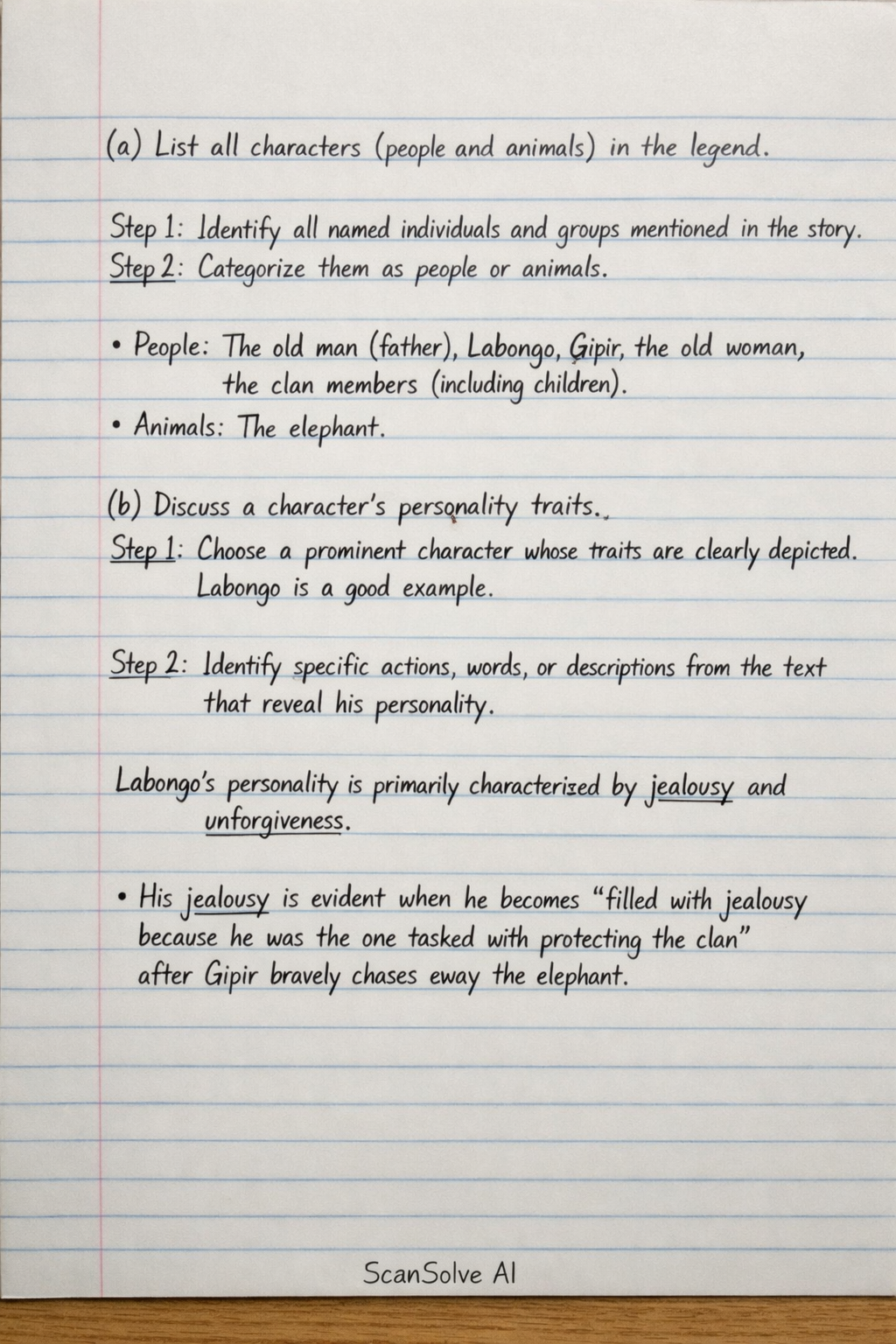
List all characters (people and animals) in the legend.
Identify all named individuals and groups mentioned in the story.
Categorize them as people or animals.
- People: The old man (father), Labongo, Gipir, the old woman, the clan members (including children).
- Animals: The elephant.
Part b· 2 steps
Discuss a character's personality traits.
Choose a prominent character whose traits are clearly depicted.
Labongo is a good example.
Identify specific actions, words, or descriptions from the text that reveal his personality.
Labongo's personality is primarily characterized by jealousy and unforgiveness.
- His jealousy is evident when he becomes "filled with jealousy because he was the one tasked with protecting the clan" after Gipir bravely chases away the elephant.
- His unforgiving nature is shown when he "called Gipir and accused him of jealousy, demanding his spear back" and "insisted that he wanted his spear back," forcing Gipir to leave his home despite Gipir's heroic act.
Part c· 2 steps
How does Gipir feel upon finding the dead elephant?
Locate the part of the story where Gipir finds the dead elephant.
Identify the emotions described in that section.
Gipir feels a mix of emotions:
- He is happy because he has completed his mission of finding the royal spear.
- He is also sad to see the elephant, which he had speared, finally dead.
Was this helpful?
Still stuck on this one?
Ask a follow-up, and the answer starts from this question.
Got a different question?Ask your own question
More English Questions
QAnalyze this excerpt, answering the following questions: a) What had happened before? b) Describe…QBased on the Xitsonga text, answer questions about Killer, his companions, Mzambia, and specific…QDescribe the character traits of monkey export trade in this narrative 2. Identify and explain four…QIn not more than three sentences explain what this narrative is about 2. Identify one instance of…QAnalyze the provided excerpt from the play Pango by Ebrahim Hussein, focusing on character Mzee…
Handwritten Step-by-Step Solution
Get this as a handwritten image on WhatsApp — like a tutor wrote it for you.
Try on WhatsApp