
We read your photo as:
Analyze the provided extract from Keats's poem, focusing on the poet's fears, the meaning of 'teeming brain', and identifying the figure of speech in 'Hold like rich garners the full-ripen'd grain'.
ScanSolve AI Answer
Here are the answers to the questions based on the provided poem extract:
-
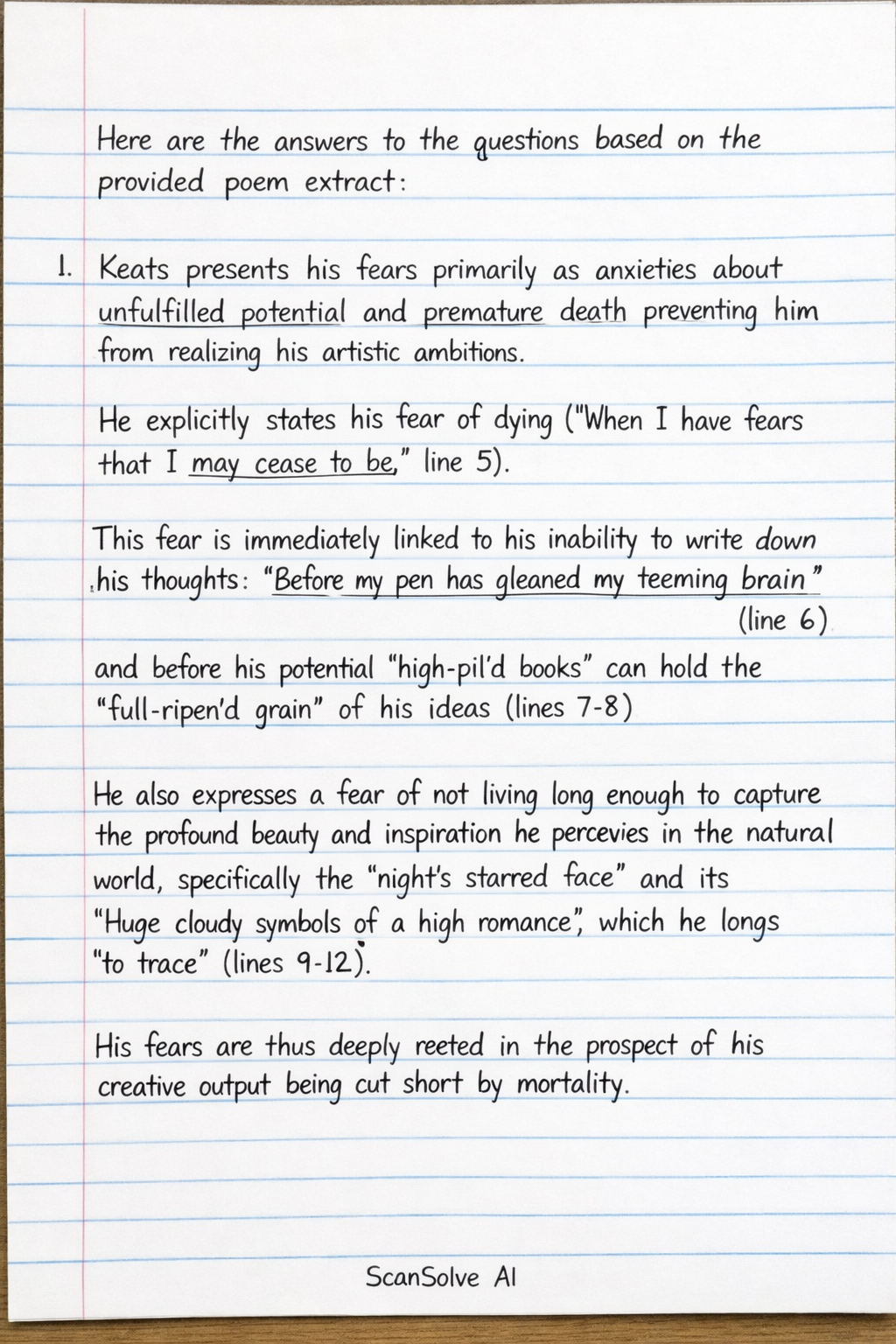
Keats presents his fears primarily as anxieties about unfulfilled potential and premature death preventing him from realizing his artistic ambitions. He explicitly states his fear of dying ("When I have fears that I may cease to be," line 5). This fear is immediately linked to his inability to write down his thoughts: "Before my pen has gleaned my teeming brain" (line 6) and before his potential "high-pil'd books" can hold the "full-ripen'd grain" of his ideas (lines 7-8). He also expresses a fear of not living long enough to capture the profound beauty and inspiration he perceives in the natural world, specifically the "night's starred face" and its "Huge cloudy symbols of a high romance," which he longs "to trace" (lines 9-12). His fears are thus deeply rooted in the prospect of his creative output being cut short by mortality.
-
The phrase "teeming brain" (line 6) suggests that the speaker's mind is overflowing with ideas, thoughts, and creative inspiration. It implies a rich and abundant source of intellectual and artistic material waiting to be expressed.
-
The figure of speech in "Hold like rich garners the full-ripen'd grain" (line 7) is a simile. A simile is a comparison between two unlike things using "like" or "as." Here, Keats compares his unwritten works (or the potential content of his books) to "rich garners" (storehouses) holding "full-ripen'd grain." This comparison emphasizes the abundance, value, and readiness of his ideas, suggesting they are mature and ready for harvest and preservation in his poetry.
-
The imagery of the night sky in lines 9-12 ("night's starred face," "Huge cloudy symbols of a high romance") contributes to the poem's meaning by introducing a sense of vastness, mystery, and sublime beauty. The "starred face" personifies the night, making it a source of profound, perhaps romantic, inspiration. The "cloudy symbols of a high romance" suggest grand, elusive themes of love, beauty, or epic poetry that Keats yearns to capture. His fear of not living "to trace / Their shadows" highlights his desire to translate this immense natural and emotional inspiration into his art, underscoring his anxiety that death will prevent him from achieving this artistic fulfillment. It contrasts the eternal, inspiring night sky with his own transient life.
-
In my opinion, Keats appears more afraid of leaving his work unfinished than of death itself. The poem begins with his fear of death ("When I have fears that I may cease to be," line 5), but immediately qualifies this fear by linking it to what he will not accomplish: "Before my pen has gleaned my teeming brain" (line 6) and "Before high-pil'd books... Hold like rich garners the full-ripen'd grain" (lines 7-8). Similarly, his fear of not living to "trace / Their shadows" (lines 11-12) refers to his inability to capture the inspiration from the night sky. Death is the catalyst for his fear, but the core of his anxiety is the unrealized potential and the unwritten poetry that death would prevent.
Still stuck on this one?
Ask a follow-up, and the answer starts from this question.
More English Questions
Handwritten Step-by-Step Solution
Get this as a handwritten image on WhatsApp — like a tutor wrote it for you.
Try on WhatsApp