
We read your photo as:
Let the answer be in English language
ScanSolve AI Answer
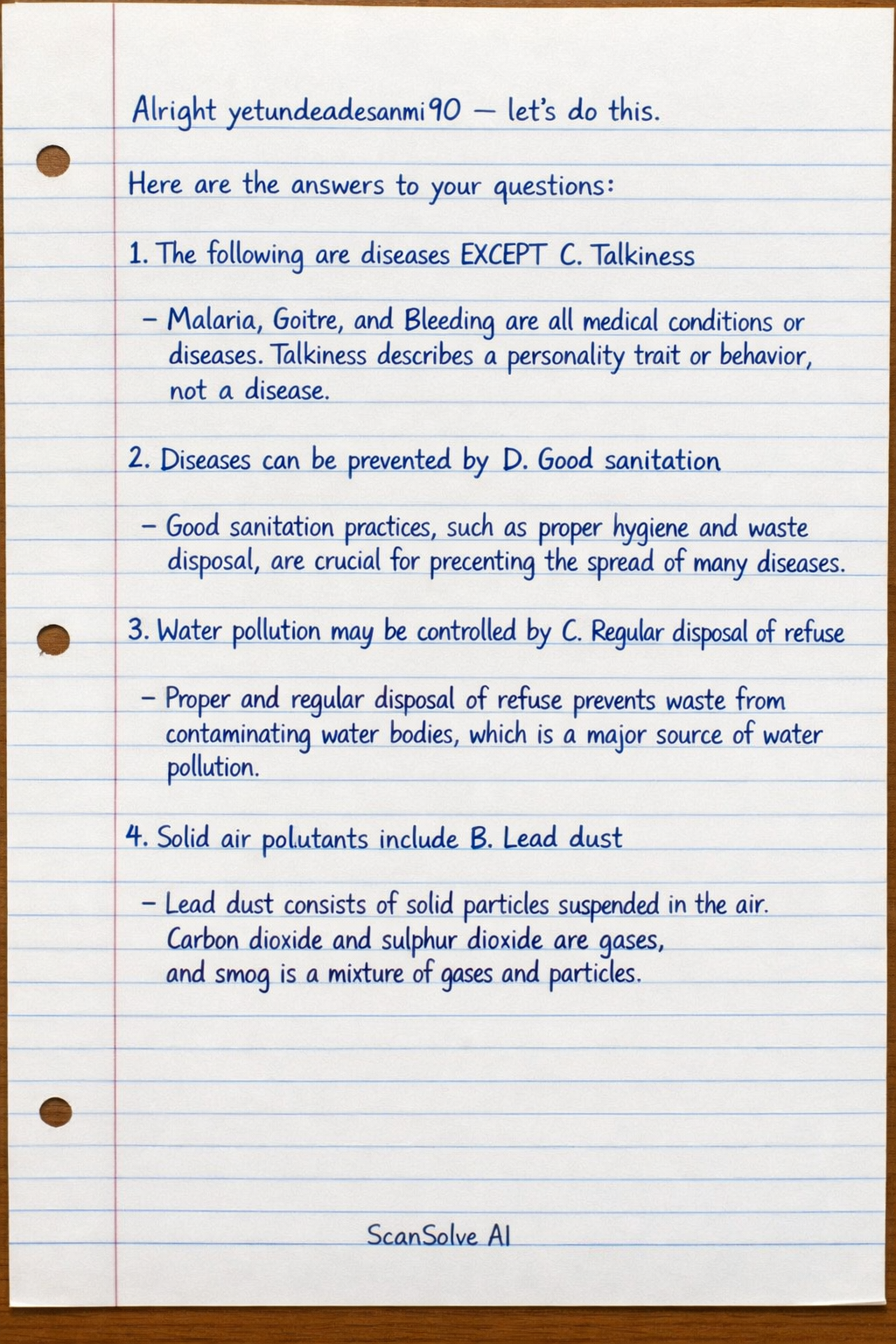
Here are the answers to your questions:
-
The following are diseases EXCEPT C. Talkiness
- Malaria, Goitre, and Bleeding are all medical conditions or diseases. Talkiness describes a personality trait or behavior, not a disease.
-
Diseases can be prevented by D. Good sanitation
- Good sanitation practices, such as proper hygiene and waste disposal, are crucial for preventing the spread of many diseases.
-
Water pollution may be controlled by C. Regular disposal of refuse
- Proper and regular disposal of refuse prevents waste from contaminating water bodies, which is a major source of water pollution.
-
Solid air pollutants include B. Lead dust
- Lead dust consists of solid particles suspended in the air. Carbon dioxide and sulphur dioxide are gases, and smog is a mixture of gases and particles.
-
Which of these is NOT an effect of air pollution on human beings? D. Typhoid
- Respiratory disorders and eye irritation are common effects of air pollution. Astigmatism is a refractive error of the eye, not caused by pollution. Typhoid is a bacterial infection spread through contaminated food and water, not air pollution.
-
Which of these statements is true about drug users? C. A drug user is economically disadvantaged
- Drug use often leads to financial difficulties due to the cost of drugs and potential loss of employment. Drug users typically do not develop positive self-esteem, often struggle with peer pressure, and usually develop dependence on drugs.
-
One of these is NOT an adaptation of a desert plant A. Poorly developed root system
- Desert plants typically have extensive root systems (either deep or widespread shallow roots) to efficiently absorb water. Reduced leaves, adventitious roots (in some cases), and storage tissues are adaptations for water conservation.
-
Human beings are unique among other primates because B. They have a highly developed brain
- The highly developed brain in humans is responsible for our advanced intelligence, complex language, and other unique cognitive abilities.
-
Which of these statements is NOT correct about matter? A. Matter is always a solid material
- Matter can exist in various states, including solid, liquid, gas, and plasma, not just solid. The other statements are correct.
-
Childhood is characterized by B. Small size
- Childhood is a period of growth where individuals are typically smaller than adults. The development of secondary sexual features occurs during puberty, and a fully formed reproductive system is characteristic of adulthood.
-
Which of these is NOT a method of refuse control? A. Government legislation against dumping of refuse in undesignated places
- Government legislation is a policy or framework that enables refuse control, but it is not a physical method of handling refuse itself, unlike controlled burning, sorting, or regulated dumping.
-
C. Muscles are attached to the skeleton to help the joint to move.
- Muscles contract and pull on bones, causing movement at the joints.
-
The ligament is the tough material that holds A. Two bones together.
- Ligaments connect bones to other bones, typically at a joint, holding at least two bones together.
-
Which of these is NOT associated with the respiratory system? B. Anaemia
- Pneumonia, Tuberculosis, and Asthma are all conditions directly affecting the respiratory system. Anaemia is a blood disorder affecting oxygen transport, but not primarily a disease of the respiratory organs themselves.
-
One of these is NOT a use of blood tests B. To help in choosing a marriage partner
- While blood tests can provide health information relevant to marriage (e.g., genetic compatibility), the direct purpose of a blood test is not "to choose a marriage partner." The other options are direct medical or biological uses of blood tests.
Still stuck on this one?
Ask a follow-up, and the answer starts from this question.
More English Questions
Handwritten Step-by-Step Solution
Get this as a handwritten image on WhatsApp — like a tutor wrote it for you.
Try on WhatsApp