
We read your photo as:
Please the answers should be in English
ScanSolve AI Answer
Answer
Step-by-step solution
5 stepsTo show that the equation is homogeneous, we need to verify that the units on both sides of the equation are the same.
Identify the units of the physical quantities.
- is wavelength, its unit is meter (m).
- is Planck's constant, its unit is Joule-second (J·s).
- is mass, its unit is kilogram (kg).
- is velocity, its unit is meter per second (m/s).
Express the unit of Planck's constant () in fundamental SI units (kg, m, s).
The unit of energy, Joule (J), is defined as the work done by a force of 1 Newton over a distance of 1 meter.
Force (Newton, N) is defined by Newton's second law ():
So, the unit of Joule is:
Therefore, the unit of Planck's constant is:
Calculate the units of the right-hand side of the equation ().
The units of the numerator are:
The units of the denominator are:
Now, we divide the units of the numerator by those of the denominator:
Simplify the units of the right-hand side.
Compare the units of both sides.
The units of the left-hand side of the equation () are meters (m).
The units of the right-hand side of the equation () are also meters (m).Since the units on both sides of the equation are identical (meters), the equation is homogeneous.
Try one yourself
A new problem that tests the same skill.
Still stuck on this one?
Ask a follow-up, and the answer starts from this question.
More English Questions
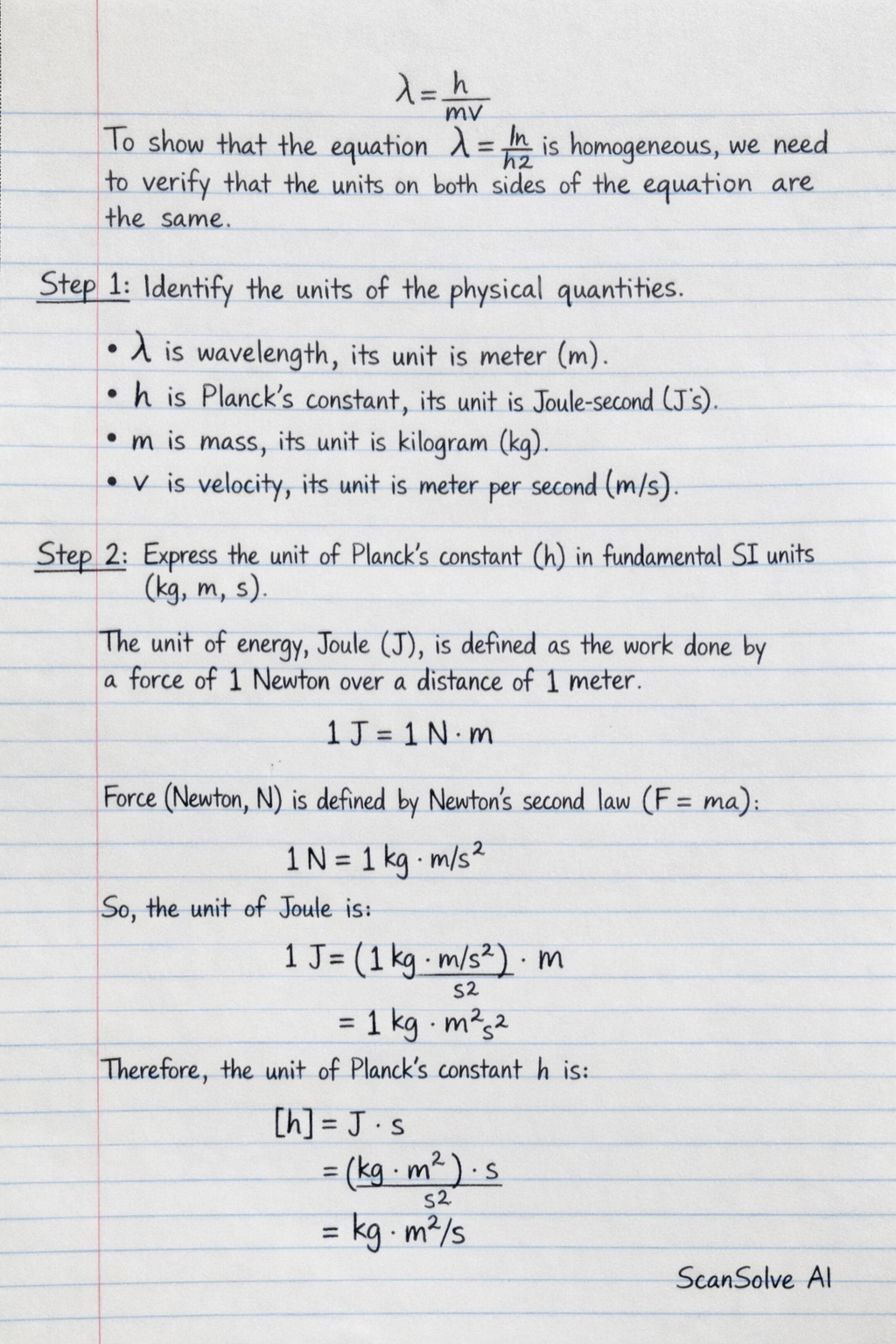
Handwritten Step-by-Step Solution
Get this as a handwritten image on WhatsApp — like a tutor wrote it for you.
Try on WhatsApp