
We read your photo as:
Solve , show working and plot it on a graph
ScanSolve AI Answer
Step-by-step solution
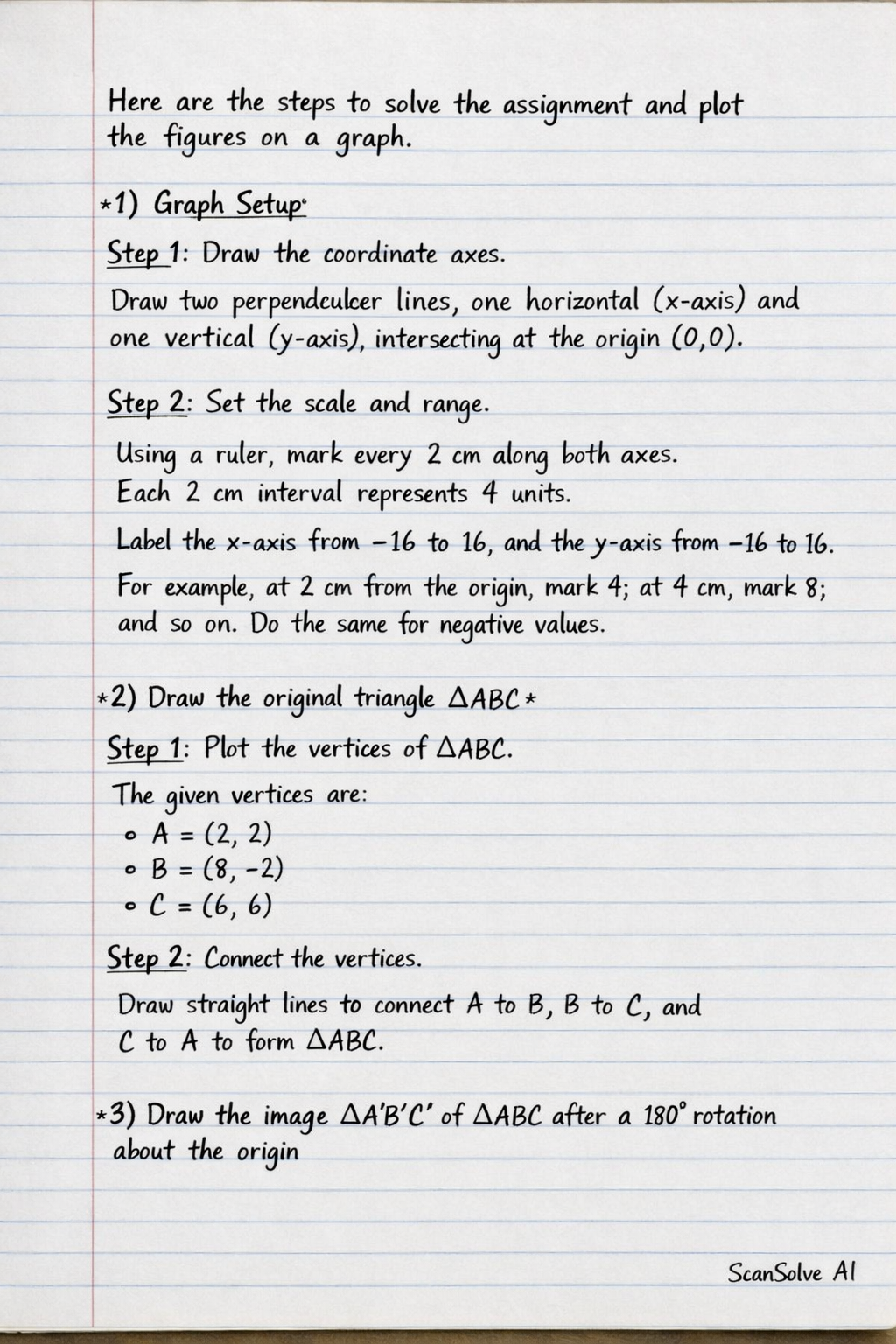
10 stepsHere are the steps to solve the assignment and plot the figures on a graph.
1) Graph Setup
Draw the coordinate axes.
Draw two perpendicular lines, one horizontal (x-axis) and one vertical (y-axis), intersecting at the origin (0,0).
Set the scale and range.
Using a ruler, mark every 2 cm along both axes. Each 2 cm interval represents 4 units.
Label the x-axis from -16 to 16 and the y-axis from -16 to 16. For example, at 2 cm from the origin, mark 4; at 4 cm, mark 8; and so on. Do the same for negative values.2) Draw the original triangle
Plot the vertices of .
The given vertices are:
Connect the vertices.
Draw straight lines to connect A to B, B to C, and C to A to form .
3) Draw the image of after a rotation about the origin
Determine the coordinates of the rotated triangle.
A rotation about the origin transforms a point to .
- The coordinates of are:
Plot and draw .
Plot the points , , and on your graph. Connect them with straight lines to form .
4) Draw the image of under the translation vector
Determine the coordinates of the translated triangle.
A translation by vector transforms a point to . Here, .
- The coordinates of are:
Plot and draw .
Plot the points , , and on your graph. Connect them with straight lines to form .
5) Draw the image of under the reflection in the line
Determine the coordinates of the reflected triangle.
A reflection in the line (the x-axis) transforms a point to . We are reflecting .
- The coordinates of are:
Plot and draw .
Plot the points , , and on your graph. Connect them with straight lines to form .
Still stuck on this one?
Ask a follow-up, and the answer starts from this question.
More English Questions
Handwritten Step-by-Step Solution
Get this as a handwritten image on WhatsApp — like a tutor wrote it for you.
Try on WhatsApp