
We read your photo as:
Solve showing all the steps, in English
ScanSolve AI Answer
Answer
Step-by-step solution
10 stepsHere's the solution to your question:
Part a
State TWO assumptions used to derive this equation.
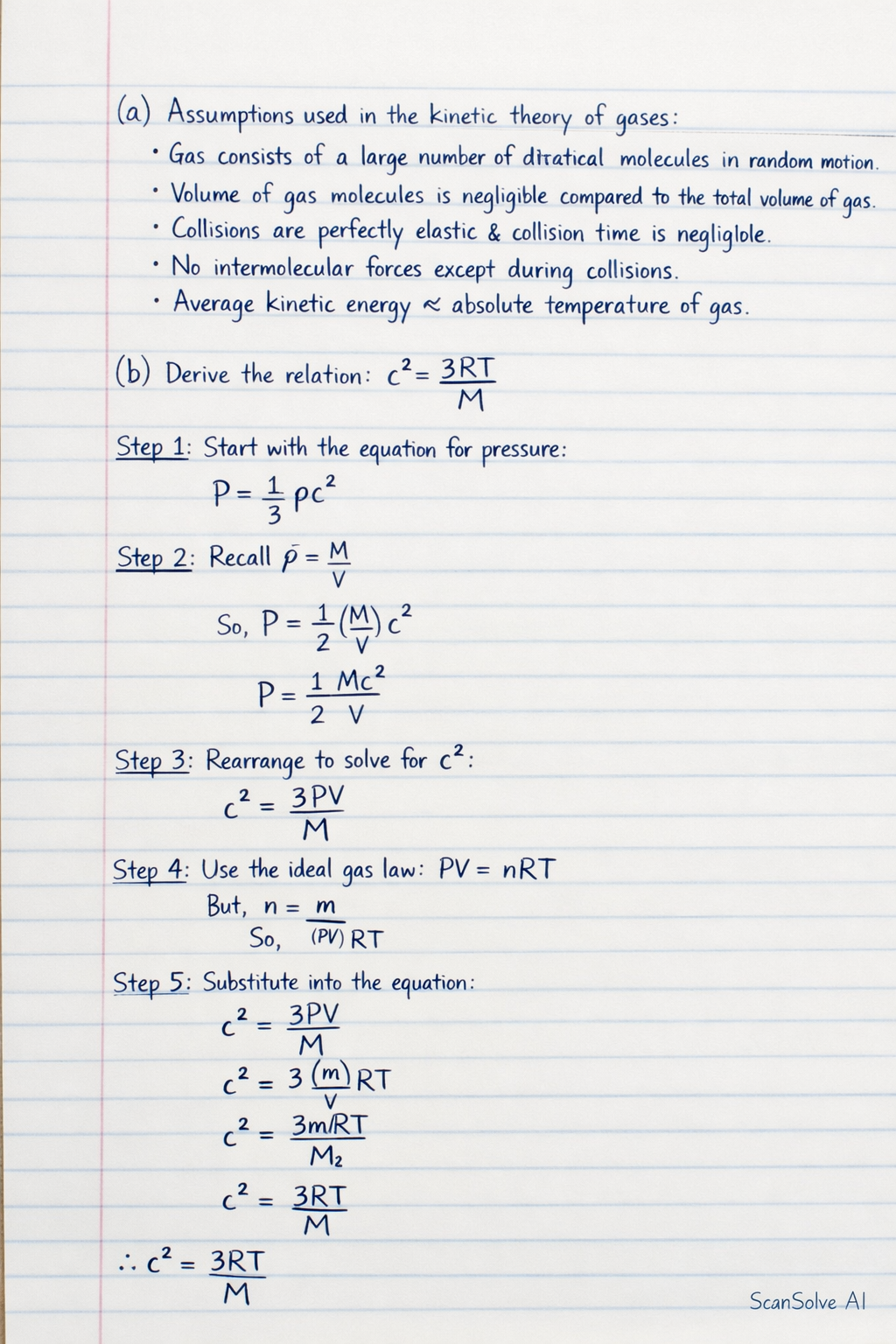
Here are two assumptions used in the kinetic theory of gases:
- The gas consists of a very large number of identical molecules that are in random, continuous motion.
- The volume occupied by the gas molecules themselves is negligible compared to the total volume of the gas.
- Collisions between molecules and with the container walls are perfectly elastic, and the time duration of collisions is negligible.
- There are no intermolecular forces between gas molecules, except during collisions.
- The average kinetic energy of the gas molecules is directly proportional to the absolute temperature of the gas.
Part b· 6 steps
Use the above equation to show that is related to the absolute temperature of the gas by;
Start with the given kinetic theory equation for pressure.
Express density () in terms of mass (), volume (), and molar mass ().
Density is mass per unit volume, .
The total mass of the gas () can also be expressed as the number of moles () multiplied by the molar mass (), so .
Therefore, .Substitute the expression for density into the pressure equation.
Rearrange the equation to isolate .
Use the Ideal Gas Law, .
Equate the expression for from Step 4 with the Ideal Gas Law:
Cancel from both sides and solve for .
Multiply both sides by 3 and divide by :
This shows the relationship between the mean-square speed () and the absolute temperature ().
Part c
Determine the root-mean-square speed of the molecules if the gas is heated to a temperature of .
Convert the given temperatures from Celsius to Kelvin.
Initial temperature,
Final temperature,Relate the root-mean-square speed to temperature.
From part (b), we know that .
This implies that the mean-square speed () is directly proportional to the absolute temperature ().
Therefore, the root-mean-square speed () is proportional to the square root of the absolute temperature:So, we can write the ratio:
Substitute the known values and solve for the final root-mean-square speed ().
Given initial rms speed, .
Round the answer to an appropriate number of significant figures (3 significant figures, based on the input values).
The root-mean-square speed of the molecules if the gas is heated to is .
Try one yourself
A new problem that tests the same skill.
Still stuck on this one?
Ask a follow-up, and the answer starts from this question.
More English Questions
Handwritten Step-by-Step Solution
Get this as a handwritten image on WhatsApp — like a tutor wrote it for you.
Try on WhatsApp