
We read your photo as:
Solve these in English showing all the steps used
ScanSolve AI Answer
Here are the solutions to the questions.
1. Dimensional Analysis and Homogeneity
a. Show that the equation is homogeneous.
An equation is dimensionally homogeneous if the dimensions of the terms on both sides of the equation are the same.
Let's determine the dimensions of each variable:
-
Specific charge (): Charge per unit mass. Dimension of charge () is (current time). Dimension of mass () is . So, .
-
Potential difference (): Energy per unit charge. Dimension of energy () is (from ). Dimension of charge () is . So, .
-
Magnetic field (): From the Lorentz force , we have . Dimension of force () is . Dimension of velocity () is . Dimension of charge () is . So, .
-
Radius (): Dimension of length. So, .
Now, let's check the dimensions of the right-hand side (RHS) of the equation . The constant '2' is dimensionless.
Substitute the dimensions:
Combine the terms:
The dimension of the left-hand side (LHS) is .
Since , the equation is dimensionally homogeneous.
b. Explain the meaning of the statement: "All correct equations must be homogeneous but not all homogeneous equations are physically correct."
-
"All correct equations must be homogeneous": This part means that for any equation to accurately describe a physical phenomenon, the dimensions of all terms on both sides of the equation must be identical. This principle ensures that we are comparing or equating quantities of the same physical nature (e.g., length with length, energy with energy). If an equation is not dimensionally homogeneous, it is fundamentally incorrect.
-
"but not all homogeneous equations are physically correct": This part indicates that dimensional homogeneity is a necessary condition for a physical equation to be correct, but it is not a sufficient condition. An equation can be dimensionally consistent yet still be physically incorrect. This can happen if the equation contains incorrect numerical constants, misses certain variables, or expresses an incorrect relationship between variables.
-
Example: Consider the equation for kinetic energy. The physically correct equation is . Let's check its dimensions: This equation is dimensionally homogeneous and physically correct.
Now consider a hypothetical equation .
Let's check its dimensions:
This equation is also dimensionally homogeneous. However, it is physically incorrect because it lacks the constant factor of . This example demonstrates that an equation can be dimensionally homogeneous but not physically correct.
2. Heat Transfer and Equilibrium Temperature
Given:
Mass of steam .
Initial temperature of steam .
Latent heat of vaporization of steam .
Latent heat of fusion of ice .
Specific heat capacity of water .
The problem states that the heat given out by the steam in condensing to water at is just sufficient to melt the ice. This means the steam condenses, and the resulting water is at . The ice melts, and the resulting water is at .
a. Calculate the mass of the ice.
-
Step 1: Calculate the heat released by the condensing steam. The heat released () when steam condenses to water at the same temperature is given by .
-
Step 2: Calculate the mass of the ice melted. The heat required () to melt ice at into water at is given by . Since :
The mass of the ice is .
b. Calculate the equilibrium temperature of the mixture in the calorimeter.
After the initial heat exchange, we have:
- Water from condensed steam: at .
- Water from melted ice: at .
These two quantities of water will now mix and reach an equilibrium temperature, . Assuming no heat loss to the surroundings (insulated calorimeter), the heat lost by the hot water equals the heat gained by the cold water.
-
Step 1: Set up the heat balance equation. Heat lost by hot water () = . Heat gained by cold water () = . Since :
The specific heat capacity of water () cancels out:
-
Step 2: Substitute the values and solve for .
The equilibrium temperature of the mixture is .
Still stuck on this one?
Ask a follow-up, and the answer starts from this question.
More English Questions
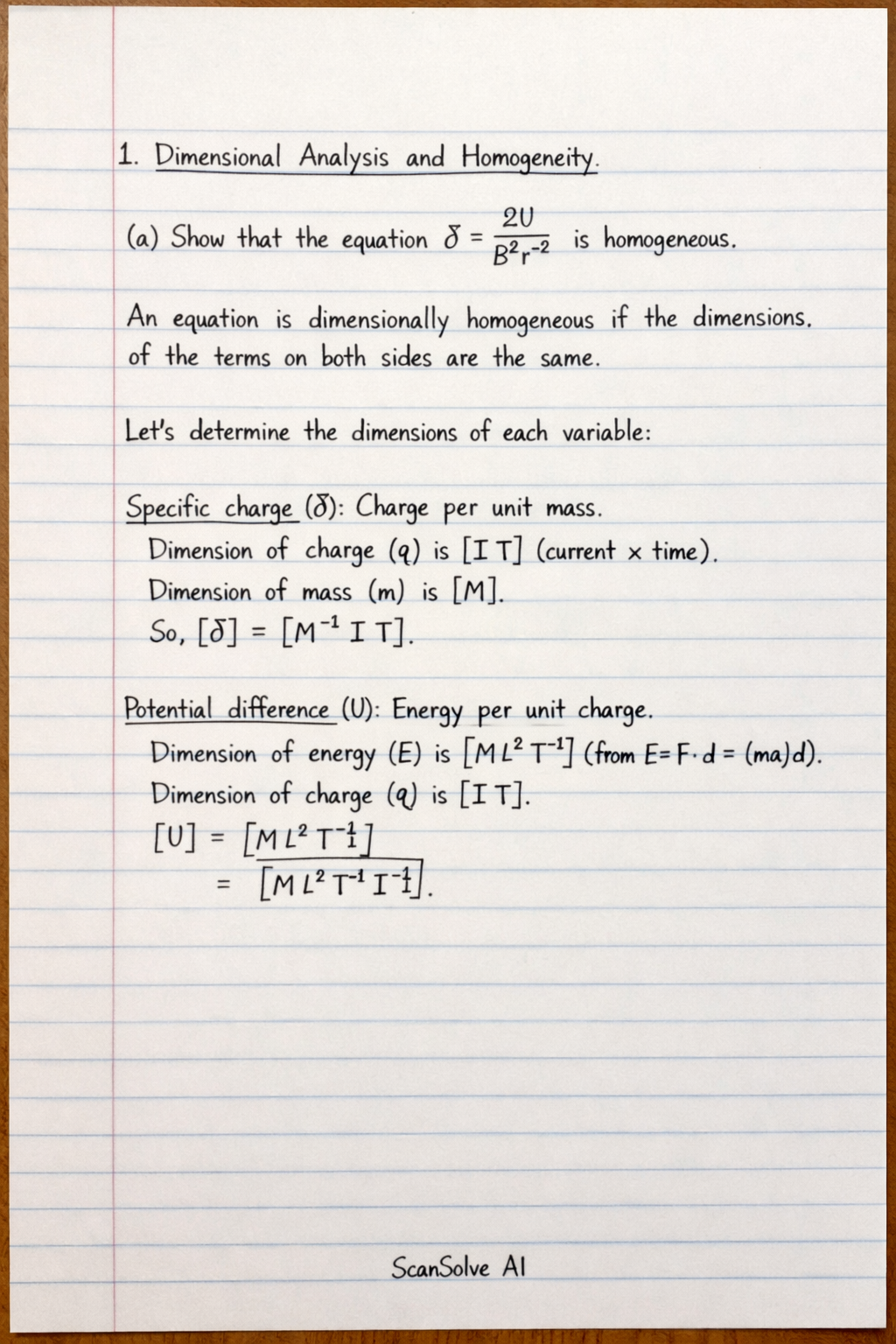
Handwritten Step-by-Step Solution
Get this as a handwritten image on WhatsApp — like a tutor wrote it for you.
Try on WhatsApp