
We read your photo as:
Solve these questions in English showing all steps
ScanSolve AI Answer
Answer
Step-by-step solution
7 stepshere is the solution to the problem.
Part a
State TWO assumptions used to derive this equation.
Here are two assumptions used in the kinetic theory of gases:
- The gas consists of a very large number of identical molecules that are in constant, random motion.
- The volume occupied by the gas molecules themselves is negligible compared to the total volume of the container.
- Collisions between molecules and with the container walls are perfectly elastic.
- There are no intermolecular forces between gas molecules except during collisions.
Part b· 4 steps
Use the above equation to show that is related to the absolute temperature of the gas by;
Start with the given equation and the definition of density.
The given equation is .
The density of a gas is its mass () divided by its volume (), so .
Substitute this into the pressure equation:Rearrange to get :
Express the mass of the gas in terms of moles and molar mass.
The total mass of the gas () can be written as the number of moles () multiplied by the molar mass () of the gas: .
Substitute this into the equation from Step 1:Use the ideal gas law.
The ideal gas law states , where is the molar gas constant and is the absolute temperature.
Substitute for in the equation from Step 2:Simplify and solve for .
Cancel from both sides of the equation:
Multiply both sides by 3 and divide by to isolate :
This shows the desired relationship.
Part c
Determine the root-mean-square speed of the molecules if the gas is heated to a temperature of .
Convert initial and final temperatures to Kelvin.
Initial temperature .
Final temperature .Relate root-mean-square speed to temperature.
From part (b), we have .
The root-mean-square speed () is the square root of the mean-square speed: .
Since and are constants for a given gas, is directly proportional to the square root of the absolute temperature: .
Therefore, we can write the ratio:Calculate the new root-mean-square speed ().
Given .
Rounding to three significant figures:
Try one yourself
A new problem that tests the same skill.
Still stuck on this one?
Ask a follow-up, and the answer starts from this question.
More English Questions
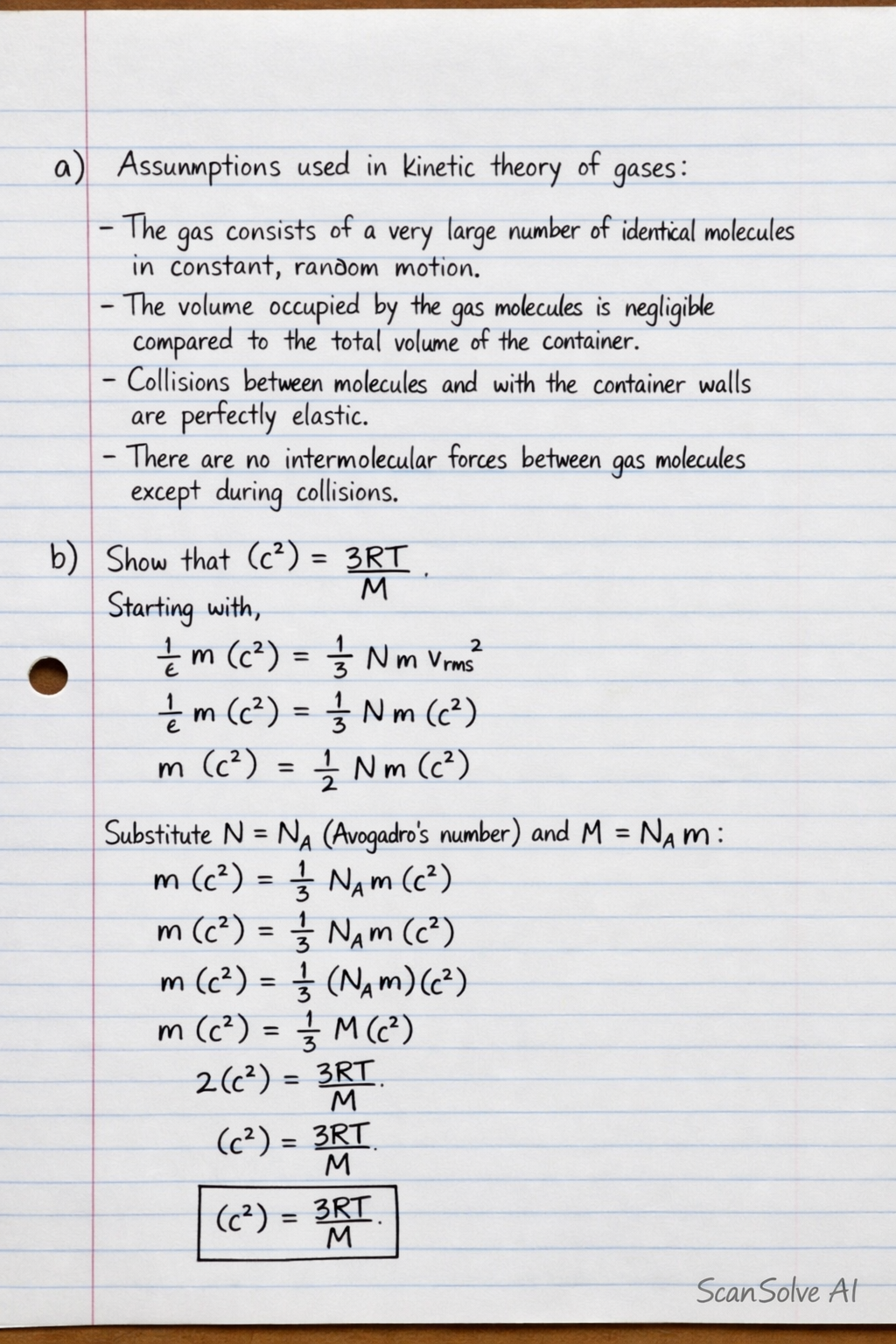
Handwritten Step-by-Step Solution
Get this as a handwritten image on WhatsApp — like a tutor wrote it for you.
Try on WhatsApp