
We read your photo as:
Solve the following in English showing all the steps
ScanSolve AI Answer
Step-by-step solution
3 stepsHere are the answers to your questions:
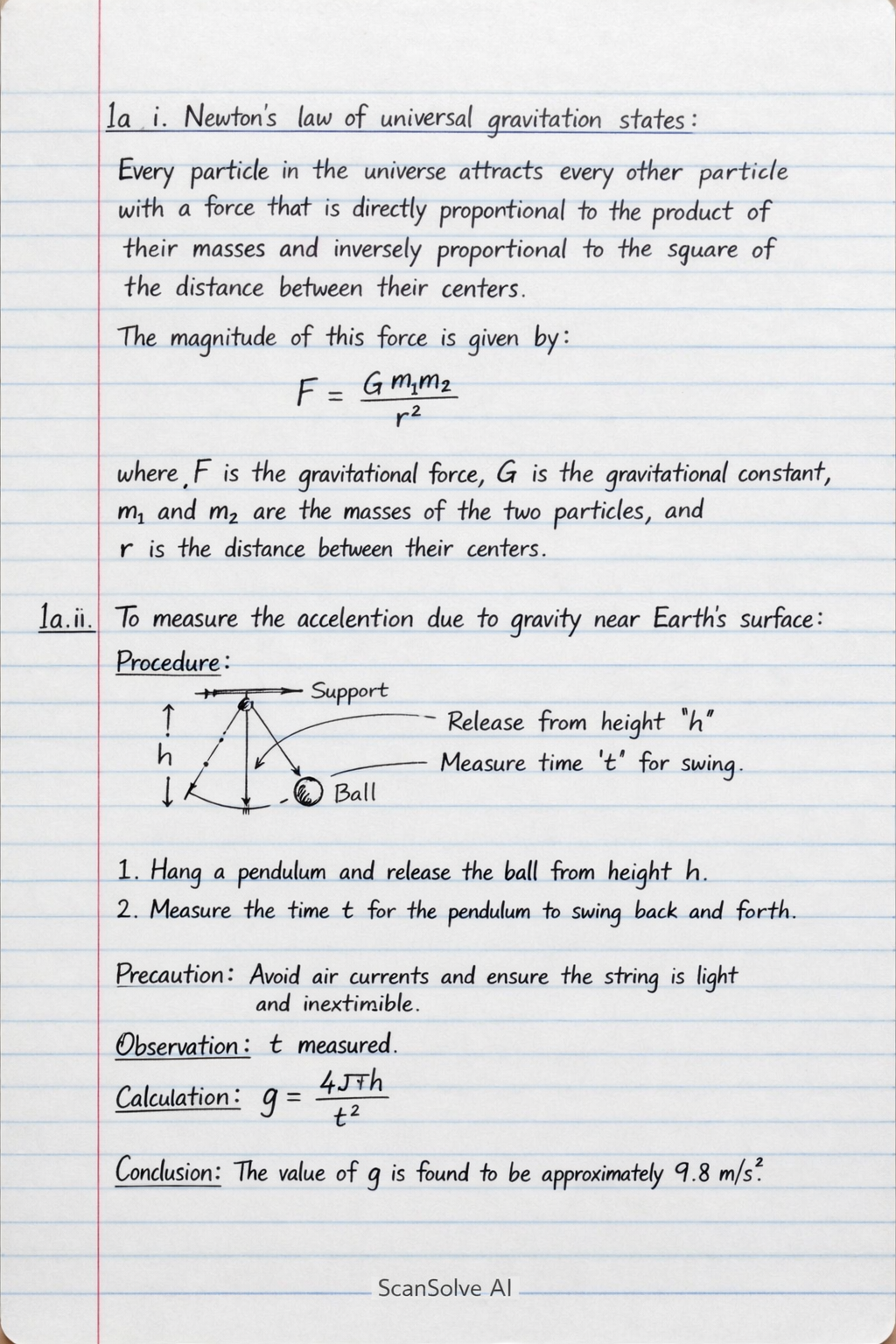
a. i. State Newton's law of universal gravitation.
Newton's law of universal gravitation states that every particle in the universe attracts every other particle with a force that is directly proportional to the product of their masses and inversely proportional to the square of the distance between their centers.
The magnitude of this force is given by:
where is the gravitational force, is the gravitational constant, and are the masses of the two particles, and is the distance between their centers.
a. ii. Describe an experiment to measure the acceleration due to gravity near the earth's surface. Your description should include a diagram, procedure, precaution, observation and conclusion.
Diagram:
Imagine a setup with a tall retort stand, a clamp holding an electromagnet, a small steel ball, a trap door, and an electronic timer. The electromagnet is connected to a power supply and holds the steel ball. The trap door is placed directly below the ball and is connected to the timer. The timer starts when the electromagnet is switched off (releasing the ball) and stops when the ball hits the trap door. A meter rule is used to measure the height of the fall.
Procedure:
- Set up the apparatus as described, ensuring the electromagnet is securely clamped and the trap door is positioned directly beneath the steel ball.
- Measure the vertical height, , from the bottom of the steel ball to the trap door using a meter rule.
- Switch on the electromagnet to hold the steel ball.
- Reset the electronic timer to zero.
- Switch off the electromagnet. The ball falls, and the timer starts simultaneously.
- The ball hits the trap door, which triggers a sensor to stop the timer. Record the time, .
- Repeat steps 2-6 several times (e.g., five times) for the same height to calculate an average time, reducing random errors.
- Repeat the entire experiment for different heights, , recording corresponding average times, .
- Plot a graph of (y-axis) against (x-axis).
Precaution:
- Ensure the apparatus is perfectly vertical to ensure a true free fall and prevent the ball from swinging.
- Minimize air currents in the room to reduce air resistance on the falling ball.
- Avoid parallax error when reading the height from the meter rule.
- Ensure the electromagnet releases the ball instantly and the trap door accurately stops the timer.
Observation:
For each measured height , a corresponding time is recorded. According to the equation of motion for free fall, . Since the initial velocity , the equation simplifies to . A graph of versus will yield a straight line passing through the origin.
Conclusion:
From the equation , the gradient of the vs graph is equal to .
Therefore, the acceleration due to gravity, , can be calculated as .
The calculated value of should be approximately .
b. i. Sketch a graph to show the variation of gravitational field strength, g, with distance, r, from the center of a spherical uniformly dense planet of radius Ro.
Description of the graph:
The graph plots gravitational field strength () on the y-axis against distance () from the center of the planet on the x-axis.
- For (inside the planet): The gravitational field strength increases linearly with , starting from at (the center of the planet) and reaching a maximum value at (the surface).
- For (outside or on the surface of the planet): The gravitational field strength decreases with the square of the distance , following an inverse square law (). The curve is smooth and approaches as approaches infinity. The maximum value of occurs at .
b. ii. Explain the shape of the above graph when .
State the relevant formula for gravitational field strength outside a spherical mass.
When the distance from the center of the planet is greater than its radius (), the point is outside the planet. For a spherical mass, the gravitational field strength at any external point is equivalent to that produced by the entire mass of the planet concentrated at its center.
The gravitational field strength is defined as the gravitational force per unit mass.Substitute Newton's Law of Universal Gravitation into the definition of .
According to Newton's Law of Universal Gravitation, the force between a planet of mass and a small test mass at a distance from the planet's center is:
Substituting this into the equation for :
Explain the inverse square relationship.
This equation shows that the gravitational field strength is inversely proportional to the square of the distance from the center of the planet (). Therefore, as increases beyond , the value of decreases rapidly, resulting in the characteristic inverse square curve shape observed in the graph.
Still stuck on this one?
Ask a follow-up, and the answer starts from this question.
More English Questions
Handwritten Step-by-Step Solution
Get this as a handwritten image on WhatsApp — like a tutor wrote it for you.
Try on WhatsApp