

This English question involves literary analysis, grammar, or writing skills. The detailed response below provides a well-structured answer with supporting evidence and clear explanations.
ScanSolve AI Answer
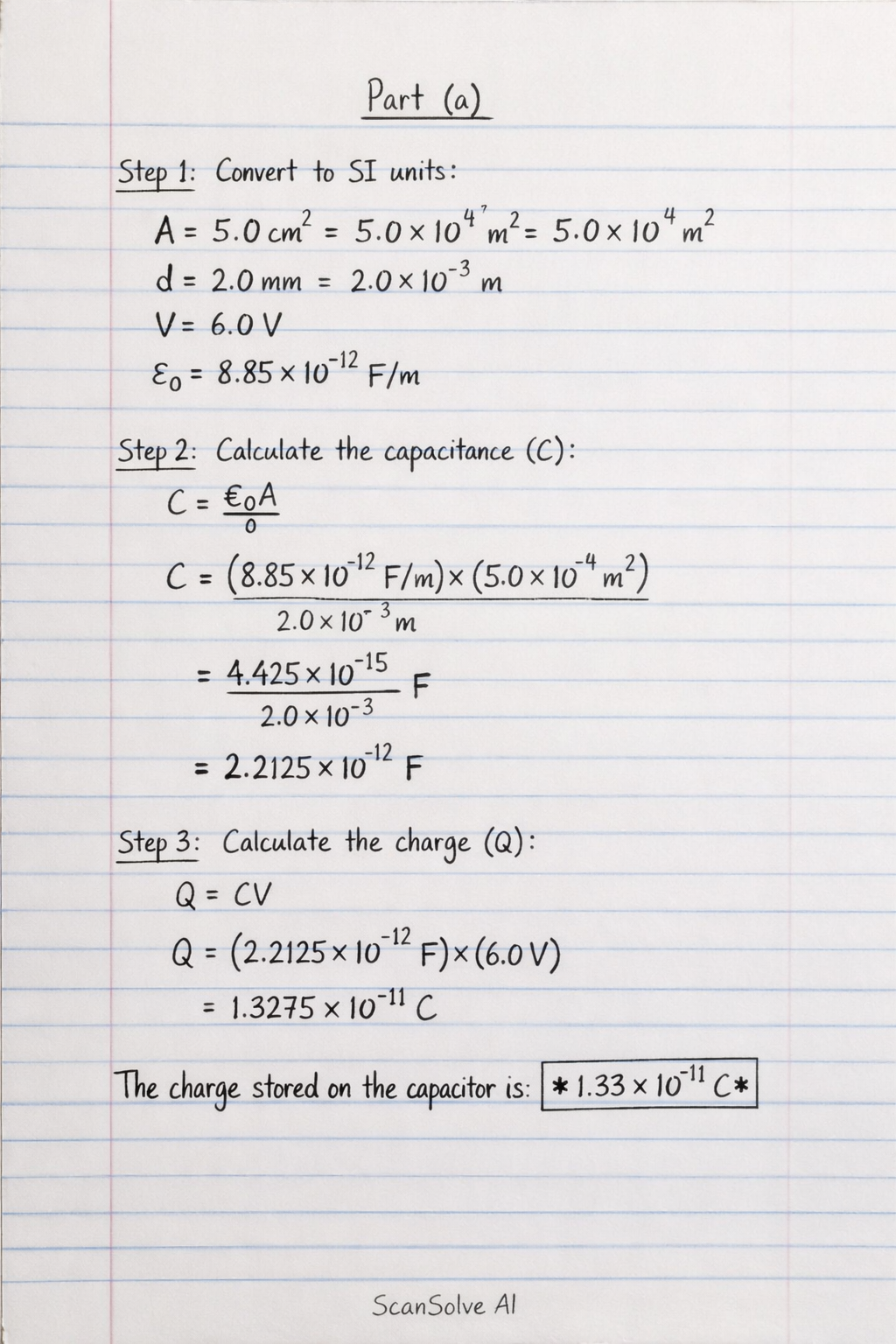
here is the solution to your physics problem: Part (a) Charge stored on the capacitor: Step 1: Convert the given values to SI units. Area of capacitor plates, A = 5.0 cm^2 = 5.0 × (10^-2 m)^2 = 5.0 × 10^-4 m^2 Separation of the plates, d = 2.0 mm = 2.0 × 10^-3 m Potential difference, V = 6.0 V Permittivity of free space, _0 = 8.85 × 10^-12 Fm^-1 Step 2: Calculate the capacitance (C) of the parallel-plate capacitor. C = (_0 A)/(d) C = (8.85 × 10^-12 Fm^-1) × (5.0 × 10^-4 m^2)2.0 × 10^-3 m C = 4.425 × 10^-152.0 × 10^-3 F C = 2.2125 × 10^-12 F Step 3: Calculate the charge (Q) stored on the capacitor. Q = CV Q = (2.2125 × 10^-12 F) × (6.0 V) Q = 1.3275 × 10^-11 C The charge stored on the capacitor is 1.33 × 10^-11 C. Efficiency of the battery: Step 1: Identify the given values for the battery circuit. Electromotive force (emf), E = 20 V Internal resistance, r = 4 Load resistance, R = 10 Step 2: Calculate the total resistance (R_total) in the circuit. R_total = R + r R_total = 10 + 4 = 14 Step 3: Calculate the current (I) flowing through the circuit. I = ER_total I = 20 V14 = (10)/(7) A ≈ 1.4286 A Step 4: Calculate the power delivered to the load (P_out) and the total power supplied by the battery (P_total). P_out = I^2 R P_out = ((10)/(7) A)^2 × 10 = (100)/(49) × 10 W = (1000)/(49) W ≈ 20.41 W P_total = E I P_total = 20 V × (10)/(7) A = (200)/(7) W ≈ 28.57 W Step 5: Calculate the efficiency () of the battery. = P_outP_total × 100\% = (1000)/(49) W(200)/(7) W × 100\% = (1000)/(49) × (7)/(200) × 100\% = (5)/(7) × 100\% ≈ 71.4\% The efficiency of the battery is 71.4\% . Part (b) How capacitance depends on geometry and dielectric materials: Capacitance (C) is a measure of a capacitor's ability to store electric charge. For a parallel-plate capacitor, its geometry dictates that capacitance is directly proportional to the area (A) of the plates and inversely proportional to the distance (d) between them (C A/d). This means larger plates or closer spacing increase capacitance. When a dielectric material is inserted between the plates, its molecules polarize, reducing the electric field within the capacitor. This allows more charge to be stored for the same potential difference, effectively increasing the capacitance by a factor known as the dielectric constant () of the material. Use of a ballistic galvanometer in material testing: A ballistic galvanometer is a sensitive instrument designed to measure the total quantity of charge (coulombs) that passes through it, rather than a continuous current. It achieves this by having a long oscillation period, allowing it to measure the impulse of a transient current. In material testing, it is used to determine the dielectric constant of insulating materials. By charging a capacitor with the test material as its dielectric and then discharging it through the ballistic galvanometer, the stored charge can be measured. Comparing this charge to the charge stored by the same capacitor with air (or vacuum) as the dielectric allows for the calculation of the material's dielectric constant. Account for equipment damage near highly charged systems, including prevention measures: Equipment Damage: Highly charged systems generate intense electric fields that can induce charges in nearby electronic equipment. This can lead to electrostatic discharge (ESD), where a sudden, high-current spark jumps to or from the equipment, causing permanent damage to sensitive semiconductor components by breaking down their internal insulation or causing thermal stress. Strong electric fields can also cause electromagnetic interference (EMI)*, disrupting the normal operation of circuits, leading to malfunctions, data corruption, or system crashes. Prevention Measures*: To prevent such damage, several measures can be employed: Shielding: Enclosing sensitive electronics in conductive materials (like metal casings or Faraday cages) to block external electric fields. Grounding: Connecting equipment to a common ground potential to safely dissipate any induced or static charges, preventing their buildup and sudden discharge. Distance and Isolation: Maintaining a safe physical distance between sensitive electronics and highly charged systems, or using insulating barriers to physically separate them. Antistatic Materials: Using materials that prevent the buildup of static electricity in the environment or on equipment surfaces. Got more? Send 'em 📸